
 EN
EN
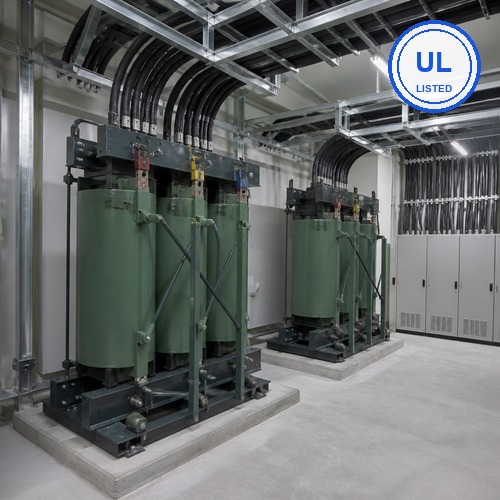
Dry Type Transformer for Data Center: A Selection Guide on Power Density and Efficiency
A hyperscaler's electrical consultant in Virginia called us last spring with a problem that would have been unheard of five years ago: their newest building was sized for 12 MW of IT load, but the transformer room — already poured in concrete — had been designed for 6 MW. AI racks now draw 100 kW or more per cabinet, and the gap between what campuses plan for and what AI workloads actually demand keeps widening. In our experience, the dry type transformer for data center projects is where that gap gets closed — or where it turns into a schedule disaster.
In this guide, we walk through where the transformer sits in a data center power chain, why dry-type units dominate the industry, the specifications that matter at 13.8 kV to 480 V, and how power density changes the loading math.
Where the Transformer Sits in a Data Center Power Chain
Data center electrical design starts with the utility medium-voltage feed — typically 13.8 kV or 12.47 kV in North America — and steps down to the utilization voltage through transformers. From there, power flows to the UPS, then the PDU, then the rack. The transformer is not a component; it is the pivot point where availability architecture gets built.
Two redundancy schemes dominate. In a 2N design, every transformer has a mirrored twin carrying the same load independently. In an N+1 design, the system runs with one spare unit online — if any transformer trips, the N+1 redundancy transformer takes over within the transfer time. Both schemes double or more the transformer count, which is why transformer lead time and floor space are now board-level topics at hyperscalers.
Here's the part most buyers miss: the transformer decision must come before the building layout, not after. A 2.5 MVA cast resin unit weighs several tonnes and needs its own fire-rated room, ventilation, and cable entry points. Re-engineering that room after the concrete is poured costs months — we have seen it happen three times this year alone.
Why Data Centers Run on Dry-Type Transformers
Walk into any modern data center transformer room and you will see dry-type units, not oil-filled tanks. The reasons are practical: no oil containment, no fire risk from flammable dielectric, indoor installation without bunding, and much lower maintenance. A dry type transformer for data center application also handles high cyclic loading better than oil units of the same class — relevant when AI training workloads surge and dip unpredictably.
Two dry-type technologies serve the market:
Cast Resin Transformers
Windings are cast in epoxy resin under vacuum. Cast resin units deliver the lowest partial discharge levels — our test floor measures below 10 pC on production units — and are the standard choice for fire-sensitive, high-value installations. A cast resin transformer for data center duty typically runs 2 MVA to 3.5 MVA per unit at 13.8 kV class.
VPI (Vacuum Pressure Impregnation) Transformers
VPI windings are impregnated with resin under vacuum pressure, offering a lower-cost alternative with excellent moisture resistance. For cost-sensitive builds where fire codes allow, VPI units deliver comparable reliability at a lower price point.
|
Feature |
Cast Resin |
VPI (Vacuum Impregnated) |
|
Partial discharge |
< 10 pC |
Higher (typically < 100 pC) |
|
Fire behavior |
Self-extinguishing |
Combustible resin, rated |
|
Best fit |
Hyperscale, high-value |
Cost-sensitive, general IT |
|
Typical unit size |
2 – 3.5 MVA |
1 – 3 MVA |
|
Indoor use |
Yes, no containment |
Yes, with fire code review |
Both lines run the test procedures published by the IEEE Standards Association (IEEE C57.12.90) on our factory test floor before crating.
Key Specifications That Define a Data Center Transformer
The data center transformer specifications that actually matter are fewer than most datasheets suggest. Focus on these five:
• **kVA and loading.** Design for 60–70% loading at nominal IT load. That headroom covers cooling, PUE variation, and future IT expansion — and it is where the data center transformer specifications and redundancy philosophy meet.
• **Voltage and vector group.** Match the primary to the utility feed (13.8 kV or 12.47 kV) and the secondary to your distribution (480/277 V three-phase, or 208/120 V for older designs). Dyn11 or Dyn1 vector groups carry the unbalanced loads common in mixed IT and cooling distribution.
• **Impedance.** Typical %Z of 5.75% limits fault current downstream and keeps breaker ratings manageable. Confirm the utility's short-circuit level before freezing the design.
• **Temperature rise and insulation.** F-class (155°C) insulation with 100°C rise is the workhorse; H-class (180°C) buys extra overload margin for AI surge patterns.
• **Efficiency.** US projects must meet the transformer efficiency DOE 2026 levels set by the U.S. Department of Energy, and North American units carry a UL listing verified under UL 1561. Our cast resin line is engineered to beat the DOE 2026 minimums by design margin, and we publish measured no-load and load loss figures from routine tests.
Need the data center transformer specifications mapped to your IT load and redundancy architecture? Our engineers answer within one business day — get a free technical quote → Contact Ryan Electric's Engineering Team
Power Density, Heat, and the Real Loading Question
The AI rack-density story is really a transformer thermal story. At 100 kW per cabinet, a 3 MW hall produces heat loads that force higher cooling demand, higher power factor swings, and faster load ramp rates. Transformers respond to that with thermal cycling — and the killer is not peak load but repeated surge cycles that age insulation faster than steady operation. The N+1 redundancy transformer in the chain sees the same surge profile, which is why we rate it for the same overload duty as the duty units.
Two engineering choices protect the asset. First, size for the surge profile, not the average: an H-class cast resin unit with 15% overload capability for two hours handles AI training bursts without entering the accelerated-aging zone. Second, monitor winding temperature rather than enclosure temperature — our units ship with RTD sensors in the windings as standard, so the building management system sees the real thermal picture.
Ryan Electric: Building Transformers for AI-Scale Loads
Most manufacturers build one dry-type technology and defend it. We build both — cast resin transformer for data center units and VPI lines on the same factory floor — which means our engineers recommend the technology that fits your site, not the one that fits our inventory. As an Eaton joint venture partner since 2023, our component supply chain carries its own certifications, which shortens the certification loop for custom designs.
A recent Southeast Asia deployment took delivery of twenty 2.5 MVA cast resin units for a 50 MW AI campus, Dyn11 at 13.8 kV, each unit passing partial discharge measurement below 10 pC, temperature-rise testing at 100% nameplate rating, and the transformer efficiency DOE 2026 levels before crating. The batch arrived in the agreed shipping window — the same sequence our test floor runs for every dry type transformer for data center order, whether the site is in Singapore or Ohio.
Right-Sizing Your Dry Type Transformer for Data Center Projects
The dry type transformer for data center decision is a five-variable trade: kVA, impedance, insulation class, efficiency, and lead time. Get those aligned with your redundancy architecture, and the transformer stops being a risk item — it becomes the most reliable link in the power chain.
Have a data center project in Virginia, Singapore, or Frankfurt? Send us your IT load profile, redundancy scheme, and utility voltage — get a free technical quote → Contact Ryan Electric's Engineering Team
Table of Contents
- Dry Type Transformer for Data Center: A Selection Guide on Power Density and Efficiency
- Where the Transformer Sits in a Data Center Power Chain
- Why Data Centers Run on Dry-Type Transformers
- Key Specifications That Define a Data Center Transformer
- Power Density, Heat, and the Real Loading Question
- Ryan Electric: Building Transformers for AI-Scale Loads
- Right-Sizing Your Dry Type Transformer for Data Center Projects