
 EN
EN
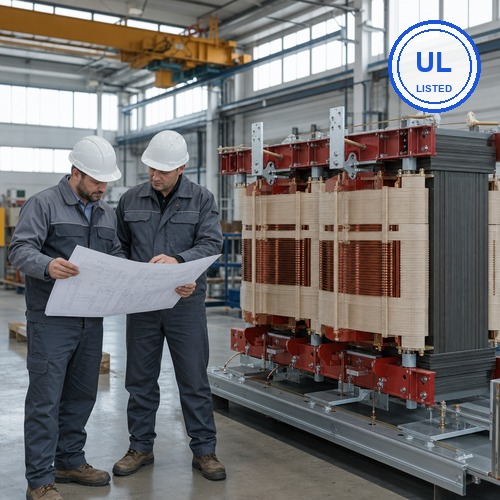
Custom Transformer vs Off-the-Shelf: When Does Customization Pay Off?
A utility engineer in Texas once told us his procurement team saved US$4,000 by picking an off-the-shelf transformer 500 kVA pad-mounted unit instead of a custom build. The rework that followed — replacing the bushings, re-terminating the secondary, and re-issuing the protection study — cost more than US$18,000 and pushed energization back nine weeks. The transformer itself was never the problem. The specification was.
Here is the part most buyers miss: the choice between an off-the-shelf transformer and a custom transformer is rarely a price decision. It is a timeline decision — and the timeline is where the real money lives. This guide walks through what standardization actually covers, when transformer customization pays for itself, and what a serious custom quote should include.
What "Off-the-Shelf" Actually Covers
An off-the-shelf transformer is a unit built to a manufacturer's standard catalogue: standard kVA steps (75, 112.5, 150, 225, 300, 500, 750, 1000 and up), standard voltage combinations such as 13.8 kV to 480Y/277 V, a fixed impedance between about 3.5% and 5.75%, and a standard temperature rise of 65/65°C or 80°C. These parameters follow the combinations defined in IEEE C57.12.00, so stock units are interchangeable across projects — which is exactly why distributors keep them on the shelf.
The advantages are real: short lead times, predictable pricing, and common spares. But the catalogue has hard edges. If your grid runs at 11 kV or 33 kV, if your site sits above 1,000 m, if your utility demands a specific impedance for fault-current limiting — the standard unit stops being standard and starts being a compromise.
|
Parameter |
Typical Off-the-Shelf Range |
What Customization Can Do |
|
Capacity (kVA) |
Standard steps: 75–3000 kVA |
Any rating matched to load profile |
|
HV/LV voltage |
Standard combos (e.g. 13.8 kV / 480 V) |
Non-standard grids: 11/22/33 kV, multi-ratio |
|
Impedance |
3.5% – 5.75% |
2% – 10%+ per system study |
|
Temperature rise |
65/65°C or 80°C |
55°C rise for hot climates, higher margin for overload |
|
Enclosure |
Standard NEMA 3R |
Custom footprint, seismic bracing, tamper-resistant hardware |
And since January 2026, efficiency is part of the specification too: the U.S. DOE's updated distribution transformer efficiency levels apply to units sold into the American market, which quietly rules out a growing number of older standard designs. A custom build is often the only clean path to a compliant, site-matched unit.
When Customization Actually Pays Off
Customization earns its keep in five situations. First, non-standard grid voltages. Southeast Asia and the Middle East run 11 kV, 22 kV, and 33 kV distribution in many regions, and a 13.8 kV standard winding simply will not connect. Second, extreme environments: above 1,000 m, IEEE C57.12.00 requires derating or reinforced insulation; in Gulf summer heat, a 55°C-rise design with oversized radiators keeps oil temperatures inside limits.
Third, special applications. A data center may need a dry-type unit with a 45 dBA sound rating and a specific impedance to limit fault current; a solar farm on a 35 kV collection network needs a transformer built around inverter output; a mining site needs dust-tight, corrosion-protected construction. Fourth, space constraints — compact designs that shrink the footprint 15–20% or bolt directly to a customer busway. Fifth, certification and grid code: UL 1561/1562, CSA C22.2 No. 47, or local utility interconnection rules that a stock import cannot satisfy.
The question we hear most from contractors in Southeast Asia is: 'Can you build it for 11 kV input?' The answer is yes — in the last two years we have shipped more custom 11 kV windings than standard 13.8 kV units. When the grid decides the spec, the transformer has to follow.
The Real Economics of Custom Transformers
Let's put numbers on the decision. A custom transformer typically costs 15–30% more than a comparable stock unit, and lead time runs 8–16 weeks instead of 2–6. On paper, that looks like a penalty. The comparison changes when you add the cost of making a standard unit fit:
|
Cost Dimension |
Off-the-Shelf Route |
Custom Route |
|
Initial purchase price |
Lower |
Higher by 15–30% |
|
Lead time |
2–6 weeks |
8–16 weeks |
|
Site adaptation |
Busbar rework, added compensation, protection restudy |
Designed in from day one |
|
Operating efficiency |
Fixed catalogue design |
Core and winding optimized for your load profile |
|
Compliance risk |
Depends on stock availability |
UL/CSA built into the design file |
In our experience, the adaptation line is where budgets die. A busbar rework plus a protection restudy plus two weeks of site downtime routinely exceeds the custom premium — and it never shows up in the first quote comparison. There is also an efficiency angle: a winding optimized for your actual load profile (typically 60–75% loading) can cut no-load loss noticeably versus a one-size-fits-all design, which matters more every year as energy prices and efficiency regulations move together.
What a Custom Transformer Quote Should Include
A useful custom quote starts with a useful brief. Here is what we ask every buyer to send, and what you should expect any custom transformer manufacturer to request:
1. Electrical parameters — kVA, HV and LV voltage, phase, frequency, impedance %, tap range.
2. Site conditions — altitude, ambient temperature, humidity, pollution level.
3. Application — data center, solar farm, mining, utility, or industrial.
4. Certification targets — UL, CSA, IEEE, or local grid code.
5. Installation format — indoor or outdoor, pad mount, busway connection.
6. Test scope — routine tests only, or special tests like partial discharge and lightning impulse.
If a supplier quotes without asking for this information, treat the quote as a guess. The numbers above determine the active material — core steel, copper, insulation class — which is 60–70% of the cost of any transformer.
Not sure which parameters matter for your project? Our engineers respond within one business day — get a free technical quote → Contact Ryan Electric's Engineering Team
How Ryan Electric Handles Custom Projects
As a custom transformer manufacturer, we treat every order as an engineering project, not a catalogue line. The route is fixed: our engineers review your brief and confirm the design within 48 hours; the design team runs electromagnetic and loss calculations; drawings and parameters are signed off before steel is cut; a first-article unit goes through the full routine test sequence — turns ratio, polarity, no-load and load loss, applied and induced voltage, temperature rise — plus special tests like partial discharge when the spec asks for them.
A recent example: a data center developer in Southeast Asia ordered 2000 kVA dry-type units with a 45 dBA sound rating and a specific impedance to limit fault current. The first batch shipped in 14 weeks with full test reports, and the certification files were ready for the local authority before the units reached site.
That workflow sits on a certification portfolio covering UL and CSA standards, and — as an Eaton joint venture partner since 2023 — our engineering team works directly with component supply chains that carry their own certifications. The point is simple: transformer customization is not a corner-cut; it is a design file, a test record, and a certification path.
Built Around Your Specification, Not the Other Way Around
If your project fits a standard catalogue page — standard voltage, standard site, standard duty — buy the stock unit and keep the budget. But if it does not, and most projects stop fitting once you count the site conditions, a custom transformer is not a premium. It is the cheapest way to get the specification right the first time.
Have a project with non-standard voltage, site, or certification requirements? Send us your one-line diagram and let the engineers take a look — get a free technical quote → Contact Ryan Electric's Engineering Team
Table of Contents
- Custom Transformer vs Off-the-Shelf: When Does Customization Pay Off?
- What "Off-the-Shelf" Actually Covers
- When Customization Actually Pays Off
- The Real Economics of Custom Transformers
- What a Custom Transformer Quote Should Include
- How Ryan Electric Handles Custom Projects
- Built Around Your Specification, Not the Other Way Around