
 EN
EN
Understanding Transformer Efficiency Classes: DOE 2016 vs DOE 2024 Standards
A utility buyer in the Midwest upgraded a fleet of 75 kVA distribution transformers two years before the new federal deadline, and the numbers came back better than expected: each unit now saves roughly the equivalent of several households' monthly electricity in annual losses. That is what happens when you read the DOE transformer efficiency standards before they force your hand — you buy on your own schedule, not someone else's.
This guide explains the two efficiency frameworks that define the US market — the 2016 baseline and the 2024 final rule — and what the difference means for your next transformer purchase.
What Are Transformer Efficiency Classes?
Efficiency classes are the minimum efficiency levels a distribution transformer must meet, set by the US Department of Energy (DOE) under the Energy Policy and Conservation Act. A transformer's efficiency is simply output power divided by input power, but the real story sits in the two loss components:
• No-load loss — the iron loss that exists the moment a transformer is energized, 24 hours a day, whether or not it feeds a load
• Load loss — the copper loss that grows with the square of the current
Here is the part most buyers miss: a 99% efficient transformer still wastes 1% of everything it carries, and distribution transformers run around the clock. Over a 30-year service life, that 1% is not a rounding error — it is a budget line. That is why transformer efficiency classes are measured at defined load points (50% of nameplate for liquid-immersed units) rather than at full load, so the comparison reflects real operating conditions.
DOE 2016: The Baseline That Reset the Market
The 2016 standards, enforced from January 1, 2016, under 10 CFR 431.196, were the first to raise the bar across all ten equipment classes — liquid-immersed and dry-type, single-phase and three-phase. They cover units with input voltage up to 34.5 kV, output voltage up to 600 V, and capacities from 10 kVA to 2500 kVA.
For a three-phase liquid-immersed unit at 50% load, the 2016 minimum for 75 kVA was 99.03%; for 500 kVA it was 99.35%. Those numbers look close, but the difference compounds: no-load loss dominates the annual energy bill of a lightly loaded distribution transformer, and the 2016 levels forced manufacturers to switch to lower-loss core steels and refined winding designs.
DOE 2024: What Changed and What It Means for Buyers
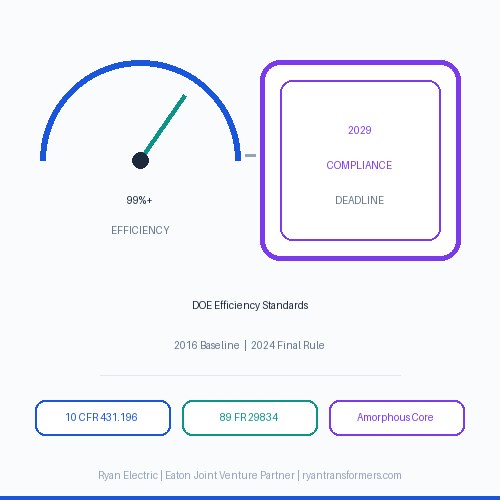
On April 22, 2024, DOE published the amended final rule (89 FR 29834), effective July 8, 2024 — with mandatory compliance required on and after April 23, 2029. This is the key date for buyers: everything ordered now must still meet 2016 levels today, but must meet the 2024 levels in 2029.
The new limits tighten every equipment class. A three-phase liquid-immersed 75 kVA unit goes from 99.03% to 99.22%; the 500 kVA rating moves from 99.35% to 99.38%. The rule also extends the capacity range upward to 3750 kVA and 5000 kVA three-phase liquid-immersed units, and keeps 13 exemption categories (autotransformers, welding transformers, and others) outside the scope. For DOE 2029 compliance, the practical takeaway is simple: low-loss core technology is no longer optional.
Efficiency at a Glance: 2016 vs 2029 Comparison Table
|
Transformer Type (50% Load) |
kVA |
DOE 2016 Min. Efficiency |
DOE 2024/2029 Min. Efficiency |
|
Liquid-immersed, 3-phase |
75 |
99.03% |
99.22% |
|
Liquid-immersed, 3-phase |
500 |
99.35% |
99.38% |
|
Liquid-immersed, 3-phase |
1000 |
99.43% |
99.46% |
|
Liquid-immersed, 1-phase |
25 |
98.95% |
99.00% |
|
Dry-type, 3-phase, low voltage |
500 |
99.14% |
99.31% |
*Values per 10 CFR 431.196 and the 2024 final rule; liquid-immersed efficiencies measured at 50% of nameplate load.
How to Meet the 2029 Standards: Core Technology Choices
DOE's own analysis points to three core-material routes that can reach the 2024 levels: traditional amorphous alloy, high-permeability amorphous alloy, and domain-refined high-permeability amorphous alloy. Grain-oriented electrical steel (GOES) remains viable with optimized designs.
In our factory, the shift is visible on the floor. When we build an amorphous core transformer for a US utility project, the core is annealed in a controlled atmosphere to relieve stress — a step that directly determines whether the unit lands inside the 2029 no-load loss window. We routinely verify no-load loss on our test bench before shipping, because a core that passes the calculation but fails the measurement is a problem we want to find in Jiangsu, not in Ohio. Our engineering work as an Eaton joint venture partner since 2023 gives us direct access to component supply chains that meet these tighter loss budgets.
Why Buyers Should Act Before 2029
Waiting until 2029 to source compliant units means joining the same crowded queue as every utility, contractor, and developer in North America. Buying now, with efficiency headroom above the current baseline, does two things: it locks in today's pricing, and it future-proofs the fleet so no mid-life replacement is triggered by the new rule.
Have a project in the US? Get a free technical quote → Contact Ryan Electric's Engineering Team
Your Efficiency Partner for the 2029 Transition
Understanding the DOE transformer efficiency standards is not about chasing paperwork — it is about knowing exactly what you are buying and when the rules change under you. The 2024 final rule gives the market a five-year runway; how you use it is a commercial decision, not a technical mystery.
Whether you need a 75 kVA pad-mounted unit for a subdivision or a 2500 kVA liquid-immersed transformer for a utility feeder, our team can confirm the efficiency class of every unit before it leaves the factory, with test reports attached. Ready to plan your 2029-ready fleet? Get a free technical quote → Contact Ryan Electric's Engineering Team
Table of Contents
- Understanding Transformer Efficiency Classes: DOE 2016 vs DOE 2024 Standards
- What Are Transformer Efficiency Classes?
- DOE 2016: The Baseline That Reset the Market
- DOE 2024: What Changed and What It Means for Buyers
- Efficiency at a Glance: 2016 vs 2029 Comparison Table
- How to Meet the 2029 Standards: Core Technology Choices
- Why Buyers Should Act Before 2029
- Your Efficiency Partner for the 2029 Transition