
 EN
EN
How to Size a Transformer for a Commercial Building Project
The panel schedule lands on your desk Monday morning, and the contractor wants the transformer order placed by Friday. You have 37 loads to reconcile, a mechanical room two feet shorter than the drawing shows, and no room in the budget for a unit bigger than it needs to be. This is where transformer sizing for commercial building projects goes wrong — rarely in the arithmetic, almost always in the load inventory that feeds it. Here is the process we walk engineers through, the same one we use when a client sends us a load sheet and asks for a second opinion.
Start with a Load Inventory, Not a Rule of Thumb
Multiplying the floor area by 10 VA per square foot is fine for a budget estimate and dangerous for a purchase order. A 40-story office tower, a regional hospital, and a retail strip center have completely different load profiles, and the difference shows up on the transformer nameplate. The kVA you actually need is the sum of what the building draws, not a guess at what it might draw.
We ask clients to build the inventory from the panel schedule in three buckets: continuous loads that run three hours or more (lighting, HVAC compressors, elevators in operation), intermittent loads (receptacle circuits, pumps that cycle), and future loads the owner has already planned — a data rack row, a rooftop unit. Each bucket gets a demand factor, the portion of connected load expected to run at the same time. Most commercial buildings land between 0.6 and 0.85 after diversity is applied; a theater or a data hall sits at the top of that range.
|
Load Group |
Connected kVA |
Calculated kVA |
|
Lighting (LED) |
180 (0.90 demand) |
162 |
|
HVAC (VFD chillers + AHUs) |
220 (0.75 demand) |
165 |
|
Receptacles & general power |
80 (0.50 demand) |
40 |
|
Elevators (2 x 40 HP) |
32 (0.60 demand) |
19 |
|
Total |
512 |
386 -> 400 kVA std. |
Notice where the demand factor does the heavy lifting: 512 kVA of connected load becomes 386 kVA after diversity, which changes the quote from a 500 kVA unit to a 400 kVA unit — roughly 20% of the equipment cost. That is why a disciplined kVA calculation up front is worth more than any discount negotiated later.
The Sizing Formula Every Engineer Should Use
Once the inventory is clean, the math is compact: Required kVA = (total connected kW x demand factor) / (power factor x transformer efficiency). Two numbers in that formula get misused constantly.
First, NFPA 70 (NEC) requires continuous loads to be calculated at 125%, which effectively means no branch circuit or feeder should run above 80% of transformer rating. We size the kVA so the calculated demand stays under that ceiling — and we flag it when a design is already running at 95% before the building is occupied. Second, power factor. A commercial building with LED lighting and VFD-driven HVAC runs closer to 0.95 than the 0.8 that textbooks use, but if the design includes welders or large motors, correct the power factor before it quietly inflates the kVA.
Then add headroom with intent: 15–20% for documented future expansion, and nothing more. Oversizing is not a safety margin, it is a first-cost and efficiency penalty — a transformer running at 30% load still draws no-load loss 24 hours a day, and DOE efficiency classes reward loading closer to 35–65%. The right answer is a kVA calculation that lands the building in that band, not one that maximizes the nameplate.
Matching the Transformer to the Building's Voltage System
In North American commercial work, the decision usually narrows to a step down transformer 480v to 208v: 480V service enters the building, and 208Y/120V feeds the branch panels. That single conversion covers most offices, retail, schools, and healthcare projects. Common sizes are 75, 112.5, 150, 225, and 300 kVA in three-phase, and the configuration is almost always delta-wye for the clean neutral it gives the 120V circuits.
Where projects depart from that pattern: 277/480V-only buildings (industrial tenants, some data centers) skip the step-down entirely, and small storefronts on a 120/240V single-phase service need a different winding arrangement altogether. If the utility feeds medium voltage — 12.47 kV, for example — and the building owns the transformer, the spec shifts to a pad-mounted or vault unit with primary protection. Write the service voltage down before the kVA, because the same 300 kVA becomes three different products on three different voltage systems.
Dry Type vs Pad Mounted: Location Decides the Design
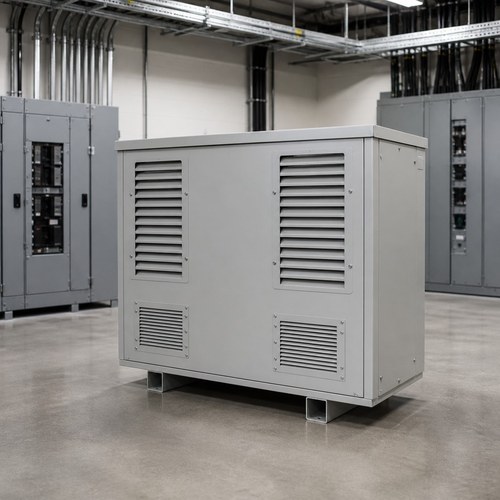
Location decides the construction. Indoors — a mechanical room, an electrical room, a rooftop penthouse — a VPI dry-type transformer in a NEMA 2 drip-proof enclosure is the standard answer: no oil containment, no fire-rating complications, low maintenance. Outdoors, where the building has no vault, a pad-mounted unit with a dead-front design and tamper-resistant enclosure is the practical choice, and in North America that means UL-listed construction and, for Canada, CSA certification.
|
Factor |
Dry Type (VPI) |
Pad Mounted |
|
Location |
Indoor / rooftop |
Outdoor, grade-level |
|
Enclosure |
NEMA 1 or 2 |
Dead-front, tamper-resistant |
|
Certification |
UL 1561 listed |
UL / CSA file coverage |
|
Typical size (3-phase) |
75–300 kVA |
75–1000 kVA |
|
Typical service |
Step down transformer 480v to 208v |
Medium-voltage primary feeds |
The rule we give contractors: if the unit lives under a roof, dry type; if it lives outside and the utility or AHJ expects a pad mount, specify one from a pad mounted transformer manufacturer with UL/CSA file coverage. Trying to save space with an indoor-rated unit outdoors is the kind of decision that fails inspection, not the transformer.
Transformer Sizing for Commercial Building Projects: Why Engineers Choose Ryan Electric
When a client sends us a load sheet, we do not quote a catalog number and stop. Our engineering team re-runs the transformer sizing for commercial building exercise against the actual panel schedule, flags demand factors that look optimistic, and returns a recommendation with the calculation shown — before we talk about price. On a recent U.S. office project, that review caught a misapplied 125% factor that would have forced a 500 kVA unit where 400 kVA was correct.
Our dry-type line is UL-listed, our pad-mounted line carries UL and CSA file coverage, and the factory behind them is 120,000 m² with the same test discipline we apply to utility-scale units — partial discharge testing, temperature rise verification, and full routine tests on every order. As a pad mounted transformer manufacturer and dry-type producer, we have been the manufacturing partner in Eaton's joint-venture line since 2023, which is why commercial developers can treat our test reports the way they treat a utility's.
Send us your panel schedule or load sheet — no charge, no obligation. We will return a kVA calculation, a voltage recommendation, and a lead time you can put in the construction schedule: [email protected]. If you are still early in design, the same worksheet works at concept stage; the earlier the transformer sizing for commercial building is locked, the cheaper the building services budget becomes.