
 EN
EN
A commissioning engineer in Riyadh sent us a photograph last August: an oil temperature gauge sitting in the red for the third hour, beside a shade thermometer reading 47°C. The transformer had been ordered against a 40°C ambient design, and it had not been overloaded once. It was simply standing where 40°C is an ordinary afternoon rather than a design margin.
Desert projects break the assumptions most transformer datasheets are built on. A transformer for desert climate duty faces three pressures at once: an ambient temperature 10 K above the standard design basis, airborne sand that attacks every cooling path and seal, and solar radiation that heats the tank itself rather than the air around it.
Why a 40°C Ambient Rating Is Not Enough in the Gulf
Every oil-immersed transformer you quote rests on a temperature assumption, and it usually sits in a footnote rather than on the nameplate. IEC 60076-2 and the IEEE C57.12 series share one basis: a 30°C average ambient, a 40°C maximum ambient, a 65 K average winding rise at rated load and an 80 K hottest-spot rise for a 65°C rise design. Those are not safety margins — they are the conditions under which insulation life is defined.
A Gulf summer removes that basis. Afternoon ambient across Riyadh, Kuwait and the UAE interior holds above 45°C for weeks, and the air reaching a radiator bank on an exposed concrete pad is hotter than a weather station measures 10 m away, because it has already crossed hot steel and hot concrete.
The arithmetic then gets uncomfortable. A 65 K rise unit at nameplate load in 40°C ambient runs near 105°C average winding temperature, with a hottest spot close to 120°C. Move the same unit to a 50°C site and every figure rises by 10 K. Insulation ageing is not linear with temperature: the IEEE C57.91-2025 loading guide, published in March 2026, treats roughly 110°C hot-spot as the reference for normal life and doubles the ageing rate for each additional 6 K above it. Ten kelvin is a step change in how quickly the paper-and-oil system consumes its life, which is why the standard's scope addresses ambient temperature and altitude variation directly.
Transformer Derating Math: What 50°C Ambient Costs You in kVA
Transformer derating is the honest way to handle a hot site, and it is far cheaper in the quotation than on the site. The loading guide's ambient correction method is the reference point: available capacity falls as ambient rises, and above about 30°C the working rule of thumb for a 65 K rise ONAN unit is roughly 1% of nameplate capacity for each additional kelvin. Confirm the exact figure against the tables for your unit — but it is accurate enough to make a buyer ask a harder question. A 2,500 kVA transformer specified at 40°C is not a 2,500 kVA transformer at 50°C.
| Site design ambient | Indicative capability, 65 K rise ONAN | What belongs in the specification |
|---|---|---|
| 30°C (standard basis) | 100% of nameplate | Nothing extra — the reference case |
| 40°C | about 90% | State the design ambient in the RFQ |
| 45°C | about 85% | Derate, or move to ONAF cooling |
| 50°C | about 80% | Derate plus forced cooling, or oversize |
| 55°C (extreme interior sites) | about 75% | Oversize, ONAF or ODAF, higher-temperature insulation |
Three answers exist once the derating is accepted. Oversize — buy 2,000 kVA where the load study says 1,600 kVA; simplest to execute, most expensive to operate, because a larger core carries higher no-load loss for the life of the plant. Upgrade the cooling class from ONAN to ONAF or ODAF — this recovers capacity but adds fans and pumps that must now survive dust. Or raise the insulation system's temperature class rather than lowering the operating temperature: a 105°C rise design with a 120°C insulation class tolerates a hotter hottest spot, it does not run cooler. Those two are frequently quoted as though they were the same thing, and they are not.
Cooling and Radiator Design When the Air Is Full of Sand
Cooling class notation tells you what has to survive on a transformer for desert climate duty. Under IEC 60076-1, ONAN is oil natural / air natural, ONAF is oil natural / air forced, OFAF is oil forced / air forced, and ODAF adds directed oil flow through the windings. Every step up that list buys capacity and adds a moving part — and on a desert site, the moving part is the part that fails.
The pattern on dusty sites is consistent enough to predict. Fans mounted low draw air through the radiator bank after it has crossed the pad, so they ingest grit along with heat. Fine dust — not the coarse sand you can see, but the fraction that passes a standard screen — bridges the gaps between fins until the radiator is effectively insulated from the air it is meant to reject heat into. After one or two dust seasons, the ONAF capacity claimed in the quotation is no longer there. The remedies are unglamorous: fan motors rated IP55, removable intake screens, fan mounting above pad level, and a cleaning interval written into the commissioning documents.
Radiator geometry belongs in the specification too. Wider fin spacing resists dust bridging, and banks on the downwind side see less abrasion but also less airflow, so the trade-off should follow measured wind direction rather than a drawing convention. On oil preservation, a hermetically sealed tank removes the conservator, breather and silica gel entirely — no desiccant to change, no atmospheric path for dust to reach the oil. Sealed designs are common up to roughly 10 MVA.
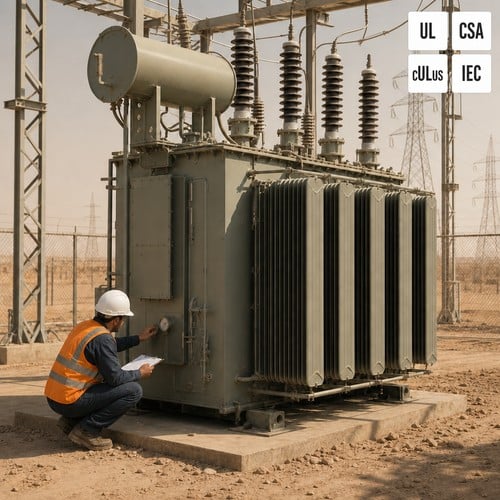
Coatings, Seals and Enclosures for a Sandblasting Wind
Desert corrosion is not coastal corrosion, and specifying it on the wrong assumption wastes money. Humidity is low, so the electrochemical driver is weaker — but ultraviolet radiation is extreme, day/night cycling is brutal, and wind-blown sand abrades any coating that has gone brittle. ISO 12944-5:2018 is the framework for the paint system, and a desert yard typically calls for a C5 category with surface preparation to Sa 2½ and a total dry film thickness of 240–320 µm: zinc-rich primer, epoxy intermediate coat, UV-stable polyurethane finish. The finish coat matters most, because a coating that chalks and cracks exposes the layer beneath it to abrasion.
The components that fail first are rarely the tank. They are the gaskets, the breather, the auxiliary cabinets and the fasteners. Gasket material should be selected for temperature and UV exposure together — EPDM or a fluoroelastomer rather than a general-purpose nitrile that hardens over a few summers. Bushings need their creepage and shed profile reviewed for dust accumulation, not only for pollution class. Cabinets should carry at least IP54, IP55 for anything with a fan, and top surfaces should be sloped so that dust does not collect and then turn into a mud film after the first rain of the season.
Solar Load: The 10 K That Never Appears in the Datasheet
Peak solar irradiance in the Gulf approaches 1,000 W/m², and a dark-painted tank in still air runs well above the ambient temperature measured in shade. That heat appears nowhere in a standard loading calculation, and it is one reason a transformer that thermal-tests perfectly in the factory behaves differently in service: solar load raises the effective ambient for the radiators and shifts the hottest-spot calculation in the direction that costs insulation life.
Three measures pay for themselves. Tank finish first — a light grey or aluminium finish reflects a meaningful share of incident radiation and costs nothing at order stage, because it is a line in the paint specification. Orientation second — banks staggered so that the western exposure is shaded during the afternoon peak avoid the worst combination of high air temperature and direct gain. A sunshade third, increasingly common on Middle East packages because a steel shelter is cheaper than 20% of extra transformer capacity. Yard layout counts as well: concrete walls radiate heat back onto a unit installed too close to them.
What to Put in the RFQ Before You Compare Quotes
When a transformer for desert climate project arrives with a temperate-climate RFQ, the quotes will not be comparable, because each supplier makes different assumptions about the same unknowns. These are the lines that change the number.
- Site design ambient: maximum, monthly average, and hours per year above 40°C
- Installation altitude, and whether an altitude derating applies
- Cooling class — ONAN, ONAF or ODAF — and whether forced cooling is acceptable
- Winding temperature rise and insulation class, with the hottest-spot limit stated as a number
- Duty cycle: continuous, cyclic or emergency overload, with durations
- Coating system, ISO 12944 corrosivity category and required dry film thickness
- IP rating for auxiliary cabinets, fan motors and control boxes
- Prevailing wind direction, distance to the nearest sand source, and any planned shelter
- Temperature-rise test conditions — referenced to 40°C, or to the site design ambient
- Spare parts package: fans, gaskets, breather consumables and a service interval
Three of those lines move the price more than the rest: the temperature-rise test basis, the cooling class and the coating system. Buyers comparing an oil immersed transformer factory China quotation against a regional supplier usually find the difference concentrated in exactly those three lines. A supplier who quotes a standard 40°C-referenced heat run against a 50°C site has offered a cheaper number and a shorter-lived transformer, and the gap stays invisible in a comparison table unless the specification forces it out.
Built for Desert Climate Sites: How Ryan Electric Specifies for 50°C
Ryan Electric has built transformers since 2007, in a 120,000 m² plant with more than 180 sets of production and test equipment and 37 patents, and since 2023 we have operated as an Eaton joint venture partner. Our units carry UL, CSA, IEEE, DEKRA, CNAS and CE certification, and the oil-immersed range covers 10 kV to 200 MVA. Hot-climate orders are a large part of what we build for the Middle East, and they are almost never catalogue orders — which is where an oil immersed transformer factory China quote and a regional one most often part company.
When a desert enquiry reaches our engineering team, the review starts with four numbers: design ambient, cooling class, corrosivity category and site altitude. From those we calculate the hottest spot at full load and at the planned overload, select the insulation system against that figure instead of a default, and write the assumptions into the offer so the buyer can check them. Coatings are specified to the ISO 12944 category the project states, fan and pump motors by IP rating rather than by what was on the shelf, and the heat run is referenced to the agreed ambient — so the test report and the site condition are the same conversation.
If you are preparing a hot-climate package — oil-immersed distribution and substation units, or a specification review of quotes already received — send the load schedule and site conditions through the Ryan Electric inquiry page, or review the oil-immersed transformer range first. You will get back a specification comment sheet rather than a bare price: ambient basis, cooling class, hottest-spot calculation, coating system and the test evidence that travels with the unit.
About the Author: This article was written by the engineering team at Ryan Electric (Jiangsu Ryan Electric Co., Ltd.), an Eaton joint venture partner and UL/CSA-certified transformer manufacturer producing oil-immersed, cast-resin and VPI dry-type transformers for utilities, data centres and infrastructure projects across the Middle East, Africa, Southeast Asia and North America.
Table of Contents
- Why a 40°C Ambient Rating Is Not Enough in the Gulf
- Transformer Derating Math: What 50°C Ambient Costs You in kVA
- Cooling and Radiator Design When the Air Is Full of Sand
- Coatings, Seals and Enclosures for a Sandblasting Wind
- Solar Load: The 10 K That Never Appears in the Datasheet
- What to Put in the RFQ Before You Compare Quotes
- Built for Desert Climate Sites: How Ryan Electric Specifies for 50°C