
 EN
EN
Transformer for EV Charging Station Networks: Sizing and Procurement When the Grid Lags Behind
The charging piles arrived in the container three weeks ago. The site permit cleared last Friday. The utility interconnection study is "in progress," and the transformer the whole project depends on has a 40-week lead time. If you build or operate EV charging networks, you already know this scene — and you know it is getting harder, not easier.
The IEA's Global EV Outlook 2026 shows charging infrastructure expanding at record pace, while Electricity 2026 puts grid buildout at 5 to 15 years per project. An EV charging site goes from permit to energization in 1 to 2 years; the grid cannot match that rhythm, and neither can a transformer ordered at the last minute. For anyone specifying a transformer for EV charging station projects, the message is simple: treat the power conversion asset with the same planning discipline as the chargers themselves.
The Fastest-Growing Load the Grid Wasn't Built For
EV charging is a different animal from the loads distribution grids were designed around. A residential feeder assumes a few kilowatts per service. A DC fast-charging site pulls megawatts in bursts — eight 350 kW stalls can draw close to 2 MW at full output, roughly the demand of a small commercial building, concentrated at a single node and switched on in minutes as vehicles arrive.
That is why the IEA's Global EV Outlook 2026 pairs its vehicle forecasts with a hard look at charging infrastructure: the bottleneck is no longer the car, it is the connection. The table below is the one we put in front of every charging network client, because it explains the whole scheduling problem at a glance:
|
Asset |
Timeline |
Risk for Charging Projects |
|
Charging site (permit → energization) |
1–2 years |
Project pace sets the deadline |
|
Grid upgrade (feeder / substation) |
5–15 years |
Often later than the site |
|
Transformer (build + certification) |
Capacity-constrained |
Must be locked early |
Source: IEA, Electricity 2026 and Global EV Outlook 2026.
EV Charger Transformer Sizing: It's Not Just Adding Up the kW
Here is the part most charging projects get wrong: transformer capacity is not the sum of charger nameplates. A site with eight 350 kW chargers has 2.8 MW of installed capacity, but real-world coincidence — vehicles arriving at different times, stalls idle, sessions tapering as batteries fill — typically lands at a 0.4 to 0.6 diversity factor. That puts the sensible transformer rating around 1.5 to 1.7 MVA for such a site, not 2.8 MVA.
Three more parameters decide the final spec. First, voltage: in North America the common arrangement is a medium-voltage primary (12.47 kV, 13.8 kV, or 25 kV) stepping down through a 480V three phase transformer to a 480/277 V secondary that feeds the charger distribution. Second, harmonics: modern chargers use active rectifiers, but older units and some high-power architectures still push current harmonics back onto the network, which is why a K-rated transformer (K-13 or K-20) is a defensible choice for mixed-fleet sites. Third, load profile: charging demand is intermittent and often peaks at night for depot fleets — an oil-immersed unit can absorb short-term overload per IEEE C57.91, while a dry-type unit should be sized closer to sustained load.
Put it together and EV charger transformer sizing becomes a five-line calculation: installed kW, diversity factor, harmonic content, ambient conditions, and a growth allowance for the next expansion phase. We do this math with the client before a single drawing is made.
Pad-Mounted or Dry-Type? Matching the Transformer to the Charging Scenario
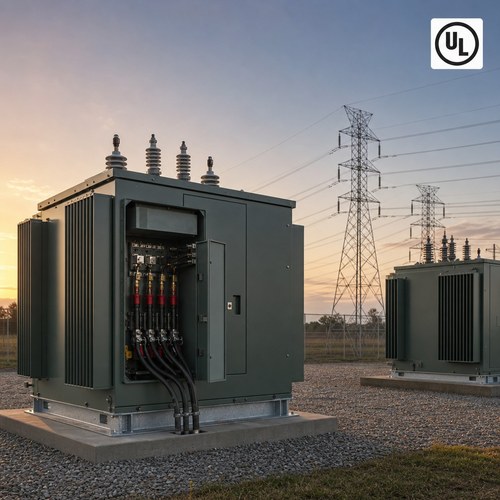
The site decides the technology. Highway fast-charging hubs — the ones drivers expect to work in any weather — are almost always served by an outdoor pad mounted transformer for EV charging: an oil-immersed, pad-mounted unit built to IEEE C57.12.20, UL-listed for the North American market, and often specified with tamper-resistant enclosures where the site is publicly accessible. These units carry the short-term overload capability that charging peaks love and need no building around them.
Urban and indoor scenarios flip the logic. A shopping-mall parking garage or an office basement favors a dry-type unit: no oil containment, lower fire risk, quieter operation, and a smaller footprint. The trade-off is overload headroom — dry-type units are sized closer to the sustained load, which means the diversity-factor calculation carries more weight.
One question we always ask: how fast will this site grow? Charging networks routinely double within three years. If the answer is "we will likely add stalls," we recommend a unit with 25–50% spare capacity or a design that allows a second transformer to be paralleled later. Retrofitting a substation pad is far more expensive than ordering the headroom up front.
How We Build for Charging Network Operators
When a charging network operator sends us a site plan with twelve DCFC stalls and asks for "the usual transformer," the first thing we ask is not kVA — it is the charger model, the utility's secondary voltage, and the certification required at the point of delivery. Those three answers decide whether the unit is a stock design or a custom build, and whether it ships in weeks or months.
We have been the manufacturing partner behind Eaton's joint-venture line since 2023, and our production floor runs UL, CSA, and IEC-certified processes. For charging projects that means the certification conversation happens at inquiry stage, not after the award: a UL-listed transformer for EV charging station with file coverage and test reports in hand moves from approval to shipment without rework. Factory acceptance tests are recorded on video, test reports are reviewed line by line with the client's engineer, and spare parts ride in the same container.
We also fit our distribution units with optional winding temperature sensors and load-monitoring ports — the same hardware that enables dynamic rating on a charging asset. For a load as bursty as EV charging, that visibility is worth having before the first stall goes live.
Three Procurement Moves That Keep Charging Projects on Schedule
Lock the transformer before the charger PO. Chargers are off-the-shelf; transformers are capacity-constrained. Reserve a production slot when the site is approved, and hold it through the interconnection study. This is the highest-leverage step in the whole project.
Standardize across the network. A network of 30 sites with two standardized transformer ratings beats 30 sites with 30 custom specs. Standard designs cut engineering time, hold price, and simplify the spare-parts strategy for the operations team.
Pre-verify certification and test documentation. UL or CSA coverage checked at RFQ stage, and factory test reports delivered with the unit — saves commissioning delays and keeps utilities happy at the point of interconnection.
One verification note: when a supplier quotes a lead time, ask where that slot sits in their current order book. A quote of 14 weeks from a factory with a full book means something different from 14 weeks with open capacity. Both answers are fine — just know which one you are hearing.
Have a charging site in development? Send us the site plan, charger model, and target energization date — we will respond with a certified transformer option and a realistic production slot. Get a free technical quote.
How to Specify a Transformer for EV Charging Station Rollouts
If your network is scaling this year — or your utility is already asking for a load letter — the cheapest insurance is a conversation with a manufacturer who builds for charging loads specifically. Send us your site plan, charger specifications, and utility interconnection requirements, and we will reply with a sized, certified recommendation and the documentation you can attach to your application.
About the Author: Written by the engineering team at Ryan Electric, a transformer manufacturer serving utility, renewable, and data center customers across North America, Southeast Asia, and the Middle East — and increasingly, the charging networks plugging into all three. We build what we quote and we write about what we see on the shop floor, not what a brochure says.
Planning a charging network? Get a free technical quote— we reply within one business day.