
 EN
EN
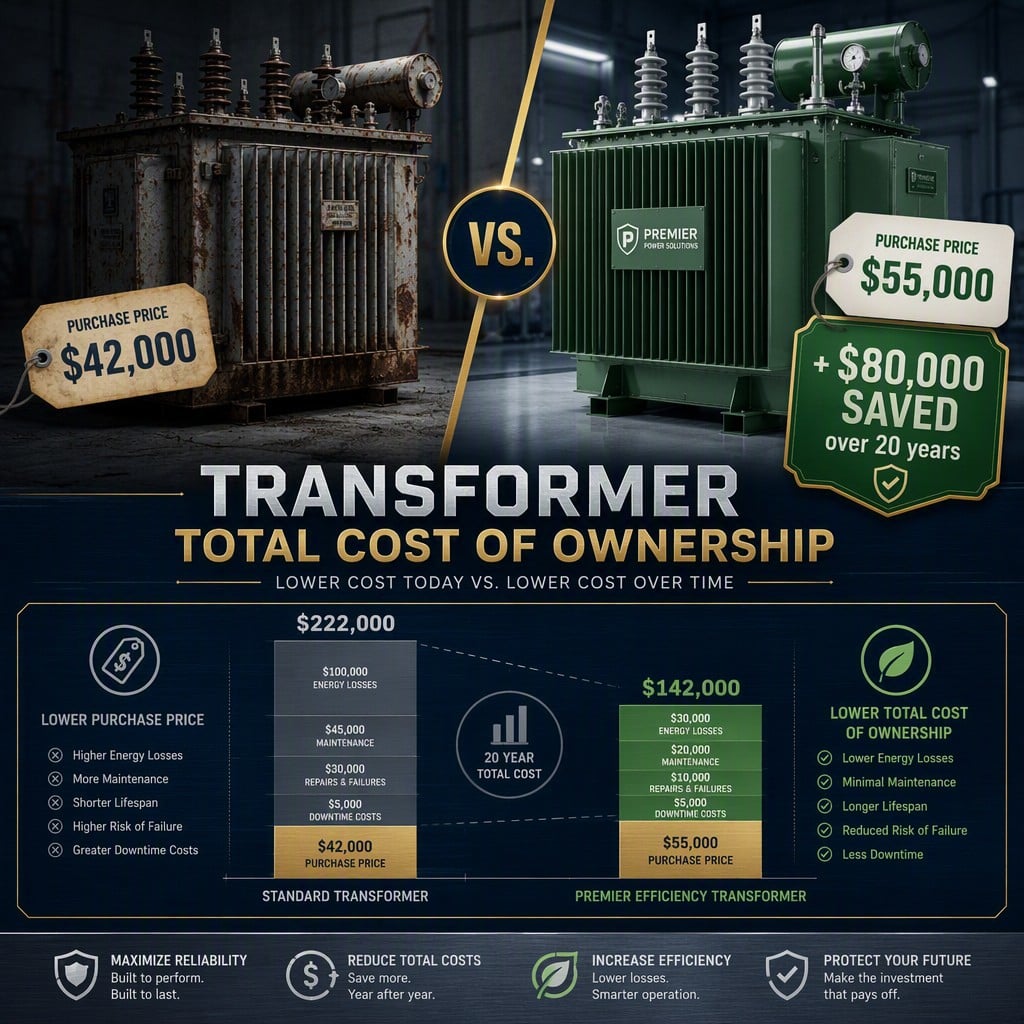
The procurement manager stared at two quotes on his desk. One from a supplier he'd never heard of: $42,000 for a 2500 kVA oil-immersed transformer, delivery in 8 weeks. The other from a manufacturer with a track record: $55,000, 12-week lead time. His project budget was tight, his boss was asking questions, and the $13,000 difference looked like an easy win.
Six years later, that same procurement manager was on the phone with us, asking for an emergency replacement. The cheap unit had failed — winding insulation degraded, oil contaminated, downtime costs already past $80,000 in lost production. That $13,000 he saved? It evaporated in year three.
This scenario plays out more often than the industry likes to admit. Because the price on a purchase order is never the real price of a transformer. The real number is the transformer total cost of ownership — and it's calculated over two decades, not two minutes in a bid comparison spreadsheet.
What Total Cost of Ownership Actually Means for a Transformer
Most buyers treat transformers like commodities: compare kVA ratings, check the price, pick the lowest. That works for office supplies. It fails catastrophically for power assets that run 24 hours a day for 20 to 30 years.
Transformer total cost of ownership breaks into four buckets, and the purchase price is just one of them:
|
Cost Category |
Share of 20-Yr TCO |
What’s Inside |
|
Purchase Price |
8–15% |
The invoice amount, shipping, import duties |
|
Energy Losses |
70–85% |
No-load (core) losses + load (copper) losses, compounded over 20 years of 24/7 operation |
|
Maintenance & Repairs |
3–7% |
Oil testing, bushing replacement, tap changer service, unplanned repairs |
|
Downtime & Replacement |
2–8% |
Lost production, emergency logistics, premature replacement if the unit fails early |
Let those numbers sink in: the purchase price accounts for roughly 10% of what you'll actually spend over the transformer's life. The other 90% is determined by what's inside the tank — the core steel grade, the winding design, the cooling system, and the quality of every joint and gasket.
Here's the part most buyers miss: a transformer with 1% better efficiency doesn't save you 1%. It saves you a percentage of 85% of your total cost, compounded every hour the unit runs. That's why two units with identical kVA ratings and wildly different price tags can have their economic positions completely reversed by year five.
The 20-Year Math: Cheap vs. Quality, Line by Line
Let's put numbers on it. Below is a side-by-side TCO comparison for a 2500 kVA oil-immersed transformer, assuming 24/7 operation at roughly 60% average loading and an industrial electricity rate of $0.10/kWh — typical for a North American manufacturing facility.
|
Parameter |
Low-Bid Unit (Standard) |
Quality Unit (High Eff.) |
|
Purchase Price |
$42,000 |
$55,000 |
|
No-Load Loss |
3.2 kW |
2.1 kW |
|
Load Loss (at 75°C) |
18.5 kW |
13.8 kW |
|
Annual Energy Loss Cost |
$12,100 |
$8,350 |
|
20-Year Loss Cost |
$242,000 |
$167,000 |
|
Expected Major Repairs |
2–3 incidents |
0–1 incident |
|
Estimated Repair Cost |
$18,000–$27,000 |
$0–$9,000 |
|
Expected Service Life |
15–20 years |
25–30+ years |
|
20-Year TCO |
~$308,000 |
~$228,000 |
The numbers tell the story: the "cheaper" unit costs about $80,000 more over its service life. And that's before we account for the downtime from those extra repairs, or the possibility of early failure forcing a complete replacement in year 15 instead of year 25.
These aren't theoretical figures. The loss values in the quality column reflect what we measure on our routine test reports — units leaving our factory typically test 15–20% below the IEC standard loss limits. The low-bid column reflects what you get when a manufacturer builds to the standard ceiling, not below it.
Three Hidden Costs Most Buyers Never See Until Year 5
Beyond the energy-loss spreadsheet, there are costs that don't appear in any bid comparison because they're invisible at the time of purchase.
Accelerated insulation aging. Every 6–8°C increase in winding hot-spot temperature cuts insulation life in half. Cheap transformers often run hotter because the manufacturer used thinner conductors, fewer cooling ducts, or lower-grade insulation paper. The unit works fine on day one. By year five, the insulation is degrading at double the expected rate. We've opened units after premature failure and found paper so brittle it crumbled to the touch — the direct result of running 15°C hotter than a properly designed winding.
Impedance discrepancies and protection failures. When a transformer's measured impedance deviates from what the system study assumed, your downstream circuit breakers may not trip when they should — or they may trip when they shouldn't. We've seen a case where a low-bid unit arrived with Uk=4.8% instead of the specified 6.0%. The plant's arc-flash study was now wrong. The fix? A $15,000 protection coordination re-study and new relay settings. That cost never appeared on the original purchase order.
Certification gaps and secondary inspection fees. Some low-cost suppliers ship units with "self-declared" compliance rather than third-party certified ratings. When the local authority having jurisdiction rejects the nameplate, you're paying for an independent testing lab to verify what the manufacturer should have proven before shipping. For a UL-listed market like the US, that can mean $8,000–$12,000 in third-party field testing and weeks of delay — all because someone tried to save money by skipping the certification process.
What DOE 2029 Efficiency Rules Mean for Your TCO Calculation
The US Department of Energy's 2029 efficiency standards for distribution transformers represent the most significant regulatory tightening in over a decade. Under the new rules, transformers sold into the US market must meet minimum efficiency levels that are 5–10% higher than current DOE 2016 baselines, depending on the kVA rating and voltage class.
If you buy a transformer in 2026 that barely meets the current standard, you're buying an asset that will be legally obsolete in three years. More importantly, the 2029 rules force the entire market upward — which means the loss levels you accept today define the resale value, the retrofit compatibility, and the regulatory compliance window of your installation.
Smart buyers are already specifying transformers that meet or exceed the proposed 2029 levels now. The price premium is modest — typically 6–10% on the purchase price — and it pays back through lower energy costs even before the regulation kicks in. Waiting until 2029 to upgrade means you'll be paying higher operating costs for three extra years on every unit you install between now and then.
How Ryan Designs for Lifetime Value, Not Just the Invoice
Our engineering approach starts at the core. We use grain-oriented silicon steel with domain refinement — a higher-grade material that reduces no-load loss by 20–30% compared to conventional M4-grade steel. It costs more per kilogram. It pays back within 18 months of operation.
On the winding side, we specify conductor cross-sections that keep current density below 2.5 A/mm² in distribution-class units. Many manufacturers push to 3.0 A/mm² or higher to save copper — but that extra half-amp per square millimeter translates to higher I²R losses for the next two decades. It's an invisible trade-off that shows up on every electricity bill.
Through our Eaton joint-venture partnership, established in 2023, we've integrated design-for-reliability practices that go beyond standard IEC and IEEE requirements. Every unit's test report includes measured loss values — no-load and load — not just pass/fail against a standard ceiling. Buyers who request it receive a TCO projection alongside their quotation, so the 20-year math is visible before the purchase decision.
Our field service history supports the numbers. Transformers we shipped to the Middle East, Southeast Asia, and North America over the past decade are still running with minimal intervention. The longest continuously operating unit in our service fleet is at year 17 and its dissolved gas analysis still shows normal readings across all fault gases.
Get a TCO Comparison for Your Project
Every project has different parameters — local electricity rates, expected load profile, ambient temperature range, and regulatory requirements. We build custom TCO projections at the quotation stage, not as an afterthought.
If you're sitting on two quotes right now and trying to justify the higher one to management, send us your specifications. We'll run the numbers with your actual electricity rate and load profile.
Have a project spec? Get a free TCO analysis with your quotation → Contact our engineering team
About the Author: This analysis was prepared by Ryan Electric's engineering and applications team. Ryan Electric is an ISO 9001-certified transformer manufacturer with over 17 years of field experience across 30+ countries. As an Eaton joint-venture partner since 2023, we design and manufacture high-efficiency oil-immersed, dry-type, and pad-mounted transformers with UL, CSA, and IEC certifications for utility, industrial, and renewable energy applications worldwide.
Table of Contents
- What Total Cost of Ownership Actually Means for a Transformer
- The 20-Year Math: Cheap vs. Quality, Line by Line
- Three Hidden Costs Most Buyers Never See Until Year 5
- What DOE 2029 Efficiency Rules Mean for Your TCO Calculation
- How Ryan Designs for Lifetime Value, Not Just the Invoice
- Get a TCO Comparison for Your Project