
 EN
EN
Step-Down Transformer 480V to 208V: A Complete Guide for Commercial and Industrial Projects
The first time a contractor opens the door to a commercial building's electrical room, the view is always the same: a 480V main feeder coming in from the utility, and somewhere nearby, a transformer that takes that voltage down to the 208Y/120V that powers everything the people inside actually use — the lights, the receptacles, the breakroom coffee maker, the rooftop HVAC units. If that step down transformer 480v to 208v is undersized, noisy, or unreliable, everyone in the building feels it.
Getting this selection right isn't complicated. But it does require understanding a handful of things that standard spec sheets don't spell out clearly. This guide walks through what every contractor, facility engineer, and project buyer should know before ordering a three phase step down transformer for a 480V-to-208V application.
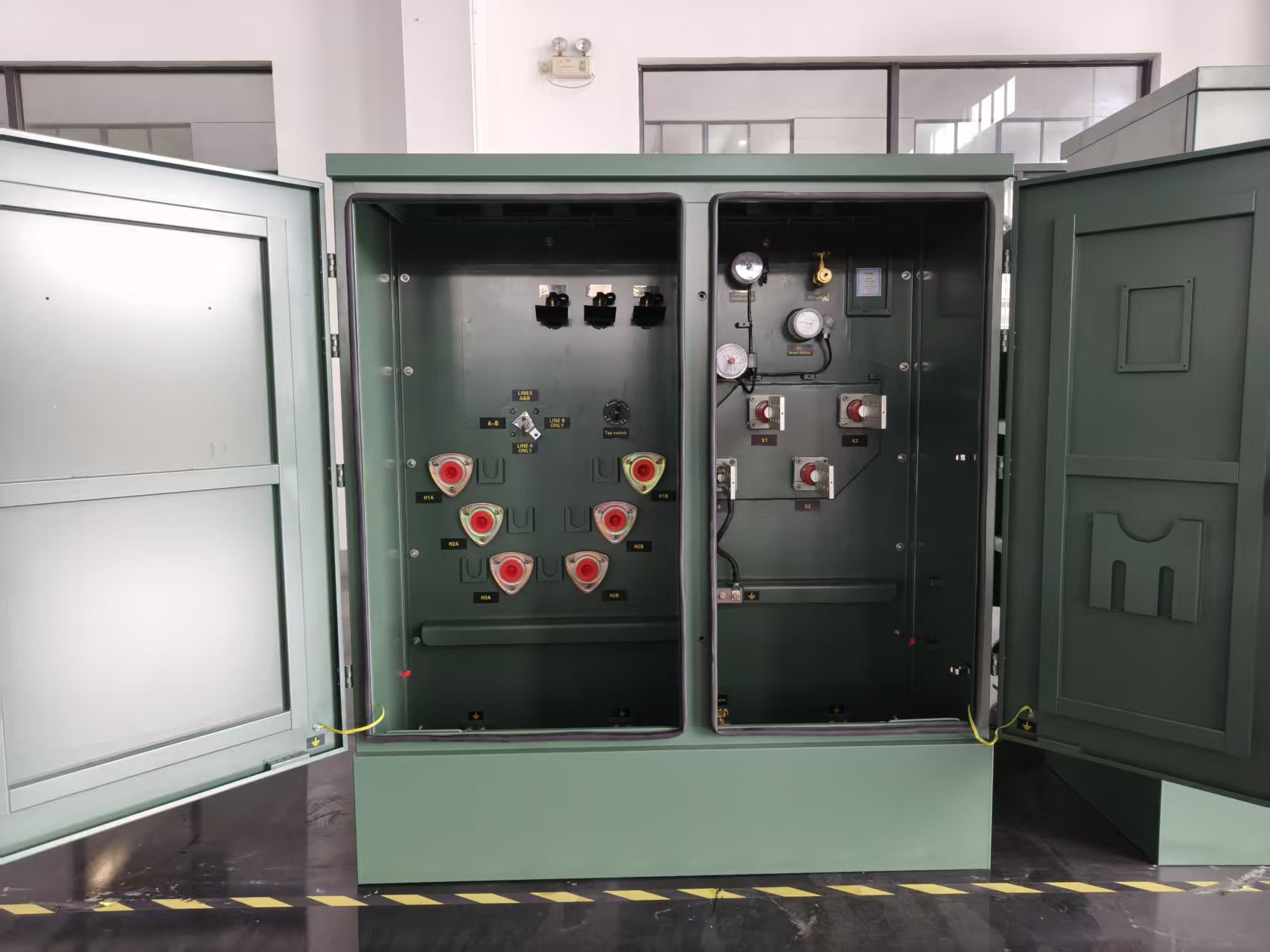
[Image: Electrical distribution room showing a dry-type step-down transformer connected to 480V switchgear and 208V panelboard]
Where 480V Meets 208V — And Why It Matters
Most commercial and light industrial buildings in North America receive 480V three-phase service from the utility. The logic is simple: higher voltage means lower current for the same power, which means smaller conductors, less voltage drop over distance, and lower installation cost for the service entrance.
But almost nothing inside a typical commercial building runs on 480V. Lighting operates at 120V or 277V. Standard receptacles are 120V. Office equipment, kitchen appliances, and HVAC controls all expect 208V or 120V. The step down transformer 480v to 208v is the bridge — it takes the utility's efficient high-voltage feed and converts it to the lower voltages that end-use equipment actually consumes.
Here's what catches first-time buyers: there are two common secondary configurations from a 480V primary. A 208Y/120V secondary gives you three-phase 208V line-to-line and single-phase 120V line-to-neutral — ideal for mixed-use buildings. A 240V delta secondary (with or without a center tap) is less common in new commercial construction but still appears in older industrial facilities. When you're ordering, the secondary configuration needs to match the downstream panelboard exactly. There's no adapting it after the unit leaves the factory.
The Four Places You'll Always Find a 480V to 208V Step-Down
Commercial Office Buildings. This is the bread-and-butter application. A 15-story office tower might have one large dry type transformer 480v unit in the basement feeding 208V risers, or it might distribute 480V vertically and put smaller step-down units on every third floor. The choice depends on whether the electrical engineer prioritized copper savings on the riser (go high voltage up the building) or consolidation of maintenance access (fewer transformers, larger conductors).
Industrial Plant Auxiliary Power. Factories almost always have 480V as their main distribution voltage because the big motors — compressors, pumps, conveyor drives — run on 480V three-phase. But the plant office, the lighting circuits, the control panels, and the battery chargers for forklifts all need 208/120V. A dedicated three phase step down transformer sits at the boundary between the heavy industrial bus and the general-purpose auxiliary panel. In these installations, the transformer often lives in a mezzanine electrical room where ambient temperature is higher than a commercial building — which means temperature rise class matters more than it does in an air-conditioned office.
Data Center Power Distribution. A hyperscale data center brings in medium voltage (typically 12.47 kV or 34.5 kV), steps down to 480V at the substation, distributes 480V to rows of racks, and then uses smaller step-down units to create 208/120V for the cabinet-level power distribution units. Any data center electrical designer knows this chain well. The differentiator is that data center transformers run at higher average loading — 60% to 80% continuously, versus 30% to 50% in a typical commercial building — which puts efficiency and thermal performance under a microscope.
Large Retail and Mixed-Use Developments. A big-box retail store or a shopping center with multiple tenants follows the same pattern: 480V service from the utility, then one or more step-down transformers feeding 208/120V panels throughout the space. The twist here is that retail tenants change over time. A space that was a clothing store (lighting-heavy, moderate receptacle load) becomes a restaurant (heavy kitchen equipment load, refrigeration, higher overall demand). The transformer that was correctly sized for the original tenant can end up undersized five years later — which is why sizing with headroom matters.
Sizing It Right: kVA Math That Saves You from a Callback
Undersizing a transformer is expensive. The unit runs hot, the insulation ages faster, and if the main breaker trips on a Tuesday afternoon in August, the building owner isn't calling the manufacturer — they're calling the contractor who specified it.
The basic three-phase kVA formula is: kVA = (V × I × √3) / 1000
For a 208V secondary with a full-load current of, say, 400A: kVA = (208 × 400 × 1.732) / 1000 ≈ 144 kVA. The nearest standard size would be 150 kVA.
But the formula alone isn't enough. Three practical considerations change the number.
Load diversity. Not everything runs at the same time. A commercial building's lighting might be at 95% during business hours, but the HVAC load varies with outdoor temperature. ASHRAE and NEC Article 220 provide load calculation methods. Apply them — don't just sum the nameplate ratings of every downstream device.
Harmonics from non-linear loads. LED lighting, VFD-driven motors, and the switching power supplies in every computer and server generate harmonic currents. These currents cause additional heating in the transformer windings. If your building has a high concentration of electronic loads (think: call center, trading floor, server room), spec a K-factor rated transformer — typically K-4 for general commercial, K-13 for data-intensive spaces.
Future capacity. A 150 kVA unit that's loaded to 140 kVA on day one leaves almost no room for the building owner to add a tenant improvement, a new server closet, or an EV charging station in the parking garage. The industry rule of thumb is 20–25% headroom above the calculated connected load. On a 150 kVA project, that's roughly 30–38 kVA of spare capacity — which typically pushes the spec to a standard 225 kVA unit.
Here's a quick-reference table for common commercial building transformer sizing scenarios:
|
Building Type |
Typical Connected Load |
Recommended kVA (with 25% headroom) |
|
Small office (< 10,000 sq ft) |
60–80 kVA |
112.5 kVA |
|
Mid-size office (10,000–50,000 sq ft) |
100–180 kVA |
150–225 kVA |
|
Retail big-box store |
150–250 kVA |
225–300 kVA |
|
Restaurant (full kitchen) |
80–120 kVA |
112.5–150 kVA |
|
Data center (per 20 racks) |
120–200 kVA |
150–300 kVA |
Dry-Type vs Oil-Immersed: Which One Belongs in Your Building?
For indoor 480V-to-208V applications, the answer is dry-type roughly 90% of the time. But let's be precise about why — and when the other 10% applies.
Dry-type transformers (cast resin or VPI) are self-extinguishing, produce no flammable liquid, and can be installed directly inside a building without a fire-rated vault or containment pit. UL 1561 covers the safety requirements. A ventilated dry-type unit with a 150°C temperature rise is the default choice for most indoor dry type transformer 480v installations — it's cost-effective, widely available, and accepted by every North American electrical inspector.
The trade-off: dry-type units run warmer and are physically larger than an equivalent oil-filled unit. In an electrical room with limited floor space and marginal ventilation, a 115°C or 80°C rise unit might be worth the premium — it runs cooler, lasts longer, and can operate in a hotter ambient without derating.
Oil-immersed transformers make sense when the unit goes outdoors — a pad-mounted installation behind a retail store, for example — or when the kVA is large enough (typically above 500 kVA) that the size and cost advantage of oil cooling outweighs the fire-safety requirements. Some industrial facilities with outdoor electrical yards also prefer oil-filled units for their higher overload capability.
The noise question comes up more often than you'd think. A dry-type transformer installed in an office building's electrical closet on the second floor will be audible through the wall if the spec didn't address sound level. NEMA ST-20 defines sound levels by kVA. For noise-sensitive locations, ask for a low-noise design — typically 3 to 5 dB below the NEMA standard — and specify vibration isolation pads between the transformer enclosure and the floor.
The Specs That Actually Matter on the Nameplate
Every transformer nameplate has a dozen data points. Four of them determine whether the unit works for your project or becomes an expensive mistake.
kVA rating and temperature rise. These two numbers are a pair — you can't interpret one without the other. A 150 kVA unit with a 150°C rise can deliver 150 kVA continuously at 40°C ambient. A 150 kVA unit with an 80°C rise can deliver the same 150 kVA, but it also has 12% additional overload capacity at the standard 150°C insulation class — meaning it's effectively a 168 kVA transformer wearing a 150 kVA nameplate. If your loading calculation lands at 160 kVA, the 80°C rise unit handles it without breaking a sweat. The 150°C rise unit doesn't.
Impedance percentage (%Z). This is the number that determines how much the secondary voltage sags when the transformer goes from no-load to full-load — and, more importantly, how much fault current flows during a short circuit. A typical 150 kVA dry-type has 4.5–5.75% impedance. Lower impedance means better voltage regulation but higher available fault current, which affects the downstream breaker and panelboard ratings. If your short-circuit study says the available fault current at the 208V panel must stay below 22 kA, the transformer's %Z needs to be high enough to keep it there.
Winding material: copper vs aluminum. Aluminum windings are lighter and cheaper. Copper windings are more compact, have lower losses, and handle thermal cycling better over decades of service. For a commercial building transformer sizing decision where the unit runs 12 hours a day, five days a week, copper typically pays back its premium in reduced losses within five to seven years. For a unit that serves emergency lighting only and runs at 5% load 99% of the time, aluminum is the practical choice.
Efficiency at 35% load. The DOE efficiency standard for dry-type distribution transformers specifies efficiency at 35% of rated load — because that's where real-world transformers spend most of their operating hours. A unit with a high full-load efficiency number but poor part-load performance is a misleading spec. The DOE's 2024 efficiency levels (10 CFR Part 431) set the minimums; units that exceed those minimums by a meaningful margin — especially at the 35% point — are worth identifying during procurement.
What Ryan Electric Brings to the 480V–208V Equation
Most transformer catalogs stop at standard kVA sizes: 30, 45, 75, 112.5, 150, 225, 300. But real projects don't always land on round numbers. When a building's load calculation comes back at 165 kVA, a 150 kVA unit is undersized and a 225 kVA unit means the owner pays for 60 kVA of capacity they'll never use.
Our factory engineers the winding configuration to the project's actual load profile — not just the nearest catalog entry. A 175 kVA unit with a custom impedance value and a specific temperature rise class isn't a special-order headache for us. It's what we do routinely for North American commercial projects.
Every step down transformer 480v to 208v we manufacture for the U.S. market carries UL 1561 listing, and we verify the certification applies to the exact kVA, voltage, and temperature rise combination on the order — not a generic "family listing" that leaves the buyer guessing. The Ryan-Eaton partnership, established in 2023, has sharpened our understanding of how North American electrical contractors expect transformers to arrive on site: nameplate oriented for easy reading from the aisle side of the electrical room, lifting lugs sized for standard rigging hardware, enclosure paint that survives a construction site without rust blooming before the drywall goes up.
Before any unit leaves the factory, our test bay runs a full suite: applied potential, induced potential, winding resistance, impedance voltage, load loss, no-load loss, and temperature rise. The test report ships with the transformer. If the contractor's commissioning agent wants to verify impedance against the submittal, all the data is in their hands before the unit arrives on the truck.
Have a 480V-to-208V project in the pipeline? Send us your load schedule for a technical quote.