
 EN
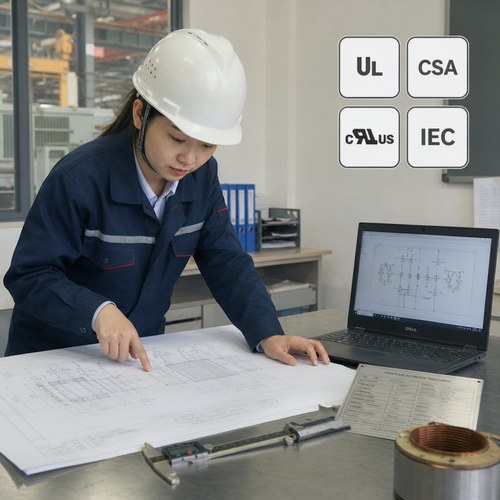
Two quotes for a 2,000 kVA unit landed on a buyer's desk in Houston in July. The lower bid won by $9,800. Nine months later the finance team pulled the guaranteed losses out of the approved submittal and ran the numbers again: at 8,760 hours a year, the difference in no-load loss alone paid back that $9,800 in under four years. The submittal had been approved. It had not been read.
That is the gap a transformer submittal review is supposed to close. Not a document check, not a rubber stamp before the purchase order goes out, but the last point at which a number can still change without steel being cut. On a custom three phase transformer, everything after drawing approval is expensive to reverse. Everything before it is a phone call.
Why the Submittal Beats the Factory Acceptance Test
A factory acceptance test tells you what was built. A submittal tells you what is about to be built. Buyers spend weeks preparing to witness a FAT and twenty minutes approving the drawing set it follows. The economics run the other way round. Once a core is cut and a tank is welded, a changed impedance target means a new winding design, a new loss calculation, a new tank, and a new slot in the test bay.
In our works, the drawing set that goes to a customer for approval is the same set the design office releases to the shop floor. Nothing gets released for core cutting until the marked-up copy comes back. That single rule is why we would rather argue about a minus sign in a tap table in week two than explain a rebuild in week fourteen.
Checks 1 to 4: The Electrical Values Your Studies Already Assumed
The first four checks are not about the transformer. They are about whether the transformer matches the model that produced your fault study, your coordination curves and your arc-flash label.
1. kVA on the right cooling basis. A nameplate reads ONAN 8,000 kVA / ONAF 10,000 kVA. A load schedule that says 10,000 kVA without naming the cooling stage has just bought a unit that carries that load only with fans running and auxiliary power available. Write the basis, the ambient, and the altitude on the drawing.
2. Ratio and tapping, with the tap table shown. Confirm the ratio at the principal tapping and check whether the design uses constant flux (CFVV) or variable flux (VFVV) tapping. On a 13.8 kV primary with ±2 x 2.5% taps, get the full table on the drawing: position, voltage, current, and which winding is tapped.
3. Vector group and clock number. Dyn11 and Dyn1 are both delta-star units and both look correct on a single-line. They cannot be paralleled without swapping phases. If the plant has an existing unit and a future second unit, the clock number belongs in the specification, not in a note on the drawing.
4. Impedance on the transformer base, not the system base. This is the mistake we see most often, and it usually arrives as an impossible number: 6% for a 2,500 kVA unit. A study run on a 100 MVA base gives 6% system impedance, which converts to 0.15% on a 2,500 kVA transformer base. The conversion is Z% transformer = Z% system x (S transformer / S system). When the drawing and the study disagree by a factor of forty, the drawing is not wrong. The base is.
Get these four right and the custom three phase transformer in the drawing will behave like the one in the model. Get them wrong and no amount of testing at the end will fix the coordination study behind them.
Checks 5 to 8: The Tolerances Someone Has to Write Down
Every guaranteed value on a submittal is a range, not a point. The ranges come from IEC 60076-1, Table 1, and they are generous enough that a unit can be fully compliant and still miss the number your business case used.
| Quantity | Tolerance allowed by IEC 60076-1 |
| Total losses | +10% of the guaranteed value |
| Each loss component (no-load, load) | +15%, provided the total loss tolerance is not exceeded |
| Voltage ratio, principal tapping | The lower of +/-0.5% and 1/10 of the actual impedance in % |
| Short-circuit impedance, two windings | +/-7.5% when impedance is 10% or more; +/-10% when below 10% |
| No-load current | +30% of the design value |
5. Loss guarantees, component by component. A 1,500 kVA unit with a 9 kW no-load guarantee may legitimately test at 10.35 kW. Run it 8,760 hours at $0.08 per kWh and that 15% is roughly $950 a year, for twenty-five years, on a unit that passed every test. If the tender evaluates losses, ask for the guaranteed figures on the transformer base at the reference temperature, and make the evaluation use the tolerance, not the promise.
6. Impedance tolerance in both directions. On a 6% unit, the +/-7.5% impedance tolerance is a real band from 5.55% to 6.45%. A minus-side unit raises secondary voltage drop and lengthens motor starting dips. A plus-side unit lowers available fault current and can leave a breaker undersized for the arc-flash study. Neither is a defect; both are a design decision that should be made in the submittal, not discovered in the test report.
7. Ratio tolerance tied to impedance. That ratio rule surprises people. At 4% actual impedance, the permitted ratio error on the principal tapping is not +/-0.5% but +/-0.4%, because the tolerance is the lower of the two. On a 480 V secondary that is under 2 V, which matters when two units are expected to share load.
8. Temperature rise and sound level. For liquid-immersed units, IEC 60076-2 sets 65 K average winding rise and 60 K top-liquid rise for ONAN designs; a nameplate offering 55/65 K dual rating is a different thermal bargain and should be priced as one. Sound level belongs on the same page, measured to IEC 60076-10, because a unit that meets its losses and misses its dBA by 4 dB is still a problem for the neighbour.
One currency note for anyone specifying this year: IEC 60076-1 Edition 4 is in development, with publication forecast for 2027 according to the IEC 60076-1 publication page. Edition 3 (2011) remains the valid edition, so quote the edition number in the specification and the submittal review has something to check against.
Checks 9 to 11: The Mechanical Interfaces a Drawing Has to Prove
9. Weights, all four of them. Core and coils, oil, total, and transport. They are not the same number and each one belongs to a different person: the crane contractor, the pad designer, the freight forwarder and the rigging crew. A 12-tonne unit quoted at total weight without transport weight has just created a permit problem at the port.
10. Enclosure, cable access and bushing layout. On a pad-mounted unit, radial feed and loop feed are different enclosures, and the difference shows up as a cable bending radius that does not fit. Check bushing orientation against the cable trench, check the cable box depth against the conductor size, and check that the compartment door swing clears the fence line.
11. Anchorage, seismic and the pad itself. If the project is in a seismic region, the qualification level (IEEE 693 or a project-specific spectrum) must appear on the drawing with the anchorage detail, not as a note promising a certificate later. The pad drawing is part of the same review: conduit stub-up positions, sump, and the clearance the utility needs for its own crew.
Checks 12 to 14: Listing, Nameplate and the Test Plan
12. Listing mark, standard and file number. A UL listed transformer is identified by three things on the nameplate: the mark, the standard it was listed to, and the file number. Customs officers and inspectors look for the file number first. For Canadian projects the cUL or CSA mark is the equivalent, and a US-only listing will stop at the border however good the unit is.
13. Nameplate against drawing against specification. Read the three side by side: kVA and cooling class, voltages and taps, vector group, impedance, temperature rise, insulating liquid, total weight, altitude. IEEE C57.12.00 governs the data a liquid-immersed nameplate must carry in North America (IEEE C57.12.00 standard page); IEC 60076-1 does the same job for IEC-market projects. A nameplate that omits the impedance reference temperature has omitted the one number that makes the impedance comparable.
14. The test plan and what you will collect. Confirm which routine tests apply, whether a temperature-rise test is included or witnessed, whether impulse tests are required, and which documents you leave the factory with. Approving a drawing set without approving the test plan is how buyers end up at a FAT with no agreed acceptance criteria.
How We Run a Submittal Review on a Custom Three Phase Transformer
Our engineering team works from a 120,000 square-metre plant in Jiangsu with 180+ sets of production and test equipment and 37 patents behind the winding and insulation designs, and since 2023 we have operated as a joint venture partner of Eaton. That partnership changed our submittal practice more than it changed our product range: the drawing set now states the impedance and loss guarantees on the transformer base at the reference temperature, so the customer's study and our test bay are comparing the same thing.
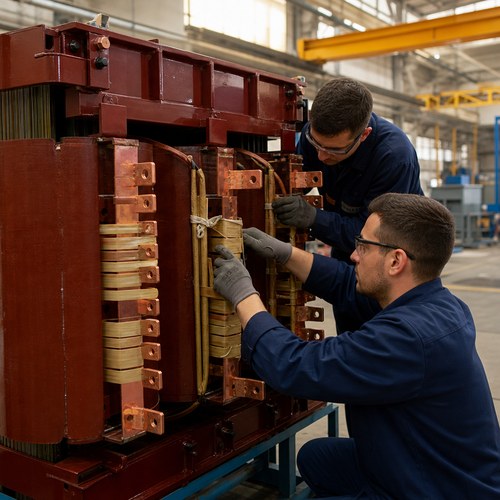
In practice, when a custom three phase transformer order arrives with a study attached, we check the base conversion before we check anything else. If the numbers cannot be reconciled, we say so in the markup and hold the release. It costs us a week at the front and saves both sides a rebuild at the back. The same rule applies whether the unit is an oil-immersed distribution transformer, a cast resin dry type, or a UL listed transformer bound for a US utility.
Send the Drawing Set, Not Just the Rating
If you are preparing a transformer submittal review for an upcoming order, send us the single-line, the load schedule and the study base along with the kVA you need. We will return a marked-up drawing set with the impedance, losses and impedance tolerance stated on the base your study actually uses, plus the nameplate data sheet you can drop straight into the submittal. Units from 50 kVA to 200 MVA, dry type, oil immersed or pad mounted, UL, cUL and CSA listings available.
About the Author
This article was written by the engineering content team at Jiangsu Ryan Electric Co., Ltd., a transformer manufacturer working with EPC contractors, utilities and data centre developers in North America, the Middle East and Southeast Asia. Ryan Electric has operated as a joint venture partner of Eaton since 2023 and holds UL, CSA, IEEE, DEKRA, CNAS and CE certifications. The checks above come from submittals handled by our design office, not from a template.
Table of Contents
- Why the Submittal Beats the Factory Acceptance Test
- Checks 1 to 4: The Electrical Values Your Studies Already Assumed
- Checks 5 to 8: The Tolerances Someone Has to Write Down
- Checks 9 to 11: The Mechanical Interfaces a Drawing Has to Prove
- Checks 12 to 14: Listing, Nameplate and the Test Plan
- How We Run a Submittal Review on a Custom Three Phase Transformer
- Send the Drawing Set, Not Just the Rating