
 EN
EN
Harmonic Distortion in Data Center Power Systems: Why K-Factor Transformers Matter
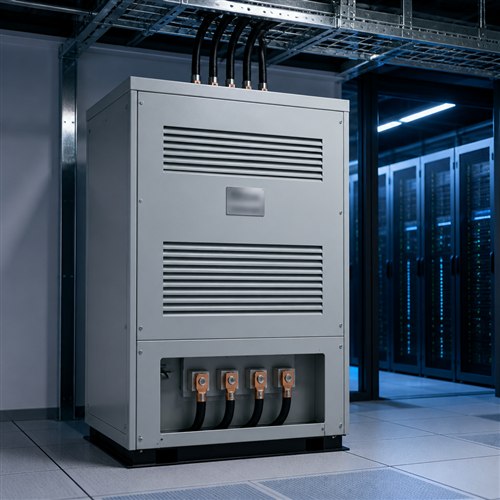
When a data center in Northern Virginia added a rack row of GPU servers last year, the electrical designer’s first concern was not capacity — it was harmonics. Non-linear loads now dominate the typical IT load profile, and a k-factor transformer is what keeps the distribution system from running hot before the racks even reach full load. Here is the engineering behind that choice.
Where Harmonics Come From in a Data Center
Every switch-mode power supply, UPS input, VFD, and GPU server draws current in short pulses rather than a smooth sine wave. Those pulses are made of the fundamental frequency plus integer multiples of it — the 3rd, 5th, 7th, and higher harmonics. The higher the harmonic content, the more distorted the current waveform, and distortion is measured as total harmonic distortion (THD).
Triplen harmonics — the 3rd, 9th, 15th — are the data center’s special problem. In a wye-connected system they do not cancel in the neutral; they add up. It is common to measure neutral current higher than phase current on a heavily loaded 208Y/120V panel, which is exactly the condition that overheats standard transformers and neutral busbars. The design reference for acceptable limits is IEEE 519, which sets THD targets for the point of common coupling.
Why Standard Transformers Overheat Under Harmonic Loads
Harmonics punish transformers in two ways. First, eddy-current losses in windings and structural parts rise roughly with the square of frequency — a 5th harmonic at 300 Hz produces about 25 times the eddy-current loss of the same current at 60 Hz. Second, harmonic currents create additional heating in the core and tank. The net effect: a standard transformer at 100% nameplate load can be operating well past its safe thermal limit without tripping anything.
That is where the K factor comes in. K is a rating that describes how much harmonic current a transformer can handle while staying within its temperature-rise limit. K-1 means sine-wave duty only; K-13 and K-20 are the common choices for data centers and industrial drives. The derating method behind these ratings is defined in ANSI C57.110, and it tells the designer exactly how much load a given design can carry at a given harmonic spectrum.
Here is the part most buyers miss: K-rated construction is not just thicker wire. It means lower eddy-current losses in the windings, a larger or dedicated neutral winding, and often a lower design temperature rise — typically 150°C rise class or better — so the unit runs cool even when the load is ugly.
K-Factor vs Delta-Wye: Two Ways to Handle Harmonics
|
Factor |
K-Rated Transformer |
Delta-Wye Connection |
|
Triplen (3rd/9th) harmonics |
Rated to carry them |
Blocked from primary side |
|
Neutral conductor |
Sized for harmonic current |
Standard sizing |
|
Cost premium |
Moderate (5–15%) |
Small |
|
Best fit |
IT, UPS, VFD loads |
Mixed loads, feeder isolation |
|
UL listing |
UL 1561 with K rating |
UL 1561 standard design |
The two approaches solve different problems. A delta-wye transformer stops triplen harmonics from flowing back into the upstream source; a K-rated unit survives the harmonics that are already in the load. For a serious data center build, designers often use both — delta-wye on the service entrance and K-rated units at the rack rows. Neither is a substitute for the other.
How to Specify a K-Rated Transformer for Your Next Build
Start by estimating the K level from the load, not the other way around. General office and mixed commercial load runs K-4; data centers, medical imaging, and heavy UPS content sit at K-13; VFD-heavy industrial or high-density GPU rows may justify K-20. If the load profile is unknown, measure the current spectrum on a comparable existing facility before committing.
Then match kVA with headroom. A K-13 rated dry type transformer for data center duty is typically specified at 80–85% of nameplate to leave thermal margin for the harmonic component of the load. Confirm that the UL listed transformer supplier can document the K rating under UL 1561 and can show you the test report for that exact design — a K rating claimed on a datasheet is not the same as one proven in the test bay.
What We Test Before a K-Rated Unit Ships
In our factory, a K-rated unit gets the same sequence as a standard build — turns ratio, no-load and load loss, dielectric — plus two things specific to harmonics. The temperature rise test is run at the K-rated current profile, and the neutral winding is verified at its rated harmonic current, not just at nameplate. The measured numbers go into the test report that ships with the unit.
One example sticks with us: a Southeast Asian colocation operator specified K-13 units for a 2.4 MW build. We supplied 112.5 kVA units with oversized neutral terminals, ran the harmonic-profile temperature rise test, and the commissioning engineer confirmed the winding temperatures matched the report within a few degrees. That is what a k-factor transformer purchase should feel like — no surprises at load-up.
Planning a data center or high-density IT build? Send us your load profile and harmonic estimate, and we will confirm the K level, size the kVA, and return a UL-listed technical quote. Get a free technical quote through our contact page.
Table of Contents
- Harmonic Distortion in Data Center Power Systems: Why K-Factor Transformers Matter
- Where Harmonics Come From in a Data Center
- Why Standard Transformers Overheat Under Harmonic Loads
- K-Factor vs Delta-Wye: Two Ways to Handle Harmonics
- How to Specify a K-Rated Transformer for Your Next Build
- What We Test Before a K-Rated Unit Ships