
 EN
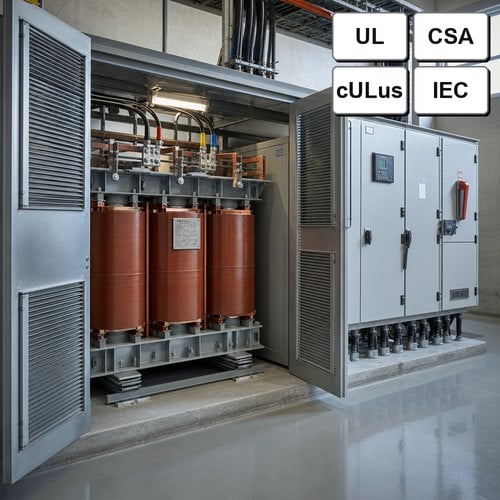
A consultant in Johor specified 630 kVA, 11 kV to 433 V, 50 Hz, 4.5% impedance. A US integrator read the same 600 kVA load schedule and ordered 750 kVA, 13.8 kV to 480Y/277 V, 60 Hz, 5.75%. Both engineers were correct. The trouble started three weeks later, when a project manager compared the two quotes line by line and asked why the American unit cost 22% more for a load that had not changed.
That question sits at the centre of IEC vs ANSI transformer ratings, two rating ladders that look interchangeable on a spreadsheet and are not. The kVA number is only the entry point. Insulation level, temperature rise basis, impedance tolerance and the enclosure standard all move once you cross from one ladder to the other, and each of them has a price attached. Here is what actually changes, using numbers from units we have built.
Two Rating Ladders That Only Look Alike
IEC 60076-1 builds its preferred rating series on the R10 ladder: 100, 125, 160, 200, 250, 315, 400, 500, 630, 800, 1000, 1250, 1600, 2000 and 2500 kVA. The steps are roughly 25% apart, which suits a market where the transformer is sized against a calculated load and the next size up is a small increment. IEEE C57.12.00 works from a shorter list for three phase distribution units: 500, 750, 1000, 1500, 2000, 2500 kVA. The gaps are 50% at the bottom and 33% in the middle. A 720 kVA load therefore lands on 800 kVA in an IEC design and on 1000 kVA in an ANSI one, because 750 kVA is not enough and there is nothing between 750 and 1000. That gap is the first place IEC vs ANSI transformer ratings cost a project money, and it happens before anyone opens the insulation level discussion.
| Calculated load | IEC 60076 selection | ANSI / IEEE selection | What the buyer actually pays for |
| 600 kVA | 630 kVA | 750 kVA | 19% more copper and core, larger tank, higher freight weight |
| 720 kVA | 800 kVA | 1000 kVA | One full step: 25% more capacity than the IEC answer |
| 1250 kVA | 1250 kVA | 1500 kVA | 20% more capacity, plus a bigger LV breaker frame |
| 1900 kVA | 2000 kVA | 2000 kVA | The two ladders meet, and the quotes converge |
An ANSI unit is not simply a bigger IEC unit. The extra capacity usually comes with a higher insulation level and tighter loss expectations, which is where most of the price gap is buried. When a buyer compares a 630 kVA and a 750 kVA quote in dollars per kVA, the smaller unit always looks cheaper. It is cheaper because it is a different product.
Current, Breaker Frames and the Number Buyers Compare
Full load current is the one figure that travels cleanly between the two systems, and it is the one most load schedules leave out. For a three phase transformer, current in amps equals kVA multiplied by 1000, divided by 1.732 times the line voltage. Run the two regional answers through that formula and something useful appears.
| Rating | Voltage | Full load current | Typical LV device |
| 630 kVA (IEC) | 400 V | 909 A | 1000 A frame |
| 630 kVA (IEC) | 415 V | 876 A | 1000 A frame |
| 630 kVA (IEC) | 433 V | 840 A | 1000 A frame |
| 750 kVA (ANSI) | 480 V | 902 A | 1000 A frame |
| 800 kVA (IEC) | 400 V | 1155 A | 1250 A frame |
| 1000 kVA (ANSI) | 480 V | 1203 A | 1250 A frame |
The 630 kVA unit at 433 V and the 750 kVA unit at 480 V carry almost the same current, 840 A against 902 A, and both land on a 1000 A frame. That is why a buyer reading only the current column concludes the units are equivalent. They are 19% apart on capacity, and on a liquid immersed unit that difference shows up as roughly 150 kg to 250 kg of additional core and winding steel, a taller tank, and a different freight class.
Where it hurts is at the boundary. A 1000 kVA ANSI unit pulls 1203 A, so the primary protection per NEC 450.3 lands on a 1250 A frame with 1600 A busbar and cable lugs to match. Move that same load to a 415 V IEC system and the current climbs to 1391 A, which pushes the design onto a 1600 A frame. The transformer kVA did not change. The switchgear, the cable and the installation labour did.
IEC vs ANSI Transformer Ratings: Where the Specs Really Diverge
Below the rating ladder sit four parameters that decide how the unit is actually built. A quote that names only kVA and voltage ratio leaves all four to the supplier's default, and the default is whatever is cheapest in that factory's standard line.
| Parameter | IEC 60076 basis | IEEE / ANSI basis | Effect on the delivered unit |
| Insulation level | Um 12 kV: 75 kV lightning impulse | 15 kV class: 95 kV BIL | 27% higher withstand, longer creepage, larger bushings, more oil |
| Temperature rise | 65 K average winding, 60 K top oil, 40 C maximum ambient, 20 C annual average | 65 C average winding, 55 C top oil, 40 C maximum, 30 C average | Less top oil margin in the ANSI design, so cooling and radiator area grow |
| Impedance tolerance | Plus or minus 7.5% below 10% Z, plus or minus 10% at or above 10% Z | Plus or minus 7.5% | Fault current and parallel operation shift with the built value, not the declared one |
| Loss guarantee | Plus 15% on total losses, no negative tolerance | Guaranteed values with measured verification on the routine test | Two units at the same kVA can differ by tens of kW at full load |
The insulation level is the line most often copied wrong. An 11 kV IEC winding tested at 75 kV impulse is a legitimate design; put the same core and coil into a 13.8 kV ANSI package and the specification now asks for 95 kV. That is not a paperwork change. Clearances to the tank wall, bushing length, phase spacing and oil volume all move, and on a pad mounted unit the whole assembly has to fit inside an envelope defined by IEEE C57.12.34, which sets compartment dimensions and tamper resistance for three phase pad mounted transformers.
Frequency adds a second layer. A core designed for 50 Hz has more turns per volt than a 60 Hz core of the same rating, so running a 50 Hz design on a 60 Hz system is thermally safe and slightly quieter. The reverse is not true. A 60 Hz unit placed on a 50 Hz system has to come down to about 83% of rated voltage to hold flux density, which takes about 17% of its kVA with it. We see this on equipment moved from North America to the Middle East, and it is always cheaper to catch it in the specification than on site.
The Fault Current Conversation Nobody Has at Quotation Stage
Now put the two units side by side on transformer impedance. The 630 kVA IEC unit at 4.5% delivers 909 divided by 0.045, or 20.2 kA of bolted fault current at the secondary terminals. The 750 kVA ANSI unit at 5.75% delivers 902 divided by 0.0575, or 15.7 kA. The larger transformer produces 29% less fault current, and nobody notices because the kVA number went up rather than down.
That single difference decides the interrupting rating of every downstream panel, the settings of the main breaker, and the incident energy printed on the arc flash label. It also explains why a European-designed package sometimes arrives with switchgear rated for 25 kA that is perfectly adequate, while a North American package with the looser impedance needs 22 kA gear checked case by case.
Tolerance makes the transformer impedance calculation softer than the drawing suggests. A declared 5.75% allows the factory to ship anything from 5.32% to 6.18% under both standards, which is 17.0 kA down to 14.6 kA at 480 V. Neither brick is defective. If the study was run at the declared value, the study is describing a transformer that may never exist. We put the impedance measured during the routine test on the test report for exactly this reason, and we encourage buyers to hand that measured figure to whoever runs the short circuit study.
What Actually Changes in the Factory
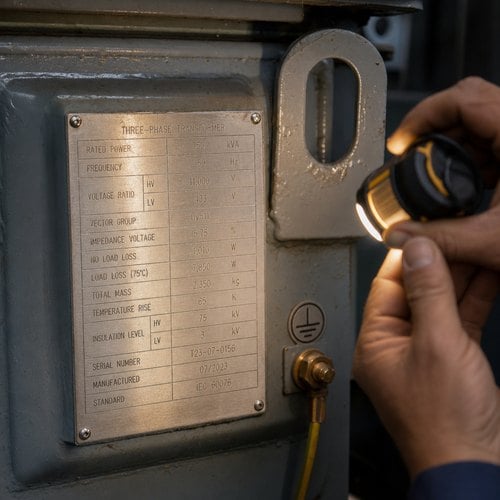
The nameplate in the photograph above is a hybrid, and we build a few of them every quarter: 750 kVA, 11 kV to 433 V, 50 Hz, Dyn11, 5.75% impedance, 65 K rise, 75 kV impulse, IEC 60076. Every line on it is legal. The 750 kVA came from an ANSI load schedule, the 11 kV and 50 Hz came from the site, and the 75 kV impulse came from the IEC basis. A buyer who inherits that unit without the drawing will assume it is an ANSI transformer, because 750 kVA is not an IEC preferred rating, and then specify 95 kV BIL for the spare.
Once a unit crosses the ladder, the shop changes more than the nameplate. A 750 kVA ANSI design at 95 kV BIL needs a wider core window and more end insulation than a 630 kVA IEC design, which changes the tank, the lifting arrangement and the transport weight. The LV winding moves from a 1000 A to a 1200 A class of busbar. The tap range is usually two 2.5% taps above and two below, so the tap changer, the lead exits and the no-load loss at each tap all get recalculated.
On the US side there is also an efficiency floor: 10 CFR 431 sets maximum losses for distribution transformers, so a 750 kVA liquid immersed unit sold into Texas is built with a better core grade than the same kVA sold into a market with no efficiency regulation. That is a real cost line, and it is invisible in a quote that only lists kVA and price.
How We Quote the Same Load Twice
The IEC vs ANSI transformer ratings question usually arrives attached to a custom three phase transformer enquiry, and our rule is to quote both ladders rather than argue for one. When a buyer sends an IEC rating with an ANSI voltage, or the reverse, we return two columns: the unit as specified, and the nearest preferred rating in the other system, with the loss, impedance and physical differences called out. Nine times out of ten the buyer keeps the original kVA once they see that the alternative changes the switchgear or the pad.
This is where the manufacturing base matters more than the catalogue. Ryan Electric has built to both ladders since 2007 from a 120,000 m2 plant with 180 sets of production equipment and 37 patents, and since 2023 the joint venture with Eaton has put the same engineering team on UL listed and IEC designs rather than running two separate lines. A 630 kVA IEC unit and a 750 kVA UL listed unit can be reviewed by the same engineer on the same day, which is the only reliable way to keep the comparison honest.
Six Lines That Settle It Before the Purchase Order
Most IEC vs ANSI transformer ratings mismatches we see arrive through what the enquiry leaves out. Add these lines to the RFQ and the supplier has no room to pick the cheaper ladder silently.
- Name the standard and the edition, not just the letters: IEC 60076-1:2011 or IEEE C57.12.00-2021.
- Give rated power, voltage ratio, frequency and the site ambient, both maximum and annual average.
- State the insulation level in kV, impulse and power frequency, not as "standard BIL".
- State impedance and its tolerance, and ask for the measured value on the routine test report.
- State the loss basis and the efficiency regime: DOE 10 CFR 431 for the US, EU 2019/1783 for Europe.
- Name the enclosure standard where it exists, IEEE C57.12.34 for a three phase pad mounted unit, or the IEC kiosk drawing.
Send a load schedule and a site data sheet with those six items and the comparison becomes arithmetic instead of opinion. Our application team reviews both ladder options against your single line diagram and returns the measured loss and impedance figures with the quotation. Start with the oil immersed transformer range or the dry type line, or send the schedule directly through the contact form at www.ryantransformers.com.
About the Author
This article was prepared by the Application Engineering Team at Ryan Electric (Jiangsu Ryan Electric Co., Ltd.), a transformer manufacturer in China supplying oil immersed, dry type and pad mounted transformers to North America, the Middle East, Southeast Asia and Africa since 2007. The team reviews rating, insulation level and impedance questions on custom three phase units, and prepares routine and type test documentation, and UL / cULus / CSA / IEEE / IEC certification packages for utility, data center and industrial projects. Drawing reviews and specification questions can be sent through the contact form at www.ryantransformers.com. Last reviewed: October 2026.
Disclosure: Ryan Electric manufactures and sells the transformers discussed in this article. Standard references (IEC 60076-1:2011, IEC 60076-3, IEEE C57.12.00-2021, IEEE C57.12.34, 10 CFR Part 431) are summarised for engineering discussion only. Confirm the applicable edition and the local authority requirements for each project.
Table of Contents
- Two Rating Ladders That Only Look Alike
- Current, Breaker Frames and the Number Buyers Compare
- IEC vs ANSI Transformer Ratings: Where the Specs Really Diverge
- The Fault Current Conversation Nobody Has at Quotation Stage
- What Actually Changes in the Factory
- How We Quote the Same Load Twice
- Six Lines That Settle It Before the Purchase Order