
 EN
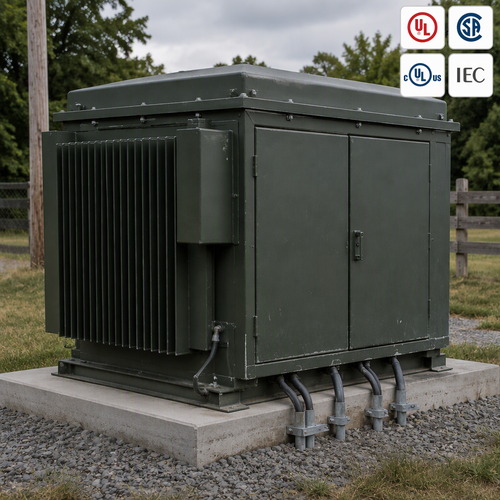
A developer in Houston sent the same 1500 kVA, 13.8 kV to 480Y/277 V specification to four suppliers last spring. The quotes came back between $38,400 and $61,900 for what the drawings called an identical unit. All four bidders held a UL listing, all four promised 12 to 16 weeks, and none of them had made an arithmetic mistake.
That spread is what buyers are really asking about when they search for a pad mounted transformer price. The number is not set by the kVA rating. It is set by how much copper and grain-oriented steel went into the unit, how much loss the design is allowed to carry, what the enclosure has to survive, and which certification file the factory has to open. Once you know where the money sits, a 60% gap between quotes stops looking like a scam and starts looking like a specification problem.
Five Buckets That Make Up a Pad Mounted Transformer Price
Strip out freight and margin and a pad-mounted unit is five cost buckets. These are the shares we see in our own cost sheets for 500 kVA to 2500 kVA liquid-filled units built to IEEE and CSA requirements.
| Cost bucket | Share of factory cost | What moves it |
| Core, grain-oriented silicon steel | 22-26% | Flux density, number of core steps, wound versus stacked |
| Windings | 30-35% | Copper or aluminum, current density, 55C or 65C rise |
| Tank, radiators, enclosure | 18-22% | Steel gauge, paint system, compartment layout, tamper resistance |
| Insulation, oil, accessories | 10-14% | Oil volume, bushings, gauges, fusing, pressure relief |
| Labour, testing, certification | 8-12% | Winding automation, test regime, UL and CSA file work |
Two lines in that table explain most of the variance. Core and windings together are roughly 55% of the bill, and both are sized by the loss target rather than by capacity. A supplier quoting 20% under the field is rarely shaving labour. They are putting less metal in the window and accepting higher loss, or they moved to aluminum without telling anyone.
Core and Copper: Where 55% of the Cost Sits
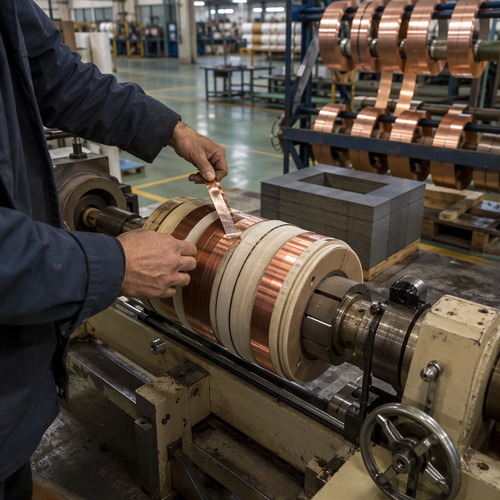
Copper sits at 100% IACS conductivity. Aluminum is about 61%. To hold the same DC resistance, an aluminum winding needs roughly 1.64 times the conductor cross-section while weighing about half as much. That single ratio drives the whole copper vs aluminum winding argument, and it is the reason two units with identical nameplates can differ by thousands of dollars.
| Metric | Copper winding | Aluminum winding |
| Conductivity | 100% IACS | 61% IACS |
| Conductor mass for equal loss | 1000 kg reference | About 480 kg |
| Conductor cost at recent metal prices | Reference | Roughly one sixth |
| Window size for equal loss | Reference | About 25% larger |
| Behaviour under sustained overload | Greater thermal margin | Hot spot rises faster |
Here is the part most buyers miss: the window. An aluminum design that holds the same transformer no-load loss and load loss needs a larger core window, which pulls the core, tank and oil back up in cost. The saving does not vanish. It shrinks to 8-12% of the unit price, and it is paid back over 20 years in energy.
Why the Efficiency Rule Moves the Price More Than the kVA
In the United States, the efficiency floor for liquid-filled distribution transformers comes from the energy conservation standards in 10 CFR Part 431. The rule sets a ceiling on transformer no-load loss and on load loss at every kVA step. Meeting the cap with a small margin is a different engineering exercise from beating it by 20%, and the difference shows up directly in the quote.
Take a 1500 kVA unit at 13.8 kV to 480Y/277 V. A compliant design might run 1.9 kW no-load loss and 13.8 kW load loss at 75C. Push the same frame to 1.5 kW and 11.6 kW and you need about 8% more copper, one extra core step and a slightly larger radiator bank, which adds roughly $3,200 in factory cost. Whether that is worth paying depends entirely on how you value a kilowatt, and most buyers never run that calculation.
Tank, Enclosure and the Details That Never Reach a Comparison Sheet
The enclosure is where cheap bids hide in plain sight. IEEE C57.12.34 defines the mechanical and electrical requirements for three-phase pad-mounted units, including the tamper-resistant compartment arrangement and the clearances between the high voltage and low voltage sections. A 12-gauge door on a three-point latch and an 11-gauge door on a single latch both pass a drawing review. Only one of them survives a site where someone backs a truck into it.
Then there are the items that never appear in a price-per-kVA table:
- Bayonet fusing or a full load-break elbow set
- Pressure relief valve and liquid level gauge
- Drain valve with oil sampling port
- Stainless steel hardware and a tinned copper ground pad
- Wildlife guards and a three-coat paint system with a zinc-rich primer
Each of those lands between $80 and $400. Add eight of them and you have moved the quote by $2,000 without changing a single rating on the nameplate. That is usually where the polite difference between two bidders lives.
The Loss You Pay for Every Month the Unit Is Energized
Utilities have priced this for decades using loss capitalization: an A factor in dollars per kW for transformer no-load loss and a B factor for load loss. Typical utility values run $5,000 to $8,000 per kW for A and $1,500 to $3,000 per kW for B. Commercial buyers rarely apply the same logic, which is odd, because they pay the bill.
Run the physics on a 1500 kVA unit at 40% average loading. A design with 1.9 kW no-load and 13.8 kW load loss draws 1.9 plus 13.8 times 0.16, which is 4.11 kW. Across 8760 hours that is just over 36,000 kWh a year, or about $3,240 at nine cents. Over 25 years, before any rate increase, the losses cost more than the transformer.
| Item | Bid A | Bid B |
| Quoted price | $41,200 | $47,800 |
| No-load loss | 2.3 kW | 1.6 kW |
| Load loss at 75C | 16.4 kW | 12.9 kW |
| Loss value (A $6,500, B $2,400) | $54,310 | $41,360 |
| Total owning cost | $95,510 | $89,160 |
Bid B is $6,600 cheaper once total owning cost is calculated, and it was the bid that looked expensive on the day of the meeting. Run the same table with a B factor of $1,200 and Bid A wins. That is why the pad mounted transformer price question has no single answer: it depends on your load profile and your electricity rate, both of which only you know.
What Ryan Does Differently on Cost
Ryan Electric has been an Eaton joint venture partner since 2023, and the plant runs 120,000 square meters with more than 180 sets of production and test equipment behind 37 patents. Core cutting, winding, tank fabrication and routine testing all happen under one roof. That matters for pricing because a unit that is not subcontracted twice does not carry two margins.
In practice the useful part is a habit rather than a number. When a buyer sends us a competitor quote to match, we ask which conductor the competing unit uses before we discuss money, because a copper vs aluminum winding choice explains half of a price gap on its own. Then we return two columns on the same drawing: the price at the efficiency level they specified, and the price at the next loss step down, with the annual kilowatt hours for each. The buyer then decides whether the cheaper column is actually cheaper. Roughly a third of them take the lower-loss column once the arithmetic is in front of them, and that ratio has been stable for three years.
One 1500 kVA Order, Two Designs, One Number That Settled It
A utility in western Canada needed 1500 kVA at 27.6 kV to 347/600 V, CSA C227 series, installed on a gravel pad beside a feed mill. The first design used a 65C rise. The second used 55C rise with the same core, which added 9% copper and $2,600 to the price. The utility took the second one, because the lower rise let the unit carry 118% of nameplate continuously through the mill's harvest season without tripping the winding temperature alarm.
That is the pattern worth remembering. The useful question is never whether a quote is high. It is which of the five cost buckets the money went into, and whether your load profile cares. Two units can be identical on a datasheet and fourteen thousand dollars apart in what they will cost you by 2050.
Send us the drawing and the load profile. We will come back with the loss figures, the total owning cost at your electricity rate, and a firm pad mounted transformer price inside 48 hours, UL listed or CSA certified as your project requires, through the contact form at www.ryantransformers.com.
About the Author
This article was prepared by the Application Engineering Team at Ryan Electric (Jiangsu Ryan Electric Co., Ltd.), a transformer manufacturer in China supplying oil immersed, dry type and pad mounted transformers to North America, the Middle East, Southeast Asia and Africa since 2007. The team reviews rating, loss and total owning cost questions on custom three phase units, and prepares routine and type test documentation and UL / cULus / CSA / IEEE / IEC certification packages for utility, data center and industrial projects. Drawing reviews and specification questions can be sent through the contact form at www.ryantransformers.com. Last reviewed: October 2026.
Disclosure: Ryan Electric manufactures and sells the transformers discussed in this article. Standard references (IEEE C57.12.34, IEEE C57.12.00, 10 CFR Part 431) are summarised for engineering discussion only. Cost shares quoted in this article are drawn from the company cost sheets for 500 kVA to 2500 kVA liquid-filled units and vary with copper and steel prices.
Table of Contents
- Five Buckets That Make Up a Pad Mounted Transformer Price
- Core and Copper: Where 55% of the Cost Sits
- Why the Efficiency Rule Moves the Price More Than the kVA
- Tank, Enclosure and the Details That Never Reach a Comparison Sheet
- The Loss You Pay for Every Month the Unit Is Energized
- What Ryan Does Differently on Cost
- One 1500 kVA Order, Two Designs, One Number That Settled It