
 EN
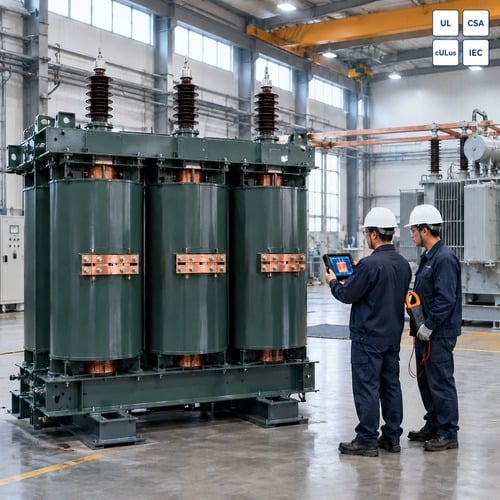
The most expensive line in a transformer purchase is not the price. It is the purchase order signed after a video tour, a PDF catalogue, and three reference photos that later turn out to belong to somebody else's plant. We have watched buyers audit a unit after it failed on site, and we have watched them audit the plant before the PO was drafted. The second group sleeps better.
Here is the uncomfortable part: most oil immersed transformer factory in China checks stop at the reception desk. Certificates get photographed, tea gets drunk, a winding hall gets walked through, and everyone flies home convinced. Six months later the tank arrives with a nameplate that does not match the drawing. This article is the checklist we would use ourselves if we were buying from a competitor.
What a Factory Tour Actually Proves
A tour proves a building exists and that people work inside it. It does not prove that the company which issued your proforma invoice owns that building, employs those winders, or can run a temperature-rise test on a 40 MVA unit. Those are three separate facts, and only the first one is visible from a visitor chair.
Start with the entity. Ask for the business licence scan and read the scope line: a manufacturer's scope names transformer design and manufacture, while a trading company's names import and export. Ask, casually, what VAT invoice type they issue. A genuine plant issues the 13% special manufacturing invoice; a pure trading desk usually cannot. Then compare the licence address against the address on the factory gate, not against the address on the website.
Layer 1: Documents Worth Reading Before You Book a Flight
ISO 9001 is the first document everyone asks for and the last one anyone reads properly. Look at the scope sentence, not the logo. It should name transformer design and manufacture, and the certification body should be CNAS-accredited so the certificate can be verified on the issuing body's own query page rather than on the PDF the salesperson emailed you.
Type test reports are where the real information sits. Four fields matter: the accredited laboratory, the report date, the rating tested, and the serial number of the unit that was tested. A report for a 20 MVA unit tells you almost nothing about the 40 MVA unit in your enquiry. IEEE C57.12.90 lists what a full routine and type test set actually contains: winding resistance, ratio, no-load loss and excitation current, impedance and load loss, dielectric tests, temperature rise, short-circuit withstand, and sound level. Ask which of those exist as measured values in watts, kelvin and pC, for a sister unit of your rating.
Certificates deserve their own paragraph, because this is where otherwise careful buyers get fooled. A UL mark photographed on the tank of an oil-immersed unit frequently belongs to a bushing, a pressure relief device or a control component rather than to the transformer itself. If a UL listed transformer supplier claim is doing the heavy lifting in a quotation, ask for the file number and the product category printed on the certificate, then read the category out loud. Oil-immersed distribution and power transformers are usually specified and tested to IEEE C57.12.00 and C57.12.90 or to the IEC 60076 series, so a clean IEEE or IEC 60076-1 test package is worth more than a logo.
Layer 2: Inside an Oil Immersed Transformer Factory in China
A transformer factory audit without a test bay walk is a supplier visit with better catering. Six pieces of equipment separate a plant from an assembly shed, and every one of them can be confirmed in about forty minutes. This is also the fastest way to test a UL listed transformer supplier claim without arguing about logos on a catalogue cover.
| What to look at | What the number tells you | What to ask for |
| Impulse generator | Maximum lightning impulse voltage available in house, e.g. 150 kV, 250 kV or 400 kV | The BIL class of your unit against the generator ceiling. A 34.5 kV class winding is commonly specified at 200 kV BIL; if the generator tops out at 150 kV, that test is subcontracted or quietly skipped |
| PD shielded room | Background noise floor in pC before the unit is energised | A background below 5 pC and a written acceptance limit, typically 10 pC at 1.5 Um/√3 for the induced voltage test |
| Temperature-rise capability | Largest kVA the bay can run at full load for a full heat run | The test sheet from the biggest unit they ran in the last year, with the rise in kelvin and the ambient recorded |
| Loss measurement set | Calibrated power analyser, CT and VT class, and calibration date | Calibration certificates dated within twelve months, and the guaranteed no-load and load loss figures in watts that your PO will reference |
| Oil laboratory | Breakdown voltage tester, moisture meter, tan delta and DGA capability | The batch test sheet for the oil going into your tank: breakdown voltage, moisture in ppm, tan delta |
| Winding and drying plant | Automatic winders, vapour-phase drying autoclave diameter and length | Autoclave dimensions against your core-coil assembly; a 3 m diameter vessel cannot dry a large power transformer core |
Two of these deserve a closer look. On impulse, the specification is only as good as the generator standing behind it, and a plant that cannot demonstrate the BIL class of your winding in its own bay is telling you something about the class of work it normally does. On oil, most project specifications call for a breakdown voltage of at least 60 kV on a 2.5 mm gap and moisture below 20 ppm before filling, but the number that matters is the one printed on the batch sheet for the oil in your tank, not the one in the brochure.
Layer 3: Capacity, Lead Time, and the Numbers Behind the Promise
Capacity is a number, not a feeling. Ask any oil immersed transformer factory in China for monthly throughput in MVA across the last twelve months, the count of winding stations, and overhead crane capacity in tonnes. A 60 MVA oil-immersed unit with tank, oil and fittings can pass 70 t, and a 32 t crane cannot load it onto a flatbed no matter what the sales email says. If the crane rating and the largest unit in their reference list disagree, believe the crane.
Lead time should come as a gate schedule, not a sentence. Design approval, core cutting, winding, vapour-phase drying, tanking and oil filling, routine tests, factory acceptance test, packing. Once those gates are dated, the liquidated damages clause becomes a real instrument rather than decoration: 0.5% of contract value per week of delay, capped somewhere between 5% and 10%, is a normal ask in 2026 and a plant that refuses the clause outright is telling you what it thinks of its own schedule.
Witnessed testing belongs in the commercial terms, priced and named, not requested three weeks before shipment. Decide now whether you or your third-party inspector will attend the routine tests, and write into the PO which tests stop the clock for your review. Witnessed testing that is negotiated after the fact tends to happen at whatever hour suits the factory.
The Twelve Checks and Five Red Flags
Compress the whole visit into twelve questions you can answer with evidence rather than impressions: licence scope, VAT invoice type, ISO scope sentence, accredited type test report with serial number, certificate file number and product category, impulse generator ceiling against your BIL, PD room background, heat-run capacity, loss measurement calibration, oil batch sheet, crane rating, gate schedule with LD clause.
Run this list twice, once on paper and once on foot, and it functions as a full transformer factory audit for a fraction of the cost of a failed tank. Then watch for the five signals that end the conversation. The plant that will not accept a second, unannounced visit. The same workshop photographs appearing under two company names. The sentence "our partner factory builds that model for us." Test reports with no serial number. And the proforma invoice issued by a Hong Kong entity while the "factory" turns out to be a 300 m² unit with a spray booth and no test bay. Any single one of these is survivable. Two of them together means you are buying from a broker.
What We Open Up at Ryan Electric
Our own plant runs 120,000 m² with more than 180 sets of production and test equipment and 37 patents, covering oil-immersed transformers from 10 kV to 200 MVA alongside cast resin and VPI dry-type units, with UL, CSA, IEEE, DEKRA, CNAS and CE documentation behind them. Since 2023 we operate as an Eaton joint-venture partner, which in practice means our process records get audited by someone other than our own customers.
When a buyer asks us for an audit pack, we send the licence, the certificates including scope pages, the equipment list with crane and autoclave ratings, redacted test reports with serial numbers intact, and the gate schedule for the requested rating. If your current supplier hesitates on any one of those five, you have your answer.
Send us your rating, voltage class, BIL and destination, and we will return a datasheet with guaranteed losses in watts plus the test list we propose to run in front of your inspector. That is a cheaper conversation than the one you have after a tank lands with the wrong nameplate.
About the Author
This article was written by the export application engineering team at Ryan Electric (瑞安电气), which reviews factory acceptance test reports, nameplate data and supplier audits for utility, EPC and data centre buyers across North America, the Middle East, Southeast Asia and Africa. The team's standing rule for any supplier claim is simple: show the number, the standard clause, and the serial number of the unit it came from.
Table of Contents
- What a Factory Tour Actually Proves
- Layer 1: Documents Worth Reading Before You Book a Flight
- Layer 2: Inside an Oil Immersed Transformer Factory in China
- Layer 3: Capacity, Lead Time, and the Numbers Behind the Promise
- The Twelve Checks and Five Red Flags
- What We Open Up at Ryan Electric
- About the Author