
 EN
Last spring an integrator in Apodaca took delivery of a 1,000 kVA pad-mounted unit for a new industrial park outside Monterrey. The transformer arrived on schedule, passed every factory test, and then sat in a bonded warehouse for nineteen days. The reason was one line in the documentation package: the NOM certificate covered a 750 kVA rating and a different enclosure type. Nothing was wrong with the machine. The NOM certified transformer in the purchase order and the transformer in the crate were not the same product on paper.
Near-shoring has pushed a wave of plant construction into Nuevo Leon, Coahuila and Queretaro, and every one of those projects ends with distribution transformers that must carry a NOM mark before the local utility will energize them. This is not a US unit with a Spanish sticker added at the dock. The certificate, the tested design and the nameplate have to line up, and the Mexican standard that governs the alignment is narrower than most first-time buyers expect.
What NOM-002-SEDE/ENER-2014 Actually Covers
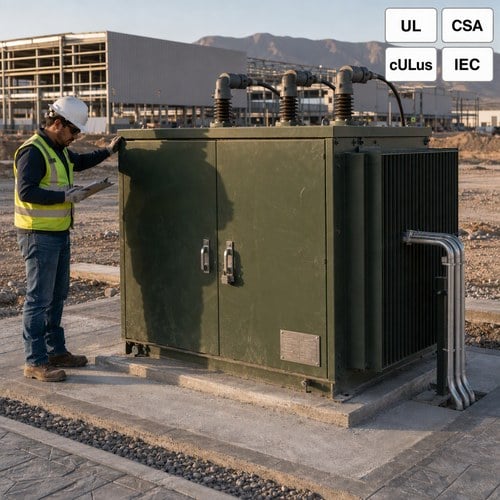
The governing instrument is NOM-002-SEDE/ENER-2014, the official Mexican standard for safety and energy efficiency of distribution transformers. Its scope is specific: pole-type, substation-type, pedestal-type and submersible units, self-cooled in insulating liquid. It sets minimum allowable efficiency and maximum total losses referenced to an 80 percent load factor, expressed in percent efficiency and in watts respectively, and it applies to units placed on the national market, including equipment that has been repaired, reconstructed or reinstalled for sale. The scope and efficiency basis are summarised in the IEA policy database.
Two details catch first-time exporters. The first is the 80 percent load factor. Efficiency is declared at a defined operating point, not at nameplate load, so a design that reads well at 100 percent load can still miss the table at 80. The second is the rebuilt clause. A rewound or reconstructed unit offered for resale falls inside the standard, which is why the used-transformer trade into Mexico is far less casual than the same trade inside the United States.
Dry-type units sit outside this particular NOM, but that does not create a loophole. A dry-type transformer installed in a Mexican facility still needs the applicable NOM conformity for its construction and installation, and the project's electrical inspector will ask for the certificate before sign-off. The standard number changes with the product family. The requirement to prove conformity does not.
Why a UL or CSA Label Does Not Transfer to Mexico
UL and CSA marks are North American safety marks issued under US and Canadian schemes, and they are excellent evidence that a design was tested by a recognised laboratory. They are not the legal instrument in Mexico. Mexican conformity is demonstrated through a NOM certificate issued by an accredited certification body, and the certificate is what the importer presents when the unit is stopped at the border or challenged by the utility.
ANCE is the best-known electrical certification body in the country and operates its own laboratories; UL de Mexico and Intertek also issue NOM certificates for transformer families. All three work the same way in practice: the certificate names a manufacturer, a plant, a product family and a defined range of ratings. Step outside that range and the certificate stops applying, even if the physical design is identical. That is exactly the gap that cost the Apodaca project nineteen days.
The commercial consequence is worth stating plainly. A UL listed transformer supplier can be completely legitimate in Ohio and still be unable to deliver a compliant unit to Nuevo Leon, because compliance is a document issued against a scope, not a reputation earned elsewhere.
The Three Documents a Buyer Checks Before the Crew Wires Anything
Our Mexican customers ask for the same three items every time a NOM certified transformer is quoted, and the order matters. First the certificate, with the rating range and plant address visible. Second the type test reports that support the declared losses and temperature rise, traceable to the design being shipped rather than to a predecessor. Third the nameplate artwork in Spanish, reviewed before production rather than after crating.
| Requirement | United States | Canada | Mexico |
| Conformity mark | UL or ETL listing | cUL / CSA mark | NOM certificate and NOM mark |
| Product standard | UL 1561 or UL 1562, IEEE C57.12 series | CSA C22.2 construction, NRCan efficiency levels | NOM-002-SEDE/ENER-2014 with NMX-J-116-ANCE |
| Efficiency basis | DOE tables at 50% load | NRCan tables | Minimum efficiency and maximum losses at 80% load |
| Nameplate language | English | English and French | Spanish |
| Who holds the paper | Manufacturer listing file | Manufacturer certification file | Certificate against a named plant and rating range |
| Typical failure mode | Wrong voltage or listing scope | Missing provincial approval | Certificate does not match the shipped rating |
NMX-J-116-ANCE: The Product Standard Sitting Behind the Certificate
A NOM certificate does not float free of a technical standard. For pole-type and substation-type distribution transformers, the referenced Mexican product standard is NMX-J-116-ANCE, which addresses construction, insulation levels, tap arrangements, impedance and the test regime that the certification body witnesses. When a buyer asks whether a design is quotable for Mexico, this is the document our design team opens first, because the differences from an IEEE build are small but they are not optional.
Above that layer sits CFE, the national utility and by far the largest single buyer of distribution transformers in the country. CFE tenders add their own technical sheets on top of the NOM: specified impedances, loss values, paint systems, test protocols and supplier registration requirements. Supplying a private industrial park in Monterrey and supplying CFE are two different commercial exercises, and a factory that has done the first should not assume it has done the second.
Where Projects Lose Weeks: Rating Scope, Language and Customs
The NOMs themselves are published in the Diario Oficial de la Federacion, and the DOF is the record that settles arguments about which edition is in force and when a revision takes effect. Certificate validity, standard revisions and transitional periods all trace back to that publication, which is why a supplier who says the rule changed last month should be able to point at a date.
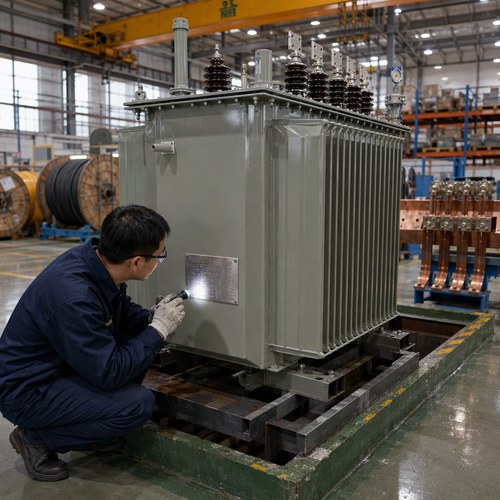
In our experience the delays cluster in three places, and none of them is technical. The rating range on the certificate does not include the kVA or voltage combination that was actually ordered. The nameplate is drafted in English and reprinted at the last minute, which restarts the documentation review. Or the certificate PDF never made it into the shipment folder, so the customs broker cannot file and the container waits at the yard.
The fix is procedural rather than expensive. Decide at the quotation stage that the units are for Mexico, put the exact ratings and enclosure type into the certification request, and treat the certificate number as a line item on the commercial invoice alongside the HS code. Four to six weeks is a realistic allowance when a design is not already covered; zero weeks is realistic only when it is.
When a NOM Certified Transformer Is the Right Order
Order the NOM variant whenever the unit will be energized on Mexican soil: new industrial parks, cold-storage and food plants along the border corridor, data centre shells in Queretaro, and any project where the local utility or the electrical inspector signs the energization permit. Order it also for rebuilt or resold equipment, since the standard reaches reconstruction as well as new manufacture. There is no practical shortcut, because the barrier is a document review, not a physical inspection that a persuasive argument can pass.
A standard export build still makes sense for equipment that stays north of the border, and for spares held in a US warehouse against a Canadian or American site. What does not make sense is buying from a UL listed transformer supplier for a Mexican project and expecting the US listing to count on the far side of the border. That plan converts a two-week administrative task into a warehouse bill and a revised commissioning date.
Ryan Electric builds for all three markets. The plant covers 120,000 square metres with more than 180 sets of production and test equipment and 37 patents, and works to UL, CSA, IEEE, DEKRA, CNAS and CE schemes, with witnessed routine testing available on request. The company has operated as a joint venture partner of Eaton since 2023. For Mexican projects we quote the NOM certified transformer variant directly, align the design with the NOM-002-SEDE/ENER-2014 loss tables and handle conformity assessment through an accredited body so the certificate scope matches what is crated.
Send us the single-line diagram and the destination state, and we will tell you which documents your project needs and where the rating range has to be widened before the order is placed. Reach the engineering desk at [email protected] or through the contact form on this site.
About the Author
This article was prepared by the engineering content team at Ryan Electric (Jiangsu Ryan Transformers), a manufacturer of dry-type, oil-immersed and pad-mounted transformers supplying utilities, EPC contractors and industrial developers across North America, the Middle East and Southeast Asia. The team works directly with our design, certification and test departments on export documentation, efficiency declarations and conformity submissions, and writes from production experience rather than from catalogue copy. Questions on Mexican conformity documentation can be directed to [email protected].
Table of Contents
- What NOM-002-SEDE/ENER-2014 Actually Covers
- Why a UL or CSA Label Does Not Transfer to Mexico
- The Three Documents a Buyer Checks Before the Crew Wires Anything
- NMX-J-116-ANCE: The Product Standard Sitting Behind the Certificate
- Where Projects Lose Weeks: Rating Scope, Language and Customs
- When a NOM Certified Transformer Is the Right Order
- About the Author