
 EN
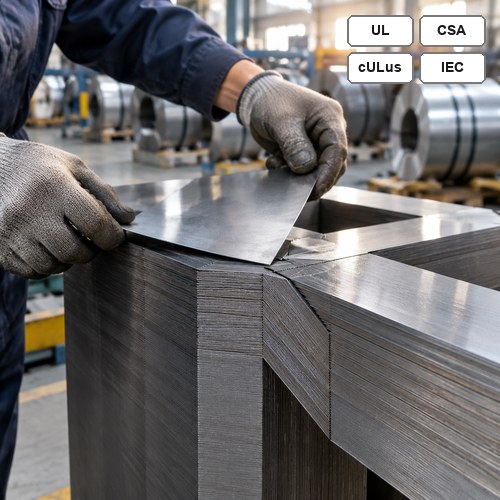
Two quotes for the same 1,500 kVA pad-mounted unit landed on a buyer's desk in Houston last month. Same kVA, same 13.8 kV delta to 480Y/277 V, same 95 kV BIL, same UL listing. Nineteen percent apart on price, and eight weeks apart on delivery.
We asked both suppliers for the core data sheet. One quoted grain-oriented electrical steel at M-4, 0.30 mm. The other quoted M-3, 0.27 mm. That one line explained most of the gap.
As a distribution transformer manufacturer, we see this every week. The core is about a fifth of the material cost and the majority of the no-load loss, yet it is usually the last thing anyone asks about before signing.
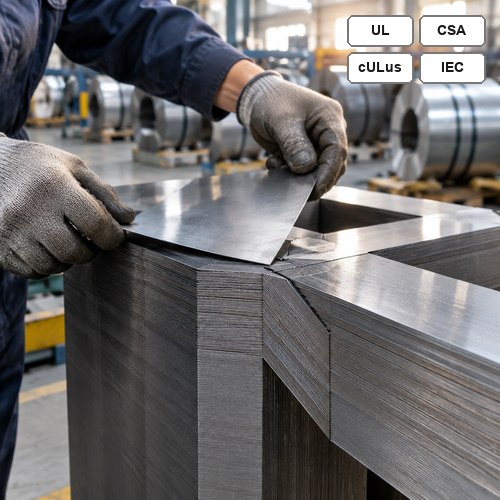
Grain-oriented core stacking on the lamination line
What Grain-Oriented Electrical Steel Actually Is
Grain-oriented electrical steel — CRGO on most purchase orders — is a low-carbon silicon-iron alloy with roughly 3.15% silicon, rolled and annealed so the crystal lattice lines up in a Goss texture along the rolling direction. That alignment is the entire point of the material. Along the rolling direction it magnetizes easily. Across it, it does not.
A core built from CRGO is a magnetic circuit with a preferred path, and every cut, joint and bolt hole in the finished stack works against that path. This is why core design matters as much as core grade, and why a cheap coil can still produce an expensive transformer.
Two loss mechanisms matter at 50 or 60 Hz. Hysteresis loss depends on the alloy and the quality of the anneal. Eddy-current loss depends on lamination thickness, which is why distribution cores are built from 0.23 to 0.30 mm sheet rather than the 0.5 mm sheet used in cheap small transformers. More silicon raises resistivity and cuts eddy current; thinner sheet cuts it further again. Modern mills also laser-scribe the surface to refine magnetic domains, worth roughly 5 to 10% of total core loss on the identical grade.
ASTM A876/A876M is the specification most purchase orders reference for fully processed grades. Here is the range buyers actually see:
| Grade | Nominal thickness | Typical max core loss, W/kg at 1.7 T, 60 Hz | Where it shows up |
| M-2 | 0.23 mm | 0.85 – 0.95 | Premium efficiency units, loss-penalty tenders |
| M-3 | 0.27 mm | 0.95 – 1.05 | The 2029 efficiency workhorse grade |
| M-4 | 0.30 mm | 1.05 – 1.15 | Standard distribution units, short-lead orders |
Read that table as a direction, not a promise. Mill data sheets differ by supplier, and the loss you buy is the loss of the finished core, not the loss printed on the coil tag.
Why Two Distribution Transformer Manufacturers Quote Different No-Load Loss
Two factories can buy the same M-3 coil and ship transformers 12% apart on no-load loss. The difference sits in the building factor — the ratio between the measured loss of the finished core and the theoretical loss of the same weight of uncut steel. A well-run core shop lands between 1.10 and 1.25. Above that, the process is costing you watts you already paid for.
Here is where the watts go. Joint design comes first: step-lap mitered joints at 45 degrees beat butt joints because flux crosses fewer gaps, and a three-step lap beats a single-step lap. Joint count per limb comes second — every additional joint adds reluctance. Bolt holes punched through the yoke are third, since the hole forces flux to divert around it. Burr left by the slitting line is fourth, because burr shorts the interlaminar insulation at the edge. Clamping pressure is fifth: over-torqued core bolts stress the sheet and raise loss.
Annealing is the step buyers rarely ask about. Cutting and shearing damage the grain structure at the edge of every lamination, and a stress-relief anneal after cutting recovers most of that damage. Skip the anneal, or send the core to a subcontractor who runs a mixed batch, and you give back part of what you paid for in the coil.
On our core line, the operator checks burr height with a micrometer on every slit coil before it reaches the cutting table. Anything above 0.02 mm is flagged, because that burr will show up as loss in the final test rather than at the cut, and by then the core is stacked. Stacks are built with a three-step lap, and every core is banded rather than bolted through the yoke.
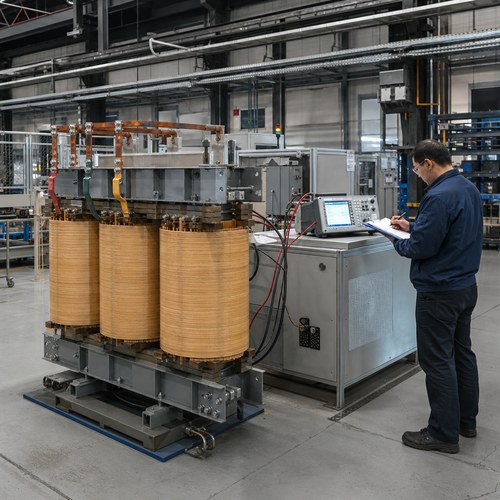
No-load loss and excitation current measurement before tanking
The arithmetic is worth doing once, because it turns a spec argument into a number. A 1,000 kVA unit with 1,200 W of core loss, running 8,760 hours a year at $0.09/kWh, burns about $946 of no-load energy every year. Ten percent of building factor, 120 W, is $95 a year — roughly $1,900 over a 20-year life, on a single transformer. Multiply that across a fleet of forty units and the core spec stops looking like a detail.
How Core Grade Sets Your Delivery Date
This is the part that surprises procurement teams. In an oil immersed transformer, the core is usually the longest-lead bought-in material, ahead of the tank and sometimes ahead of the bushings. Grain-oriented steel is a mill product sold on annual allocation contracts, and the 0.27 mm high-permeability grades are the tightest slice of that allocation, because every manufacturer chasing the 2029 efficiency tables wants the same coil.
So when a supplier offers to pull six weeks out of the schedule by moving from M-3 to M-4, they are probably not exaggerating about the schedule. They are trading your no-load loss for their mill position. If the project carries a loss evaluation clause, that trade usually loses money across the life of the unit. If the project is temporary site power due in ten weeks, taking M-4 may be exactly right. The mistake is making that trade by accident because nobody asked which grade was quoted.
Regulation now sits inside that calculation. Under 10 CFR 431.196, liquid-immersed and low-voltage dry-type distribution transformers manufactured on or after 23 April 2029 must meet the amended efficiency tables, and the current text is published at the eCFR 10 CFR Part 431 Subpart K. A unit ordered in 2028 for a 2029 energization sits directly on that line, and the core grade is where compliance is actually bought — not in the nameplate or the catalogue.
That has a procurement consequence worth flagging early. If you are buying a 2029-ready unit in 2026 or 2027, you are effectively reserving M-3 allocation two to three years ahead of the compliance date, in competition with every other buyer who read the same rule.
Reading the Loss Guarantee in a Quote
Guaranteed and typical are not the same number, and quotes rarely say which one they mean. IEC 60076-1 permits a tolerance of +15% on guaranteed losses, so a 1,200 W guarantee legally covers 1,380 W. If you are writing a penalty clause, write it against the guaranteed figure, measure it by the no-load loss method in the current IEEE C57.12.90 test code, and cap the tolerance in the purchase order.
We publish the guaranteed value with the tolerance already inside it. If the design calculates 1,180 W, the guarantee says 1,180 W and the factory test has to land at or under that number. It is a harder promise to make, and it removes an argument at acceptance testing. It also forces the core shop to hold building factor low all year, which is the point.
Two more things to check in a quote. First, whether load loss is corrected to a 75 °C or 85 °C reference, because the two numbers are not interchangeable and quotes rarely say which convention was used. Second, whether the core weight is listed at all. A 1,000 kVA design that carries 40 kg less core is either built on better steel or built on less steel, and the two outcomes look identical on a one-page quotation.
What We Changed in Our Own Core Shop
Ryan Electric has built transformers since 2007, on a 120,000 m² site with more than 180 sets of production and test equipment and 37 patents. As a distribution transformer manufacturer with core cutting under our own roof, we run oil immersed transformer cores and dry type cores through the same cutting, step-lap stacking and stress-relief annealing lines rather than through a subcontractor. That is the only way we have found to hold building factor repeatably across a production year. Every unit gets a no-load loss and excitation current measurement before it goes to tanking, so a bad stack is caught while the core is still accessible instead of after oil filling.
Since 2023 we have operated as an Eaton joint venture, and the audit discipline that came with that partnership changed how we document core steel. Mill certificate, heat number and measured lamination thickness are recorded against the serial number of every unit and travel with the test report. For a buyer in the United States or Canada, that paperwork is what makes a UL or CSA listing defensible five years later when an inspector asks which steel went into the unit.
Six Questions Before You Approve the Core Specification
Ask these before the purchase order, not after the factory test:
- Which ASTM grade and thickness, and what is that mill's data sheet loss at 1.7 T?
- Is the guaranteed no-load loss a hard limit, or a typical value with tolerance on top?
- What building factor did the design assume, and what did the last three units of this size actually test at?
- Is the core annealed after cutting, and is the anneal in-house or subcontracted?
- Are the mill certificate and heat number supplied with the routine test report?
- If the delivery date moves up eight weeks, which grade changes and who decides?
Send us the specification and the energization date. We will answer with the core grade, the guaranteed no-load loss and the delivery week in a single document, and we will say plainly if M-4 is the honest answer for your schedule. Every distribution transformer manufacturer will quote you a loss number; fewer will show you the mill certificate behind it. Start from the oil immersed transformer range, or send the datasheet through our contact page.
About the Author — This article was written by the transformer engineering team at Ryan Electric (Jiangsu Ryan Transformers), a distribution transformer manufacturer producing oil immersed, dry type and pad mounted units for projects in North America, the Middle East and Southeast Asia. The team owns core design, loss evaluation and factory acceptance testing for units from 15 kVA single-phase to 200 MVA power transformers.