
 EN
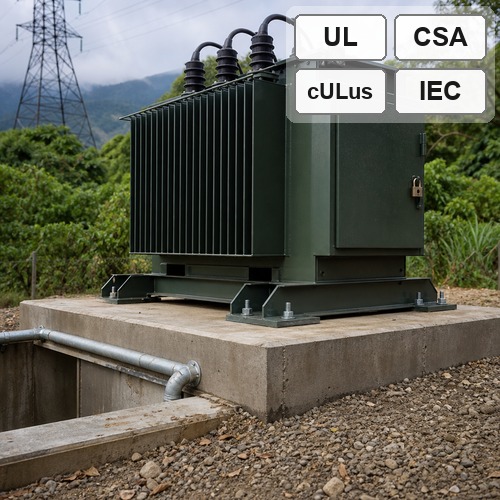
The tender arrived as twenty pages of civil works and one line of electrical scope: supply and install 6.6 kV shore power. We asked the port's electrical engineer what frequency the visiting fleet ran on. There was a pause, then the answer: whatever is standard. That one unanswered question decides the rating of the shore power transformer, whether the berth needs a static frequency converter at all, and whether a cruise ship can actually plug in when it arrives.
Cold ironing has moved from a pilot-project line item to a permit condition in a growing number of ports, and the electrical package is usually the part that gets written last and reviewed least. This guide covers what a shore power transformer has to survive at a berth, which values belong in the specification, and the harmonic and corrosion details that decide whether the unit is still in service after fifteen years of salt air.
Cold Ironing Load Is Not a Building Load
A ship at berth shuts down its auxiliary engines and takes everything from shore: hotel load, reefers, pumps, cranes on self-unloaders, and on a cruise vessel the entire HVAC and galley load. Peak demand is high and it steps on in one move. A large cruise berth is commonly planned around 7.2 MVA at 6.6 kV, which is roughly 630 A of secondary current, while a container berth with reefer racks sits nearer 1.5 to 3 MVA.
The duty is also repetitive in a way a distribution transformer never sees. Every vessel connection energizes the transformer and then the ship's own transformer, so inrush happens several times a day, sometimes with a cable of 200 to 400 m between the berth box and the vessel. Add 45 °C ambient in a Gulf port, 90% relative humidity, and a 20 to 30 year design life, and the thermal margin that looked generous on the datasheet starts to look thin.
Voltage, Frequency and the Converter Decision
High voltage shore connection is standardised in IEC/IEEE 80005-1, and the 2021 amendment to that standard exists largely because phase rotation at the ship-shore interface caused problems in service. The practical takeaway for a transformer buyer is narrower: the berth has to deliver the voltage and frequency the ship expects, and the transformer is only one part of that chain.
Three configurations cover most tenders, and they demand three different transformer specifications.
| Berth configuration | Transformer duty | What changes in the specification |
| 60 Hz grid, 60 Hz fleet | Step-down only, e.g. 33 kV to 6.6 kV | Closest to a normal distribution unit: standard impedance, ONAN or ONAF cooling, C5-M paint for the marine atmosphere |
| 50 Hz grid, 60 Hz fleet | Feeds a static frequency converter, or sits on the converter output | Harmonic-rich current, DC offset on converter output, higher eddy and stray losses, fan and pump auxiliaries on the converter side |
| 50 Hz grid, 50 Hz fleet (ferries, RoRo) | Step-down only, e.g. 11 kV to 6.6 kV | Voltage ratio and tap range sized for the actual fleet, not for a future one |
Where the frequencies match, a shore power transformer is a conventional distribution or power transformer with an unusual corrosion specification. Where they do not, the transformer lives downstream of a converter and inherits its waveform. That second case is where most of the engineering risk sits, and where a standard loss evaluation quietly becomes wrong.
Where Harmonics Hit the Transformer
Ship rectifier front ends are the source. A six-pulse arrangement produces characteristic 5th and 7th harmonics; a twelve-pulse arrangement pushes the dominant orders out to the 11th and 13th. Those currents pass through the transformer, and winding eddy losses rise roughly with the square of the harmonic order, so the 11th and 13th do far more heating per amp than the fundamental.
Two numbers belong in the specification. The first is a harmonic loss allowance, expressed either as a K-factor or as a stated harmonic spectrum the unit must carry at rated current without exceeding its temperature rise. The second is the voltage distortion limit at the point of common coupling, where IEEE 519 harmonic limits set 5% total harmonic distortion for systems between 1 kV and 69 kV. A 6.6 kV berth sits squarely inside that band.
Here is the part most port specifications miss. Raising transformer impedance to control fault current also raises voltage distortion for the same harmonic current, because more of the distortion appears across the transformer itself. Impedance, converter pulse number and filter design have to be chosen together. When a berth enquiry arrives with 8% impedance and a twelve-pulse converter and no filter, we flag the combination before quoting.
Salt, Humidity and the Berth Environment
A berth is a coastal site with an unusually aggressive atmosphere: salt fog, tidal humidity, diesel exhaust, and hose-down cleaning near the terminal building. For outdoor jetty installation, the paint system should be specified to C5-M of ISO 12944, with 316 stainless for exposed fasteners and a tank base that will not rust through at the anchor points. Hot-dip galvanised base frames are common, and we ask for the coating thickness in micrometres rather than the colour name.
Enclosure and cooling follow from placement. Oil-immersed units suit an outdoor pad beside the berth; cast resin dry type units suit the indoor terminal building where fire load and cable routing favour a unit without liquid. In both cases specify IP54 minimum, anti-condensation heaters on the LV compartment, and a temperature rise class that still holds at the site ambient rather than at the 40 °C default in the catalogue.
One detail we raise early, because it is expensive later: fan failure. An ONAF unit that is rated for full berth load with fans running will lose 25 to 30% of its capacity when a fan motor seizes in August. Either specify a fan group alarm wired to the port's monitoring system, or size the ONAN rating for the realistic continuous load and treat the forced-cooling stage as headroom for peak hotel load.

What to Put in the Shore Power Transformer Specification
The table below is the minimum data set we need before a berth quotation can be priced properly. Missing lines come back as assumptions, and assumptions come back as change orders. Where a line also appears in IEC/IEEE 80005-1, quote the standard clause next to it, so the supplier and the port inspector are reading the same requirement.
| Parameter | Typical berth requirement | Why it matters |
| Rated power | 7.2 MVA per cruise berth; 1.5 to 3 MVA per container berth | Sets the whole thermal design and the cable size from the berth box |
| Voltage ratio | 33 kV or 11 kV primary to 6.6 kV or 11 kV secondary | Must match the ship switchboard, not the port grid |
| Frequency | 60 Hz for a 60 Hz fleet, 50 Hz for a 50 Hz fleet, converter where they differ | Decides whether a converter, and its harmonic spectrum, enters the design |
| Impedance | 6 to 8% typical, coordinated with fault level | Too low and the ship switchboard sees excessive fault current; too high and voltage distortion rises |
| Harmonic duty | Stated spectrum or K-factor, 5% THDv at the PCC | Prevents winding hot spots that no standard loss test will reveal |
| Cooling | ONAN with ONAF stage, fan alarm to port SCADA | Keeps the berth in service when a fan fails |
| Corrosion | C5-M paint to ISO 12944, 316 stainless fasteners, IP54 | Fifteen years of salt air is the real acceptance test |
| Tests | Routine tests, temperature rise run, PD measurement for cast resin | Gives the port something to compare against the next tender |
How Ryan Approaches a Berth Enquiry
We build liquid-immersed and cast resin units in a 120,000 m² plant with more than 180 sets of production and test equipment, backed by 37 patents, and since 2023 we have operated as a joint venture partner of Eaton. That matters less than the engineering conversation, but it does mean a berth enquiry reaches people who have argued about impedance before.
For a mixed fleet, the useful option is a dual secondary voltage with off-circuit link selection, so one design serves 6.6 kV and 11 kV vessels without a second spare unit on site. Off-circuit tap links are also the cheapest way to cover a grid voltage that drifts from the drawing. Every unit leaves with routine tests recorded as measured values, a temperature rise run at rated current, and a photograph of the nameplate taken before crating, because the nameplate is the first thing a port inspector reads on arrival.
The high voltage shore connection interface is where most of the argument happens, and it usually happens between three parties who never meet: the port's electrical consultant, the ship's technical manager, and the transformer supplier. We ask for the ship's single-line diagram early. A twelve-pulse converter on board changes the harmonic duty on our winding, and a vessel with a 6.6 kV switchboard and a 60 Hz generator cannot be served by a 50 Hz berth without a converter, however generous the transformer rating looks on paper.
If you are writing a berth specification now, send us the fleet mix, the grid voltage and frequency, and the fault level at the berth box. Those three inputs decide more about the shore power transformer than any other page of the tender, and they are usually the three that arrive last. Our engineers will come back with a rating, an impedance recommendation and a harmonic allowance in writing, so the electrical package can be reviewed before the civil works are poured.
About the Author: This article was prepared by the engineering team at Ryan Electric (Jiangsu Ryan Electric Co., Ltd.), a transformer manufacturer founded in 2007 and a joint venture partner of Eaton since 2023. The team designs oil-immersed, cast resin and pad mounted transformers for port, data centre, utility and industrial projects, and supports customers through specification review before tender. For berth enquiries, contact [email protected].