
 EN
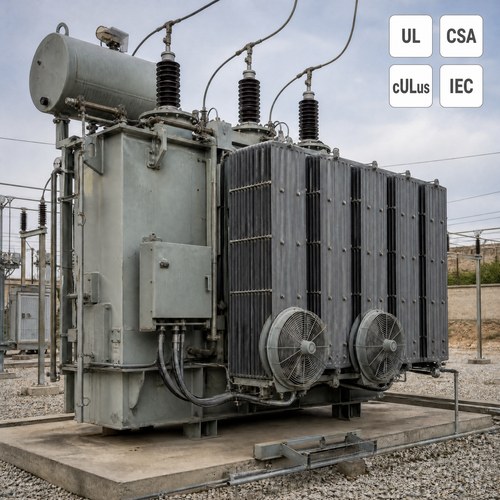
A data centre contractor in Johor sent us a load schedule last year with a single number on it: 10 MVA, continuous. His incoming oil immersed transformer had arrived with a nameplate reading ONAN 8,000 kVA / ONAF 10,000 kVA — the transformer cooling classes that every quotation lists and almost nobody reads — and he had sized the 11 kV cable, the switchgear and the protection settings against the second figure. At commissioning the fans ran, the load climbed, and the top-oil alarm went off at 96 °C on a 33 °C afternoon.
Nothing was broken. The unit was doing exactly what its rating sheet said it would do — under conditions nobody had written into the purchase order. That gap between a cooling code and a real installation is where most transformer capacity disputes begin.
What the Transformer Cooling Classes Code Actually Tells You
Transformer cooling classes are a four-letter shorthand that describes two things at once: the cooling medium in contact with the windings, and the method that moves heat out of that medium. The first letter is the internal medium (O for mineral oil, K for a non-mineral liquid with fire point above 300 °C, L for synthetic ester with fire point above 300 °C), the second is the circulation method (N natural, F forced, D directed), and the last two letters repeat the same logic for the external medium — air, water, or forced air.
So ONAN means oil natural, air natural: the oil circulates by thermal siphon and the tank and radiators lose heat to still air, with no fans and no pumps anywhere in the system. ONaf becomes ONAF when fans blow air across the radiator bank. OFAF adds oil pumps. ODAF directs oil flow into the winding ducts, which is how large generator step-up units keep winding gradients under control.
| Cooling class | What is running | Typical capacity gain | Where it is used |
| ONAN | Nothing — thermal siphon only | Base rating | Distribution units, rural substations, pad-mounted units |
| ONAF (stage 1) | One fan bank | +25% to +33% over ONAN | Urban substations, industrial plants with peak loads |
| ONAF (stage 2) | Second fan bank | a further +15% to +20% | Data centres, steel and cement plants |
| OFAF | Fans plus oil pumps | +40% to +60% over ONAN | Power transformers 40 MVA and above |
| ODAF | Directed oil flow plus fans | Highest for a given frame | Generator step-up, HVDC converter units |
Those percentages are the ranges our design office works with when it builds a rating sheet. They are not a rule from any standard — each manufacturer's radiator area, oil volume and fan selection land in a different place, and the only number that counts is the one in your guaranteed technical particulars.
The Second Rating Is Not Free Capacity
Here is the part most buyers miss. An ONAF transformer does not simply have more capacity than the same unit running ONAN. It has capacity that exists only while a set of conditions is true, and every one of those conditions can fail independently of the transformer.
The fan bank needs auxiliary power. On several North American projects we have seen a utility refuse the ONAF rating in an interconnection study because the station service supply was not backed up by a transfer scheme — if the fans stop, the unit silently reverts to 8 MVA while the protection is still set for 10 MVA. The transformer did not change. The rating did.
The fans also need to be there. A 10 MVA cooler bank typically carries two to four axial fans at around 0.55 kW each, with motor bearings, contactors, thermostats and a control circuit that switches stages on top-oil temperature. Every one of those is a maintenance item with a finite life, and a seized fan motor removes a cooling stage in the middle of a summer peak. When we quote a unit, we quote the fan-stage control philosophy in the same document as the impedance, because the rating is a control-system behaviour, not just a winding design.
Then there is the ambient assumption. Temperature rise limits are referenced to an ambient that is defined over a day and over a year, not a single afternoon. A unit guaranteed at 65 K average winding rise is guaranteed for a stated maximum ambient, and the 33 °C day in Johor was not the problem — the problem was that nobody had asked what happens at 40 °C with the fans in stage one only. That is the most common mistake we see in transformer cooling classes specifications: the four letters get copied from a datasheet without the ambient basis that makes them true.
Temperature Rise: the Number Behind the Code
The letters tell you how heat leaves the unit. The temperature rise tells you how much heat the insulation is allowed to feel. For liquid-immersed units the two limits that matter are average winding rise and hottest-spot rise, and they are set in IEEE C57.12.00, which you can read in summary form on the IEEE Standards Association page for C57.12.00-2021. For a 65 K average winding rise design — still the most common specification in Asia and the Middle East — the corresponding hottest-spot allowance is 80 K, which works out to roughly 110 °C at the reference ambient.
That 110 °C figure is where insulation life is decided. Paper aged at 110 °C loses tensile strength at a rate that halves its remaining life for every 6 to 8 K above that point, which is why a unit running 8 K hotter than its design does not simply age 8% faster. It ages several times faster, and nothing in the routine test report will warn you until the furan numbers start climbing years later.
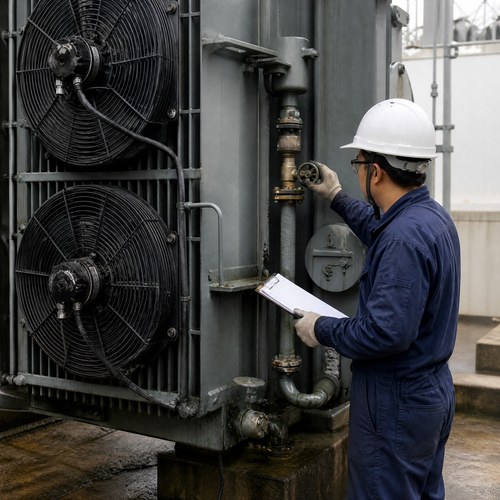
This is also why the heat run matters more than the certificate. A temperature-rise test per IEEE C57.12.90 measures the actual top-oil and winding gradients at rated load; it is the only evidence that the radiator area, oil volume and fan selection in the drawing actually add up to the nameplate. On an ONAF transformer the heat run matters twice over, because every fan stage is a separate operating point that has to be verified, not inferred.
Fans, Pumps and the Maintenance Bill
Cooling stages are cheap to specify and expensive to keep. Every moving part added to a transformer becomes a scheduled inspection, a spare part in somebody's store, and a failure mode that shows up as an unplanned derating rather than a clean trip.
In our experience with ONAF transformer fleets the ranked failure list is short and predictable: fan motor bearings dry out first, then contactor coils, then the thermostat that stages the second bank. Pumps on OFAF units add shaft seals and a differential pressure interlock that will nuisance-trip if the oil level drops. None of this is exotic, and all of it is avoidable at the specification stage.
One point should be written into the specification: what the unit does when a cooling stage fails. If the second stage fails and the load does not shed, the winding absorbs the difference. A winding temperature trip is a safe outcome; a winding that quietly runs at 120 °C for a season is not.
Ambient, Altitude and Enclosure: Where Ratings Quietly Shrink
Two derating factors catch out more projects than any other: site ambient and altitude. Our design sheets apply roughly a 1.0% to 1.2% capacity reduction per degree Celsius above the rated ambient, which means a 50 °C desert site costs a 40 °C-rated unit a meaningful slice of its nameplate before any load is connected. Above 1,000 m the reduced air density does the same thing to air-cooled heat rejection, and the correction has to appear on the rating plate calculation, not in a footnote.
Enclosure is the third factor. A pad-mounted unit sitting in a tamper-resistant enclosure per IEEE C57.12.28 is not breathing the same air as an open substation transformer, and a unit installed against a wall or inside a fenced compound with restricted airflow will run hotter than its test bay predicted. Add solar gain on a dark enclosure in the Gulf and the difference is not academic.
Sound follows the same logic in reverse. Fans add roughly 5 to 8 dB(A), so a unit specified at 58 dB(A) ONAN becomes a 64 dB(A) machine at night with stage two running. If the site has a noise covenant, the ONAF figure is the one the neighbours will hear.
What to Write on the Datasheet
When our engineers review a specification for an oil immersed transformer factory in China shortlist, the documents that close fastest are the ones that answer these points in writing:
• Cooling class and stage count, stated as a sequence (ONAN / ONAF1 / ONAF2), not as a single label.
• Capacity at each stage, with the ambient temperature each figure assumes.
• Altitude and ambient correction, applied and shown, not left to the factory to discover.
• Fan control philosophy: trigger temperatures, stage delays, and behaviour on stage failure.
• Auxiliary supply: voltage, phase, and whether it is backed up by the station DC or a transfer scheme.
• Sound level at each stage, in dB(A) at the specified measuring distance.
• Loss figures at reference temperature, which for US distribution units also has to satisfy the efficiency tables in 10 CFR Part 431 Subpart K, the US DOE distribution transformer rule that sets the minimum efficiency a compliant unit must reach.
A specification that answers all seven fits on two pages, and prevents the commissioning argument about whose nameplate was correct.
How We Rate and Test It, and What We Recommend
Buyers who audit an oil immersed transformer factory in China usually start with winding conductor grade and finish with cooling, which is the wrong order. The cooling stage is where the capacity claim actually lives. Our plant in Jiangsu runs the heat run on every custom-rated liquid-immersed unit, and the rating sheet that ships with the transformer carries the measured top-oil and winding gradients rather than the guaranteed values alone. That matters when a consultant has to defend an overload study or an interconnection application: the numbers have a test behind them.
We build both oil immersed transformer ranges and dry-type units on a 120,000 m² site with 37 patents in the portfolio, and since 2023 we have operated as an Eaton joint venture partner — an arrangement that shows up mostly in documentation discipline rather than in marketing language. UL, CSA and IEC files, drawings, and thermal data arrive as one package.
One practical note: ask for the cooling stage sequence on the test report, not just the nameplate — the technician who energises the unit reads the report, not the plate.
The Johor unit was eventually fine. We re-staged the fans to bring the second bank in 6 K earlier and the owner moved 1.2 MVA of non-critical load to a second transformer — a cheaper fix than a replacement, and only possible because the rating sheet told us what the unit could actually do.
Transformer cooling classes are the cheapest capacity decision in the whole package, and the easiest to get wrong, because the second rating always looks like free headroom until the ambient, the auxiliary supply and a fan bearing disagree with you. If you are specifying a liquid-immersed unit now, send us the load profile, the site ambient and the altitude through ryan-transformers.com — our engineers will come back with a stage-by-stage rating and the test data behind it.
About the Author: Written by the engineering team at Ryan Electric, a UL/CSA-certified transformer manufacturer in Jiangsu, China and an Eaton joint venture partner since 2023, supplying oil-immersed, dry-type and pad-mounted transformers to data centre, utility and industrial projects across North America, Southeast Asia and the Middle East.
Table of Contents
- What the Transformer Cooling Classes Code Actually Tells You
- The Second Rating Is Not Free Capacity
- Temperature Rise: the Number Behind the Code
- Fans, Pumps and the Maintenance Bill
- Ambient, Altitude and Enclosure: Where Ratings Quietly Shrink
- What to Write on the Datasheet
- How We Rate and Test It, and What We Recommend