
 EN
EN
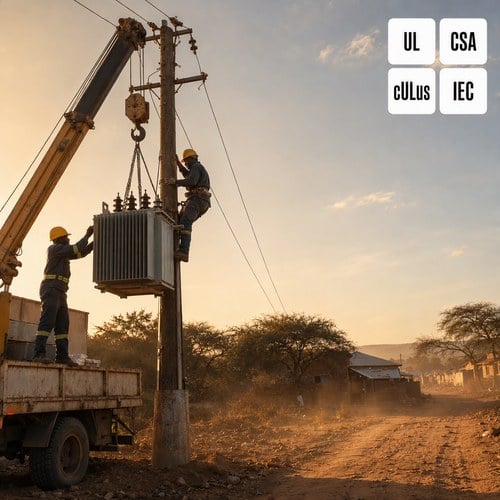
The last piece of equipment between a substation and a household is an oil immersed distribution transformer — usually a 25 to 200 kVA unit on a pole or a concrete plinth, ordered in batches of fifty rather than one at a time. On 16 June 2026, the World Bank Group and the African Development Bank Group announced that Mission 300 had connected more than 50 million people to electricity across 40 countries, at nearly double the pace recorded when the initiative launched. Every one of those connections sits downstream of a transformer order.
That scale changes the specification conversation. A single industrial transformer can be engineered as a one-off; a fleet cannot. Ratings, loss limits, tap ranges and documentation have to repeat across hundreds of units, across several years, and across contractors who install them without a factory engineer standing on site.
The Demand Picture Behind the Order Book
The numbers in the June 2026 announcement describe the duty your transformer will actually see. Tanzania has connected 7.5 million people under the initiative — a five-fold increase over its pre-Mission 300 annual pace. Ethiopia has connected 4.6 million. The two development banks have committed nearly $15 billion to related projects, with roughly $4.5 billion in co-financing behind them. The full announcement is published on the World Bank Group press release.
What that means for procurement is less glamorous than the headline. Demand arrives as fleet tenders: two hundred units for one province, then four hundred for the next, with the same drawings and the same nameplate language expected both times. Program offices in rural electrification work care about three things a one-off buyer never asks about — repeatability of the design, consistent test documentation on every unit, and a delivery schedule that follows the construction season rather than the factory's convenience.
A supplier who cannot hold a drawing across repeat orders costs more than the unit-price difference suggests. Re-approving a transformer drawing, a nameplate and a test template for every lot is engineering time that program budgets rarely include.
Why a Rural Feeder Rejects an Industrial Specification
Load density is the first difference. Urban distribution feeders commonly carry 2 to 5 MVA per square kilometre. A rural feeder often carries less than 100 kVA per kilometre. With that much LV conductor between the transformer and the last customer, voltage drop — not thermal capacity — usually decides where the next unit goes. Many programs set a ceiling of 5 to 6% total voltage drop to the farthest customer, and that ceiling forces either heavier LV conductor or more, smaller transformers placed deeper into the network.
The second difference is load shape. Rural demand grows in steps that no forecast captures: a milling machine, a welding set, an irrigation pump, a cold store. Each of those loads is single-phase or unbalanced, and each arrives without warning. A feeder that measured 30% loaded at commissioning can be running at 110% two years later, with the hottest spot inside the winding doing work the nameplate never promised.
Units of this size are almost always pole mounted transformers in both IEEE and IEC markets, and pole mounting imposes its own limits: tank weight, dimensions and clearance to the conductor run have to be agreed with the utility's line crew before the first unit is built, not after delivery.
Here is the pattern that shows up in the RFQs we quote. A program office sends a specification for 50 kVA units against a five-year forecast of 30 kVA. Our engineers usually write back one question: what happens in year three, when the village's agro-processing load connects? In most cases the answer moves the order to 100 kVA, or keeps the 50 kVA but specifies a lower temperature rise class so the unit can carry the extra load without spending its insulation life early. Both answers are defensible. Leaving the question unasked is not — and it is the most common mistake we see in rural electrification fleet specifications.
Ratings and Standards: Selecting the Right Oil Immersed Distribution Transformer
Two rating ladders dominate rural programs, and mixing them mid-tender is expensive. Networks built around IEEE practice use the preferred distribution ratings of IEEE C57.12.00 and, for overhead units, the requirements of IEEE C57.12.20-2023, which covers single- and three-phase, 60 Hz, liquid-immersed, self-cooled overhead-type distribution transformers of 500 kVA and smaller, at high voltages of 34,500 V and below. Networks built around IEC practice use the IEC 60076 series and the metric rating ladder.
| Parameter | IEEE-based networks | IEC-based networks |
| Reference standard | IEEE C57.12.20-2023 for overhead units 500 kVA and smaller | IEC 60076 series |
| Frequency | 60 Hz | 50 Hz |
| Typical voltages | 13.8 kV or 24.94 kV primary; 240/120 V or 480Y/277 V secondary | 11 kV or 33 kV primary; 400/230 V secondary |
| Rating ladder | Single-phase 25/37.5/50/75/100/167 kVA; three-phase 75/112.5/150/225/300/500 kVA | 50/100/160/250/400/630 kVA |
| Typical impedance | 2.5 to 4% | about 4% at 100 to 630 kVA |
| Lightning impulse level | 95 kV for the 15 kV class | 75 kV for the 12 kV class; 170 kV for the 36 kV class |
| Tap range | Plus/minus 2 x 2.5% off-circuit | Plus/minus 2 x 2.5% off-circuit |
The parameters that decide whether a fleet behaves are impedance and tap range. If units that will later be paralleled on the same LV bus carry different impedance values, load sharing is uneven, and the weaker unit runs hot long before the nameplate says it should. Write the impedance target with a tolerance into the specification, and hold it across every lot. The same discipline applies to the tap range: a feeder fed from a long MV line sees voltage sag at its far end, so plus/minus 2 x 2.5% of off-circuit taps is the practical minimum, and some programs widen it where the line is exceptionally long.
Insulation level deserves a line of its own. A 12 kV-class winding is routinely impulse tested at 75 kV, a 24 kV-class winding at 125 kV, and a 36 kV-class winding at 170 kV, with the test sequence defined in IEC 60076-3. In lightning-heavy regions those numbers matter more than any efficiency figure, because the arrester and the winding insulation have to survive the same event together.
Losses Are the Cost You Keep Paying
Line losses get attention in program documents; transformer losses decide the energy bill for the next quarter century. No-load loss is the energy a transformer consumes simply by being energised, and it does not care whether the village is drawing power at noon or asleep at three in the morning. Load loss behaves the opposite way — it scales with the square of the current, so it falls away whenever the load is light.
Rural units spend most of their life at light load, which flips the usual priority. Take a 100 kVA unit with a 150 W no-load loss energised continuously: that is roughly 1,314 kWh a year before a single customer switches on a light. With a 60 W no-load loss from an amorphous core, the same unit consumes about 526 kWh a year. The difference — around 790 kWh per unit per year — is invisible on an individual invoice and very visible across a 300-unit fleet, where it adds up to roughly 237 MWh annually.
That arithmetic is why loss limits belong in the RFQ as measured values, not as adjectives. Ask for guaranteed no-load loss and load loss figures at the reference temperature, and ask for the measured values in the routine test report of every unit. Where a tender evaluates total owning cost with capitalized losses, a moderate increase in purchase price for a lower-loss core pays back well inside the transformer's service life.
Three Field Failures That Show Up in Rural Fleets
Most of the oil immersed distribution transformer failures we get called about in rural programs have nothing to do with manufacturing quality. They come from the environment the unit is asked to work in.
Oil and hardware theft. Pole mounted transformers in low-patrol areas lose bushings, oil and copper. The practical response is spec-level: tamper-resistant fasteners on valve covers, a drain valve that needs a special tool, and a bushing type your own crew can replace from local stock instead of waiting for a factory shipment.
Overload from unplanned connections. The unplanned mill or welding shop pushes the unit past nameplate, and the winding pays for it. Where a program knows its growth curve, order the lower temperature rise class rather than the next kVA step, and require the load capability to be documented rather than implied.
Moisture contamination before energisation. Units can sit in a provincial store for months before a line crew reaches the site, breathing humid air through an exhausted breather. Sealed-tank or nitrogen-blanketed construction, a breather matched to the local climate, and a mandatory insulation resistance plus oil breakdown voltage check before energisation prevent most of these failures. We issue that check list with the delivery documents on every fleet order.
If you are writing the specification for a fleet of rural distribution units, send us the network data — voltage class, load forecast, climate and reference standard — and our engineers will return a compliance sheet against it, with the exceptions marked.
What to Put in the RFQ
Seven items decide whether a fleet order for an oil immersed distribution transformer runs smoothly. None of them is exotic, and two of them cost nothing at quotation stage.
1. Rating and ratio. kVA from the ladder that matches your standard, primary and secondary voltage, and winding connection.
2. Tap range. State it. Do not leave it to the factory default.
3. Impedance. A target with a tolerance, so units paralleled later share load as intended.
4. Loss limits. Guaranteed no-load and load loss, plus measured values in each unit's routine test report.
5. Insulation level and tests. Impulse level, applied and induced voltage tests, and temperature rise evidence where the load duty justifies it.
6. Mechanical and environmental detail. Ambient and altitude, mounting arrangement, tank finish and paint system for the site climate, bushing type and orientation.
7. Documentation and packing. Drawings, per-unit test report, nameplate language, sea-freight protection and storage instructions.
Items two and four are the ones that cost nothing now and prevent the most expensive conversations later.
How Ryan Electric Supports Electrification Programs
Ryan Electric has been building transformers in Jiangsu since 2007, from a 120,000 m² factory with more than 180 sets of production and test equipment and 37 patents in its portfolio. Since 2023 the company has operated as an Eaton joint venture partner, and holds UL, CSA, IEEE, DEKRA, CE and CNAS certifications — the document set North American and European utilities ask for before a first order. Our oil immersed distribution transformer range covers the 10 kV and 20 kV classes up to 5,000 kVA, built to GB, IEC, IEEE, UL, CE and ASTA standards, with 35 kV class power transformers above that for substation work. Ratings and drawings are published on our oil immersed transformer product page.
Fleet orders for rural electrification programs are handled the way the order pattern demands. One drawing set is frozen for the whole program. The same routine test sheet — ratio, winding resistance, insulation resistance, no-load loss, load loss, applied and induced voltage — is issued with every unit, with measured values rather than guaranteed ones. Nameplates are printed to your standard, and packing is built for long sea transit and extended storage in a humid climate. If your program runs the same 100 kVA unit across three years of construction, the thirtieth unit leaves the factory to the same drawing as the first.
If your program is ordering 50 kVA units this year and 100 kVA units next year, the specification you write now will be reused hundreds of times. Send us the draft along with your network data through the contact form on our distribution transformer range — our engineers will mark it up with the items the factory needs pinned down, and quote against your standard rather than ours.
About the Author: This article was written by the engineering team at Ryan Electric, an Eaton joint venture partner and UL/CSA-certified transformer manufacturer in Jiangsu, China, supplying utility, data center and renewable energy projects across North America, the Middle East, Africa and Southeast Asia.
Table of Contents
- The Demand Picture Behind the Order Book
- Why a Rural Feeder Rejects an Industrial Specification
- Ratings and Standards: Selecting the Right Oil Immersed Distribution Transformer
- Losses Are the Cost You Keep Paying
- Three Field Failures That Show Up in Rural Fleets
- What to Put in the RFQ
- How Ryan Electric Supports Electrification Programs