
 EN
EN
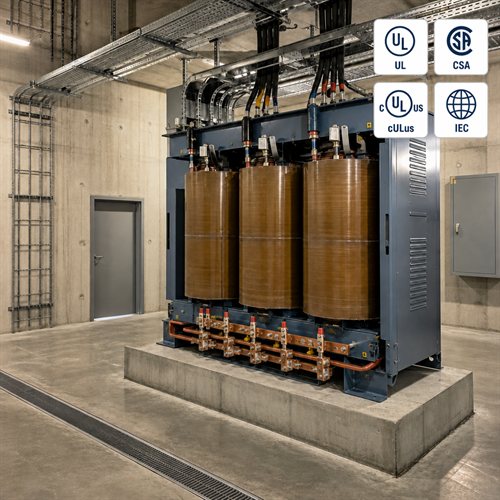
The equipment failure in a road tunnel almost never starts on the lighting circuit. It starts on the fans. A commissioning engineer described the sequence to us in plain terms: the first jet fan bank starts clean, the second bank is fine, the third bank comes on and the 480 V bus sags, the drive trips on undervoltage, and ventilation drops into fault before the smoke test can even begin. The transformer for tunnel ventilation had been sized from a load list. Nobody had modelled the start.
That is the awkward thing about tunnel power. Most of the time the load is modest — a few hundred kilowatts of lighting, a handful of fans, some pumps. For a few seconds, several times a day, it is not modest at all. And the same unit that rides through a motor start also has to live with VFD harmonics on the ventilation drives and keep working while a fire burns a few metres away.
What Actually Loads a Tunnel Substation
A tunnel is a small industrial plant stretched along a kilometre of concrete. Ventilation dominates the electrical load, but it is not the only one, and the different loads behave nothing alike. Signing off a single kVA number without separating them is where most specification errors are born.
| Load | Typical range | Duty | What it does to sizing |
| Jet fan (axial, drive-fed) | 22-250 kW | Staged start/stop, hundreds of cycles per year | Locked-rotor current and voltage dip on the LV bus |
| Tunnel ventilation fan | 200-1,000 kW | Continuous, reversible for smoke extraction | Largest single motor; usually sets the sizing floor |
| Smoke damper actuators and controls | under 10 kW | Emergency only, must hold position | Small load, but shares the same panel and UPS circuit |
| LED tunnel and emergency lighting | 30-350 kW | Continuous, 100% duty | Harmonic-rich; raises neutral current |
| Drainage sump pumps | 15-110 kW | Intermittent, wet environment | Start against a water column; moisture ingress risk |
| Substation ventilation and dehumidifiers | 10-60 kW | Continuous | Raises the ambient the transformer itself sits in |
| SCADA, CCTV, signage | under 20 kW | Continuous | Ride-through requirement during a fire event |
Design guidance already treats these as distinct disciplines. The FHWA Road Tunnel Design Guidelines (https://www.fhwa.dot.gov/publications/focus/05nov/03.cfm) devote separate sections to ventilation, lighting, fire precautions and seismic design — but all of them land on one load schedule, and one transformer usually has to carry the result.
Motor Starting Sets the Floor, Not the Running Load
Running load is the easy number. Add the fans, the lighting and the pumps, apply a diversity factor, and a 1,500 kVA unit looks generous against a 900 kVA tunnel. Then look at the start.
A standard NEMA Design B induction motor draws roughly six times full-load current during a direct-on-line start. Take a 250 kW jet fan motor at 480 V: full-load current sits near 300 A, so locked-rotor current is around 1,800 A, and it holds there for the two to four seconds the fan needs to reach speed. Start a second bank half a second later and the transformer is carrying a load it will never see again in normal operation. That is the number that decides the nameplate.
Two parameters govern whether the start is acceptable: transformer percent impedance and feeder impedance. A 5.75% impedance unit limits fault current comfortably but produces a deeper voltage dip at the motor terminals. A 4% unit flattens the dip and pushes prospective short-circuit current up, which the LV breaker rating and bus bracing then have to absorb. On a 700 m feeder running to a mid-tunnel fan room, cable impedance can contribute more voltage drop than the transformer itself.
Practical experience: we run the start calculation before a tunnel quotation leaves the factory, and when a customer sends only a load list we send one question back — what is the largest motor, how is it started, and how long is the cable to it? That single answer has changed the specified rating on more tunnel projects than any other line in the schedule.
VFD Harmonics Change the Duty of a Transformer for Tunnel Ventilation
Almost every new jet fan is driven by a variable frequency drive, because a fan that runs at 30% speed during off-peak hours pays for its drive in energy cost alone. The drive also changes what the transformer sees at its secondary terminals.
A six-pulse drive draws a non-sinusoidal current with total harmonic distortion that typically lands between 25% and 45% at the input. IEEE 519 caps voltage distortion at 5% on a bus below 69 kV, and tightens the current distortion limit as available short-circuit current falls. Tunnels sit at the awkward end of that curve: long feeders, comparatively weak sources, and several drives fed from one secondary bus.
The consequence is that a transformer feeding tunnel ventilation drives cannot be specified from kVA alone. Harmonic current adds eddy-current and stray losses that push winding hot-spot temperature above what a sinusoidal load would produce at the same apparent power. That is why a cast resin transformer on a tunnel project is often ordered with a K-factor rating, an oversized neutral, or a delta winding that traps triplen harmonics, together with a winding temperature class that leaves headroom above the design load.
Our rule of thumb for drive-fed tunnel boards where VFD harmonics dominate: take the connected drive capacity, add a margin for harmonic loss, and specify the winding temperature-rise class one step above the bare requirement. The extra cost sits in the quotation. The cost of getting it wrong arrives in year seven.
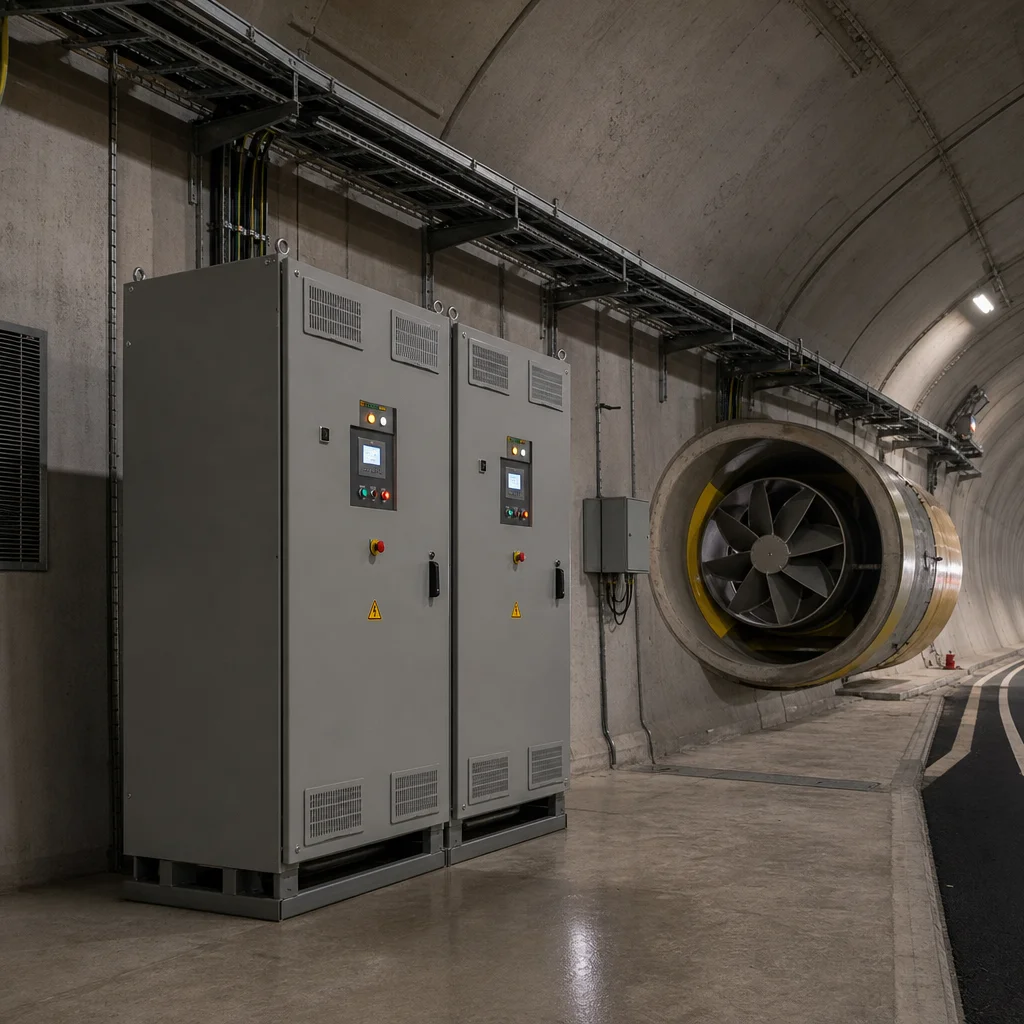
Fire Safety Decides the Technology, Not the Price
Ask why nearly every in-tunnel substation runs dry-type equipment and the answer is not efficiency. It is fire safety. NFPA 502 (https://www.nfpa.org/codes-and-standards/nfpa-502-standard-development/502) sets the fire protection and fire life safety requirements for road tunnels, bridges and other limited access highways, and it treats ventilation as a critical life safety function that must keep running while a fire is burning.
That requirement ripples straight down to the transformer. An oil-filled unit placed inside the tunnel envelope brings a flammable liquid, bunding, a vault and additional fire separation with it, so most designers avoid the argument and specify a cast resin transformer inside the bore or in an adjacent room. The product standards are unambiguous about what such a unit must satisfy: IEEE C57.12.01 (https://standards.ieee.org/ieee/C57.12.01/6775/) covers general requirements for dry-type distribution and power transformers, and IEC 60076-11 covers dry-type power transformers up to 36 kV.
One detail gets missed more often than any other: the transformer is only as good as the feeder. Where the emergency ventilation circuit is required to hold circuit integrity through a fire event, the cable and the jointing have to survive the same conditions. A self-extinguishing cast resin unit wired with standard cable is a common and expensive inconsistency.
The Tunnel Environment Works on Equipment Quietly
Tunnel air is wet, dusty and mildly corrosive. Relative humidity above 85% is routine inside a ventilation shaft, brake and tyre dust settles on every horizontal surface, and a coastal tunnel adds chlorides to the mix. Shaft ambient can sit between 40 and 45°C through the summer, measured where the transformer actually stands rather than at the portal.
Resin-encapsulated windings handle that better than a wrapped dry-type winding, because on a cast resin transformer the casting seals the winding against moisture ingress. The specification still has to follow the environment: anti-condensation space heaters, an IP-rated terminal box, and a design ambient taken from the shaft, not from the regional weather average.
Altitude matters as well. At 1,500 m a transformer loses close to 9% of the air density available for convective cooling, so a unit that passes its temperature-rise test at sea level is not automatically acceptable on a mountain alignment. Ask the supplier to state the derating that applies at your site ambient and altitude, and to show the calculation rather than a generic curve — that is the same check we apply to every transformer for tunnel ventilation we quote.
What We Ask Before We Quote
Five items decide the rating, the price and the delivery date on a tunnel transformer order. If they are clear in the enquiry, the quotation usually comes back right the first time:
- Load schedule, with the largest motor highlighted. Give us its starting method and the cable length from the substation. Everything else follows from that one entry.
- Drive type and count. Six-pulse, twelve-pulse or active front end, plus the available short-circuit current at the LV bus — this fixes the harmonic margin.
- Site conditions. Design ambient, altitude, humidity, and the seismic category that applies to the alignment.
- Fire strategy. Equipment inside the tunnel envelope, in a dedicated substation, or remote — the answer determines dry-type versus liquid-filled.
- Certification and efficiency target. UL, CSA or IEC test reports, and the efficiency level required by the destination country.
Ryan Electric builds dry-type and oil-immersed transformers for infrastructure and industrial projects across North America, the Middle East and Southeast Asia. Our Jiangsu factory covers 120,000 m² with more than 180 sets of production and test equipment, and the certification portfolio includes UL, CSA, IEEE, DEKRA and CNAS. Since 2023 we have operated as an Eaton joint venture partner, which placed our testing and quality documentation under an external audit process instead of self-declaration. A tunnel order is treated the same as a data centre order: routine test data, temperature-rise records and certification files ship with the unit.
Send the Load Schedule, Not Just the kVA
The number that decides a transformer for tunnel ventilation is rarely the first number on the load list. Send our engineers the load schedule, the largest motor, the drive type and the site conditions, and you will get back a rating, a harmonic margin and a derating calculation you can defend in design review rather than a nameplate chosen by rule of thumb.
About the Author: This article was written by the engineering team at Ryan Electric, a transformer manufacturer in Jiangsu, China and an Eaton joint venture partner since 2023, supplying UL, CSA and IEC certified dry-type and oil-immersed transformers to tunnel, metro, data centre and utility projects across North America, the Middle East and Southeast Asia.
Table of Contents
- What Actually Loads a Tunnel Substation
- Motor Starting Sets the Floor, Not the Running Load
- VFD Harmonics Change the Duty of a Transformer for Tunnel Ventilation
- Fire Safety Decides the Technology, Not the Price
- The Tunnel Environment Works on Equipment Quietly
- What We Ask Before We Quote
- Send the Load Schedule, Not Just the kVA