
 EN
EN
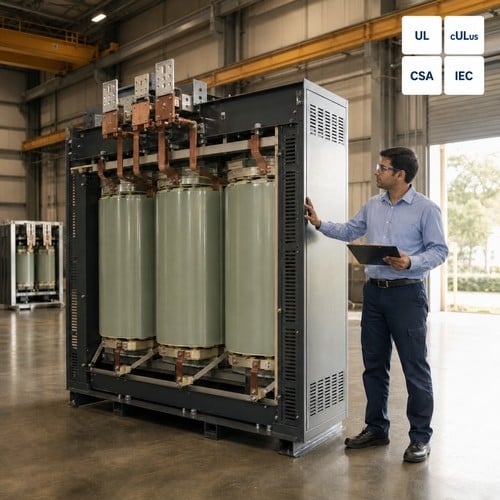
A contractor in Texas sent us a submittal package last month for a 2,000 kVA dry type transformer — 13.8 kV primary, 480Y/277 V secondary, cast resin epoxy coils — with one line that stopped the review cold: “UL 1561 listed.” His engineer had pulled that standard from an earlier 480 V project. The voltage class had changed. The standard should have changed with it.
That one line decides which factory tests get run, which markings are legal on the nameplate, and how the unit reads at inspection. Two transformers that look identical on a single-line diagram can sit in different product families in the eyes of a UL listed transformer evaluation — and the difference between them is a single number.
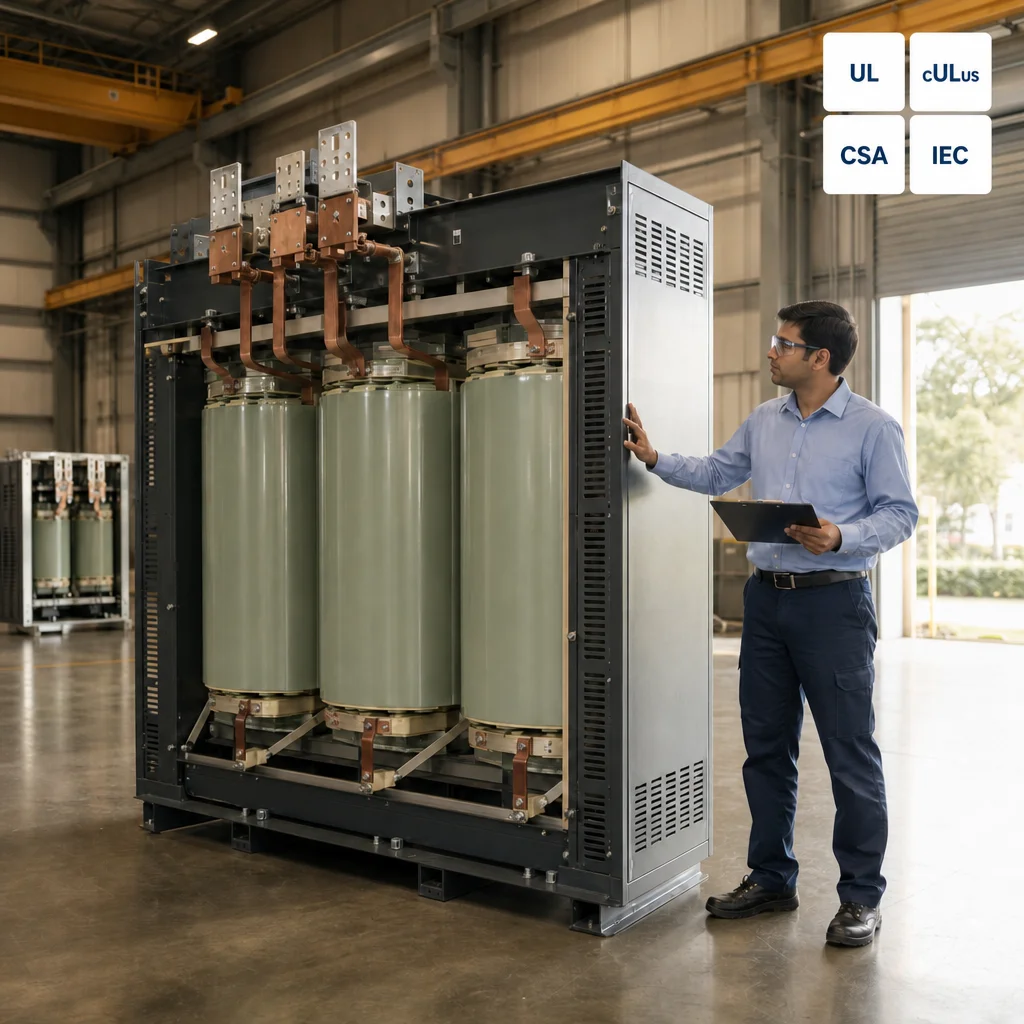
Where the 600 V Line Comes From
The boundary is not a transformer-industry convention. It comes from the code. ANSI/NFPA 70, the National Electrical Code, treats a nominal 600 V and below as low voltage; above that, different rules for clearances, enclosures and protection apply. The UL standards that evaluate dry type transformers are drawn along that same line, and each one carries its own scope and its own test plan.
For most buyers specifying a UL listed transformer, three documents drive transformer certification requirements:
- UL 1561 — dry type general purpose and power transformers, 600 V and below
- UL 1562 — dry type distribution transformers, 601 V to 35,000 V
- UL 5085-1 — low voltage transformers (Part 1, general requirements), the family that also carries control and Class 2 units
Then there is the Canadian twist. CSA C22.1, the Canadian Electrical Code, defines low voltage as 31 V to 750 V inclusive, while the NEC stops at 600 V nominal. The scope text of the low voltage transformer standard says it plainly: units for Canada may be rated above 600 V up to 750 V, while the limit in the United States is 600 V. A 600 V class unit bound for Ontario and the same drawing staying in Ohio are therefore not evaluated against identical upper limits. The scope and edition history are published on the UL 5085-1 standard page.
Table 1 — Voltage class and the governing dry type standard
| Voltage class | Governing UL standard | Typical product |
| Up to 600 V | UL 1561 — dry type general purpose and power | 480 V to 208Y/120 V dry type unit, 600 V class |
| 601 V to 35,000 V | UL 1562 — dry type distribution | 13.8 kV/480 V cast resin unit, unit substation transformer |
| Low voltage, general purpose / control / Class 2 | UL 5085 series (Part 1 general, Part 2 cord-connected, Part 3 Class 2 and 3) | Control transformers, machine tool and Class 2 transformers |
| Canada, up to 750 V | UL 1561 / UL 5085-1 evaluated to Canadian limits | cULus marked units; CSA C22.1 defines low voltage as 31–750 V |
UL 1561 — Dry Type Transformers Rated 600 V and Below
Edition 4 of UL 1561 was published in March 2011 and reaffirmed as an American National Standard on August 31, 2023 with no technical changes. It covers air-cooled dry, ventilated and non-ventilated general purpose and power transformers used in accordance with the NEC — step-up, step-down, insulating and autotransformer constructions, plus air-cooled and dry-type reactors. Exposed-core and compound-filled constructions are covered once they are rated more than 10 kVA. The published scope is on the UL 1561 standard page.
The exclusions are where submittals go wrong. UL 1561 does not cover liquid-filled transformers, voltage regulators, motor-starting autotransformers or variable voltage autotransformers — and, decisively for our Texas contractor, it does not cover any transformer with a nominal primary or secondary rating above 600 V, or overvoltage taps rated above 660 V. Units with rectifying or waveshaping circuitry are outside as well, which is the boundary that sends rectifier transformers down a different evaluation path.
So the 480 V delta to 208Y/120 V dry type transformer feeding a commercial building is a UL 1561 product. The 13.8 kV cast resin unit upstream of it is not, however similar the two look on one drawing.
UL 1562 — Dry Type Distribution Transformers, 601 V to 35,000 V
Edition 4 of UL 1562 was published in January 2013 and last revised on August 11, 2020, when the insulation system requirements were updated. It picks up exactly where the 600 V standard stops: single-phase and three-phase dry-type distribution transformers, explicitly including solid cast and resin encapsulated constructions, in ventilated or non-ventilated enclosures, rated for a primary or secondary voltage from 601 V to 35,000 V. That voltage window is the most useful single fact in this article: it is why a 13.8 kV data center unit and a 480 V building unit cannot share a test card. Scope details are published on the UL 1562 standard page.
Its exclusion list is longer, and every line has caught a buyer somewhere: instrument transformers; step-voltage and induction voltage regulators; current regulators; arc furnace transformers; rectifier transformers; specialty transformers; mining transformers; motor-starting reactors and transformers. If your load is an electrolyzer, a plating rectifier or an electric arc furnace, the transformer sits outside this standard by scope even though its voltage falls comfortably inside the 601 V to 35,000 V window.
The last exclusion is the one that surprises project managers most. Transformers under the exclusive control of an electric utility are out of scope, indoors or outdoors. If the unit sits on the utility side of the meter, the utility specification and the NESC govern the evaluation, and a “UL 1562 listed” line in your spec may be neither necessary nor sufficient. Behind the meter — a data center, hospital, process plant or commercial tower — it is the document your inspector will reference.
This is the first thing our engineers check on an incoming inquiry. Send the primary and secondary voltage, the kVA, the application and the installation country, and the governing standard and test plan come back in the same reply — instead of surfacing at drawing approval.
Three Questions to Settle Before You Quote a UL Listed Transformer
Almost every standards mismatch we see traces back to one of three questions that never got asked at the RFQ stage.
- What are the primary and secondary voltages, exactly? 480 V, 600 V, or 601 V and above. The answer selects the standard, and the standard selects the test plan and the nameplate markings.
- Is the application on the exclusion list? Arc furnace, rectifier, mining, motor-starting and instrument duty all fall outside both dry type distribution standards. Say it at inquiry, not at drawing approval.
- United States or Canada? The Canadian low-voltage ceiling is 750 V, so cULus marking and the Canadian code definition can change what your submittal has to demonstrate.
The conversation usually starts with a phone call from someone who has already bought. A project manager in Texas called us after a 2,500 kVA dry type unit arrived carrying a 600 V class listing with a 13.8 kV primary. Nothing was wrong with the transformer itself. It was built, tested and labeled correctly — against a standard that did not cover his application. What he needed was an evaluation path, not a repair.
What Changes on the Factory Floor
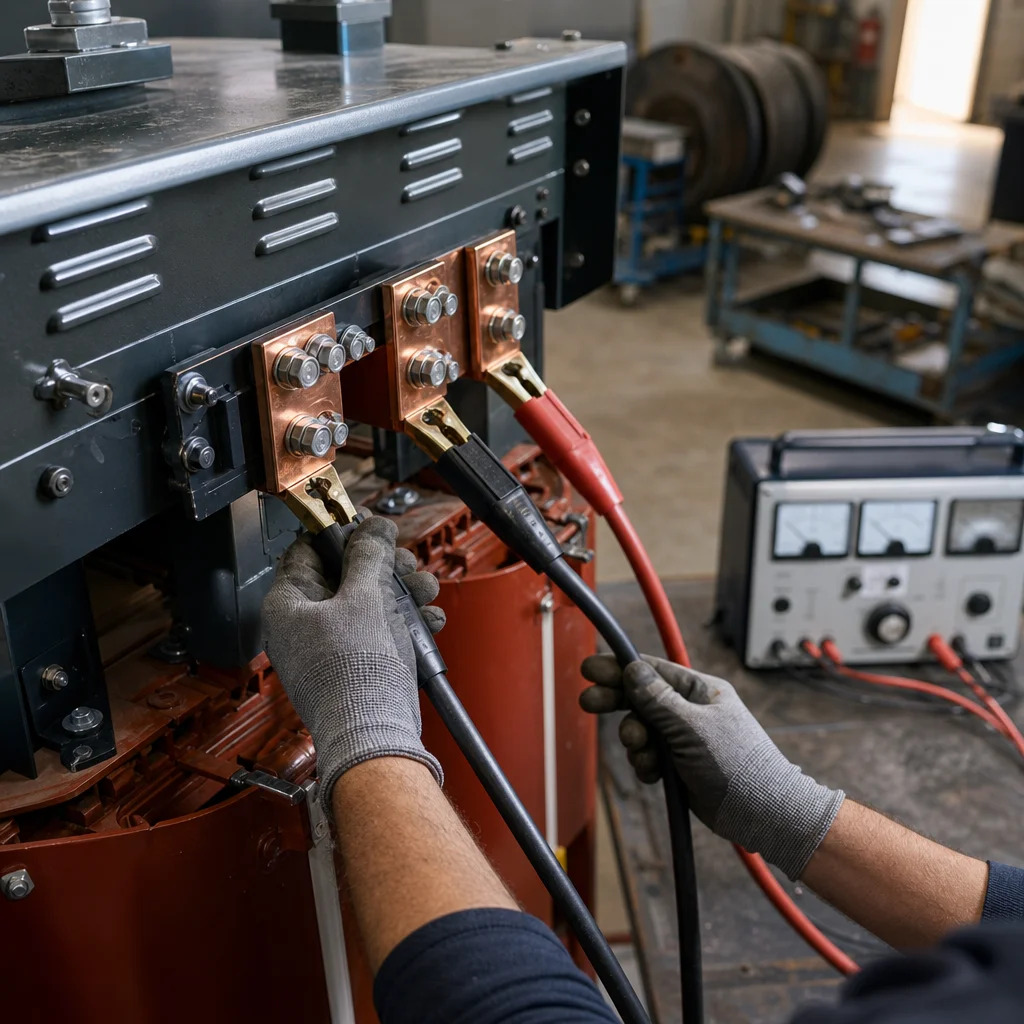
On our production lines the standard number is not paperwork — it drives the test card. Routine tests on the dry type lines cover winding resistance, ratio, no-load loss and load loss, plus applied potential and induced potential dielectric tests, with partial discharge measurement recorded for cast resin units when the project specifies it. For a 601 V and above unit, the dielectric test levels and the clearance assumptions come from the higher-voltage standard, and the test bay setup follows the scope, not the habit.
Nameplate and marking control matters just as much. The listing mark, the manufacturer identification and the file relationship have to match the released construction; a marking that disagrees with the evaluated design is a commissioning headache nobody budgets for. We build both dry type and oil immersed units, and as an Eaton joint venture partner we run UL, CSA, IEEE, DEKRA and CNAS transformer certification work across a 120,000 m² manufacturing base. The scope question comes up on essentially every North American inquiry — it is not a once-a-quarter topic.
If your drawings are not frozen yet, send us the voltage class and the application before the RFQ closes. One email now is cheaper than re-evaluating a unit after it lands on site, and it is the cheapest form of transformer certification insurance a project manager can buy.
Matching Voltage Class to Standard — A Submittal Checklist
Use the table below as a first filter when you write a specification, then confirm the details with your supplier before the drawings are released. It is written for a UL listed transformer destined for North America.
Table 2 — Submittal checklist by project type
| Your project | Standard to cite | What to expect |
| 480 V / 208Y120 V dry type, behind the meter | UL 1561 | 600 V class or below; no overvoltage taps above 660 V; routine dielectric tests |
| 600 V class dry type installed in Canada | UL 1561 to Canadian limits, cULus marking | Low-voltage ceiling is 750 V per CSA C22.1, not 600 V |
| 13.8 kV / 480 V cast resin, data center or plant | UL 1562 | Inside the 601–35,000 V window; higher dielectric test levels; solid cast and resin encapsulated covered |
| Rectifier, arc furnace, mining or motor-starting duty | Neither — scope exclusion | Separate evaluation path; do not specify UL 1561 or UL 1562 by default |
| Utility-owned transformer | Utility specification and NESC | UL 1562 excludes transformers under exclusive utility control |
If you remember one number from this article, make it the boundary itself. 600 V and below is one standard. 601 V and above is another. Everything downstream — dielectric test levels, creepage and clearance assumptions, nameplate content and often lead time — follows from that split.
Order the Right Unit the First Time
Certification questions cost money when they surface late: a re-evaluation, a re-marking, or a unit sitting in a warehouse while a project waits. Send us your voltage class, kVA, application and destination country, and our engineers will confirm the governing standard, the test plan and a realistic production slot. Ryan Electric builds dry type and oil immersed units for data center, utility, industrial and renewable projects, with a quotation desk reachable through ryan-transformers.com.
About the Author: This guide was written by the engineering team at Ryan Electric, a UL/CSA/IEEE-certified transformer manufacturer and Eaton joint venture partner based in Jiangsu, China, supplying dry type, oil immersed and pad mounted transformers to data center, utility, industrial and renewable projects across North America, the Middle East and Southeast Asia.
Table of Contents
- Where the 600 V Line Comes From
- UL 1561 — Dry Type Transformers Rated 600 V and Below
- UL 1562 — Dry Type Distribution Transformers, 601 V to 35,000 V
- Three Questions to Settle Before You Quote a UL Listed Transformer
- What Changes on the Factory Floor
- Matching Voltage Class to Standard — A Submittal Checklist
- Order the Right Unit the First Time