
 EN
EN
Last quarter, a contractor in Texas sent us a photo of a transformer nameplate from a competing quote. The unit was rated 1,000 kVA, 13.8 kV delta to 480Y/277 V, UL-listed — everything looked right until we read the temperature-rise line: 80°C, not 65°C. That single difference cut the unit's continuous loading capability by roughly 12%, and it explained why the quote was cheaper. The contractor had no idea that the nameplate was the most important document on the job site.
Here is what a transformer nameplate actually tells you — and how to read the ratings that decide whether your unit passes inspection, meets code, and carries the load you paid for.
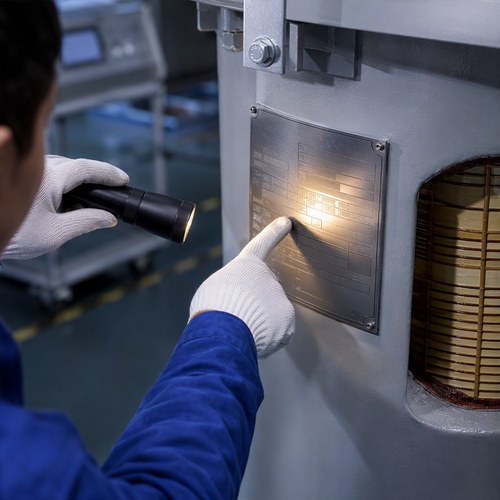
What a Transformer Nameplate Is and Why It Is a Legal Document
A transformer nameplate is not a sticker. In North America, the marking requirements trace back to the standards that govern the unit itself: IEEE C57.12.00 for liquid-immersed distribution and power transformers, and UL 1561 or UL 1562 for dry-type units. The nameplate data is part of the certified design, which is why inspectors, utility engineers, and insurance surveyors treat it as the unit's identity document. If the nameplate does not match the test report, the unit has effectively failed inspection before the first energization.
The IEEE C57.12.00-2021 standard sets the general requirements for liquid-immersed units, including the minimum nameplate information. Our factory follows this document on every oil-immersed unit we build, and we keep the exact nameplate layout on file for each serial number — because customers, utilities, and customs officials all ask for it at different points in the project.
The 14 Ratings That Matter on a Transformer Nameplate
Read a nameplate in the order that affects your project most. The table below covers the ratings our quoting engineers check first:
| Rating on Nameplate | What It Means for Your Project | Common Values |
| kVA rating | Continuous apparent power at rated conditions; sizes your unit | 500 kVA – 2,500 kVA (distribution) |
| Primary voltage | HV winding voltage and connection (delta or wye) | 13.8 kV, 34.5 kV delta |
| Secondary voltage | LV winding voltage, often wye with neutral | 480Y/277 V, 208Y/120 V |
| Temperature rise | Winding temperature rise above ambient at rated load | 65°C (oil), 80/115°C (dry) |
| Percent impedance (%Z) | Voltage drop and available fault current through the unit | 4% – 7% |
| BIL | Basic impulse insulation level, lightning withstand | 95 kV, 110 kV, 150 kV |
| Cooling class | How the unit sheds heat (ONAN, ONAF, etc.) | ONAN, ONAN/ONAF |
| Sound level | Audible noise in dB(A); matters near homes and offices | 55 – 65 dB(A) |
| Phase and frequency | Three-phase or single-phase; 50 or 60 Hz | 3-phase, 60 Hz |
| Insulation class | Thermal capability of the insulation system (dry-type) | Class F (155°C), Class H (180°C) |
| Vector group | Winding phase relationship; Dyn11 vs Dyn5 affects parallel operation | Dyn11, Dyn5, Yyn0 |
| Tap range | Off-load or on-load voltage adjustment range | ±2 × 2.5% |
| Oil volume / total weight | Shipping and foundation planning | Depends on kVA rating |
| Certification marks | UL, CSA, cULus marks with file numbers | UL file no., CSA class no. |
That table is the short version. The long version is that each line maps to a design decision inside the tank or the enclosure, and a change on one line usually forces changes on two or three others. When a buyer asks us to "just bump it to 1,500 kVA" on a quote that was sized at 1,000 kVA, our engineers rebuild the core, the windings, and the cooling calculation — the nameplate is simply the visible tip of that work.
Temperature Rise: The Nameplate Rating Most Buyers Misread
In our RFQ review meetings, the temperature rise line causes more confusion than any other nameplate entry. A liquid-immersed unit rated 65°C rise means the average winding temperature can rise 65°C above a 30°C average ambient at rated load — that is the design basis for its kVA rating. A unit quoted at 80°C rise is built with less core and copper for the same kVA, which is exactly why it costs less.
Here is the part most buyers miss: you cannot simply swap a 65°C unit for an 80°C unit and assume the nameplate kVA is honest. The higher-rise unit reaches its limiting temperature sooner under load, which shortens insulation life and reduces overload headroom. When a Canadian utility asked us to verify a pad-mounted unit for a residential feeder, the first thing our engineer checked was whether the temperature rise matched the specification — because the nameplate governs real capacity, not the brochure.
Percent Impedance and BIL: The Pair That Protects Your System
Percent impedance (%Z) on the nameplate determines two numbers your protection engineer needs: voltage regulation and available fault current at the secondary terminals. A 5.75% impedance unit limits fault current more than a 4.5% unit, which changes breaker ratings and cable bracing downstream. If you are paralleling transformers, %Z matching between units is not optional — IEEE C57.12.00 requires impedance values to fall within 7.5% of each other for parallel operation, or load sharing drifts.
The BIL rating (basic impulse insulation level) is the lightning and switching surge withstand of the winding insulation. A 15 kV-class unit typically carries a 95 kV or 110 kV BIL. If your site is in a high-lightning region, the BIL tells you whether the unit can ride out surges that arresters let through. We have quoted custom units for African utilities where the engineer specified BIL above the standard level because the local lightning density justified the premium.
Cooling Class and Sound Level: Reading the Fine Print
The cooling class explains how the nameplate kVA changes with cooling equipment. An ONAN/ONAF unit is rated for a base kVA with natural oil and air cooling, and can carry roughly 115–125% of that rating when the forced-air fans run — the nameplate shows both ratings (for example, 1,000/1,333 kVA). Buyers who ignore the slash rating often overspend on a larger unit than needed, or undersize for fans their site will never install.
Sound level, measured in dB(A) per the IEEE C57.12.90 test code, is increasingly specified for units near property lines, schools, and residential zones. Municipal noise ordinances in many U.S. and Canadian cities set daytime limits around 55–60 dB(A) at the property boundary, which means a standard unit may need an enclosure or a low-noise design. In our factory, sound level testing is available as a routine measurement, and the result is documented on the transformer test report that ships with the unit.
Certification Marks: What UL and CSA File Numbers Prove
The certification marks on a transformer nameplate are your proof that the unit was evaluated by an accredited body. For North American projects, look for UL, cULus, or CSA marks that correspond to the unit type — a UL listed transformer for the U.S. market carries the UL mark with a file number, while dry-type units for Canada commonly carry CSA certification such as CSA C22.2 No. 47. Each mark traces to a file or class number, and you can verify the current status of a UL listed transformer's file number directly in the UL Product iQ database — a two-minute step that catches expired or reassigned certifications before you pay.
When we ship pad-mounted transformers to Canada, the first thing our team checks is whether the CSA certification number is visible on the nameplate — customs inspectors look for it immediately, and so do the utility engineers who review the unit before energization. We have also seen buyers in the Middle East request IEC-compliant nameplates that list both metric and imperial data. That request is easy to accommodate, but it must be specified before the plate is manufactured, not after.
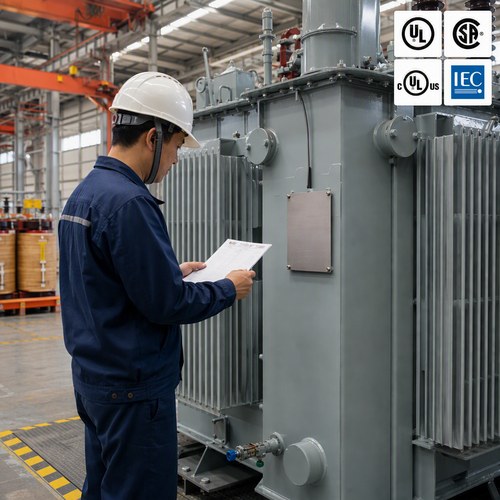
How Ryan Electric Builds Nameplates That Survive Inspection
Ryan Electric has built distribution and power transformers at our 120,000 m² factory in Jiangsu since 2007, and we ship to North America, the Middle East, Southeast Asia, and Africa. As an Eaton joint venture partner, our engineering team follows the documentation discipline that Eaton's supply chain requires — which is why every unit leaves with a nameplate that matches the factory test report line by line.
Three practices apply to every order. First, the nameplate layout is confirmed against the purchase order before manufacturing, so kVA, voltage, vector group, and certification marks are locked early. Second, routine tests — ratio, polarity, impedance, no-load loss, and dielectric tests per IEEE C57.12.90 — are recorded against the serial number, and the nameplate is marked accordingly. Third, the certified transformer test report ships with the unit, so the nameplate data and the paperwork agree when your inspector checks them.
If you are comparing quotes or reviewing an incoming unit, send us a photo of the transformer nameplate and your specification. Our engineers will confirm whether the ratings match — within one working day, at no charge. Contact us through ryantransformers.com/contact-us with your nameplate photo and spec sheet.
About the Author — This article was written by the engineering team at Ryan Electric, an Eaton joint venture partner and UL/CSA-certified transformer manufacturer in Jiangsu, China, serving utility, data center, and industrial buyers across North America, Europe, the Middle East, and Southeast Asia. We write about transformer selection, certification, and procurement from direct factory experience.
Table of Contents
- What a Transformer Nameplate Is and Why It Is a Legal Document
- The 14 Ratings That Matter on a Transformer Nameplate
- Temperature Rise: The Nameplate Rating Most Buyers Misread
- Percent Impedance and BIL: The Pair That Protects Your System
- Cooling Class and Sound Level: Reading the Fine Print
- Certification Marks: What UL and CSA File Numbers Prove
- How Ryan Electric Builds Nameplates That Survive Inspection