
 EN
EN
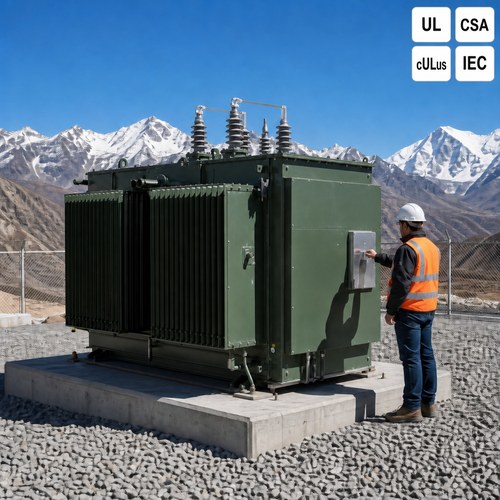
A utility engineer in Nairobi sent us an RFQ for a high altitude transformer last quarter — 1,000 kVA pad-mounted, 13.8 kV delta to 480Y/277 V, 65 K rise, UL-listed. The spec sheet looked like a hundred others we quote. Then our engineer asked the one question missing from most RFQs: what is the site elevation? The answer, 1,795 m, changed the design, the price, and the lead time.
Why 1,000 Meters Is the Line in the Sand
Every mainstream transformer standard assumes sea-level air. IEC 60076-1 and the IEEE C57.12.00 general requirements both define standard conditions as altitudes up to 1,000 m — IEEE states the figure as 3,300 ft — and both require corrections above that line. The physics is easy to explain to a procurement manager: cooling works by moving air, and thin air carries less heat per cubic meter. At 2,000 m, air density is roughly 18% lower than at sea level; at 3,000 m, it is about 26% lower.
That is why the same design that sails through a Texas summer at 200 m can run hot at a Kenyan highland substation. On an oil-immersed unit, the radiators and cooling fans do the work; on a dry-type unit, every ampere of cooling depends on air moving through the winding ducts. Ignore elevation and the transformer quietly lives a derated life — or ages its insulation far faster than the nameplate promises.
Two Corrections That Decide Whether the Unit Survives
When we engineer a high altitude transformer, we apply corrections in two independent places: the thermal design and the insulation system. Buyers who know about only one of them end up with surprises at factory acceptance testing or on site.
Thermal Correction: The Capacity Side
IEC 60076-1 steps the allowable temperature rise down above 1,000 m in increments of 500 m, and the practical response is the same in IEEE C57.12.00 territory: either the rise limit is reduced or the cooling is uprated. Our standard move for elevated sites is to design the winding for a 55 K average temperature rise instead of the standard 65 K — which means more conductor cross-section, larger radiators, and sometimes forced-air fans added to the cooler bank. The altitude derating factor we assign at the quoting stage flows straight onto the final nameplate rating, so nobody on the project confuses “designed for 2,400 m” with a sea-level rating.
Insulation Correction: The Clearance Side
Air does real dielectric work inside every transformer: across bushings, between phases, to ground, and through the cooling ducts of a dry-type winding. Thinner air holds off voltage less effectively, and partial discharge starts at lower voltages as altitude climbs — a documented effect that matters most for cast resin and VPI windings. In practice we increase clearances and creepage distances according to the correction factors in the governing standard, and we watch the curve closely above 2,000 m. The factory impulse test is still performed at sea level; the design, not the test, carries the altitude compensation.
Dry-Type vs Oil-Immersed at Altitude: The Data Center Angle
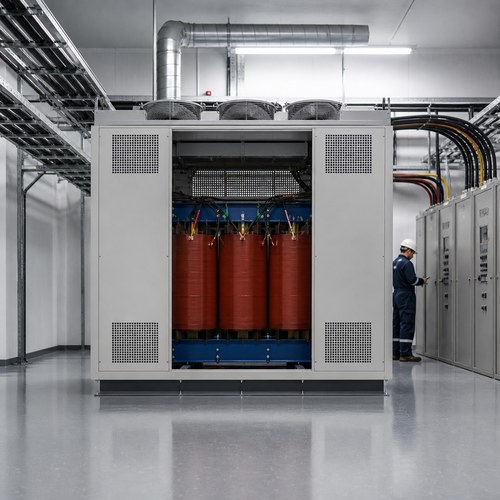
This is where the technology choice gets interesting. Data center campuses in Mexico City (2,240 m), Bogota (2,640 m), and Nairobi (1,795 m) are expanding faster than local grids can feed them, and indoor units are almost always cast resin or VPI because of fire codes. A cast resin transformer at 2,200 m needs its cooling correction taken seriously — the entire winding is cooled by air that is nearly one-fifth lighter than at sea level — and its partial discharge performance deserves extra margin. Oil-immersed units shed most heat through radiators and oil circulation, which makes them more forgiving of altitude, but cooler sizing, oil level, and breather behavior still need review.
We have quoted both technologies for elevated sites, and the pattern is consistent: buyers who send the elevation in the first email get a cleaner specification review than those who discover it when the transformer arrives. Transformer cooling at altitude is not exotic engineering — it is a routine correction applied with discipline.
What We Check Before Quoting an Elevated Site
Every RFQ that reaches our desk now carries an elevation field, because we learned the hard way that “mountainous area” on a project brief is not an elevation. When a project sits above 1,000 m, our engineering team checks five things before a price is drafted:
1. The altitude derating factor is applied to the nameplate kVA, not buried in a footnote. 2. Transformer cooling at altitude assumes site air density — radiator area, fan capacity, and duct design are sized for the actual site. 3. Insulation clearances and creepage are increased for bushings and dry-type windings, with PD margin for cast resin. 4. Accessories are re-checked: conservator volume, breather sizing, and pressure relief settings at site barometric pressure. 5. The factory test certificate carries a clear altitude-correction statement, so the inspector sees the same numbers we do.
Since 2023, Ryan Electric has operated as an official joint-venture partner of Eaton, and the design-review discipline from that partnership sits on top of every elevated-site quotation. Each high altitude transformer we ship is type-tested to UL, CSA, cULus, or IEC depending on destination, and our 120,000 m² factory in China runs 180+ sets of production equipment. The test report for an elevated-site project always states the correction applied and the revised rating — that document is your insurance against a wrong-nameplate dispute at customs or commissioning.
Elevation Table: How Far the Correction Goes
| Site Elevation | Air Density vs Sea Level | Main Risk | Typical Design Response |
| Up to 1,000 m (3,300 ft) | -9% or less | None for standard ratings | Standard design, no correction |
| 1,000 - 2,000 m | -9% to -18% | Thermal derating ignored | Cooling uprated, 55 K rise design |
| 2,000 - 3,000 m | -18% to -26% | Thermal + partial discharge margin | Derating factor on nameplate, longer clearances, PD margin |
| Above 3,000 m | Beyond -26% | Combined thermal and dielectric stress | Full correction study, longer bushings, fan-assisted cooling |
The table is a simplification — the correction methods in the standards are step-based, not linear — but it explains why the same transformer model can carry two completely different nameplates depending on destination. Always ask for the altitude-corrected rating in writing. For a high altitude transformer, the correction is not a negotiable extra; it is the design. For the thermal side of this decision, our earlier guide to transformer temperature rise covers the physics in depth.
Send the Elevation, Not Just the Spec
If you are specifying a transformer for a site above 1,000 m — a substation in the highlands, a mine at 4,000 m, a data center on a plateau — include the elevation in your RFQ. Our engineers will confirm the altitude derating factor, the cooling design, and the insulation margins before you sign anything. Send your load profile and site elevation through ryantransformers.com, and if your project crosses standard systems, check our IEC 60076 vs IEEE C57 standards comparison before you finalize the spec.
About the Author: This article was written by the transformer engineering team at Ryan Electric (Jiangsu Ryan Electric Co., Ltd.), a manufacturer of oil-immersed, dry-type, and pad-mounted transformers since 2007. The team supports utilities, EPC contractors, and industrial buyers across North America, Southeast Asia, the Middle East, and Africa with UL/CSA/cULus/IEC certified equipment and application engineering.