
 EN
EN
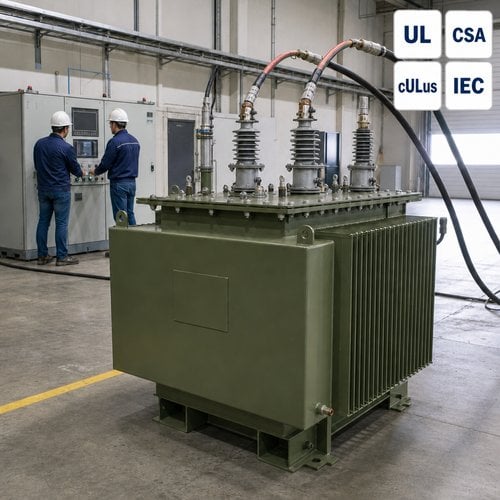
Three weeks ago, an EPC buyer in Hanoi sent us a transformer specification written around IEEE C57.12.00, with "60 Hz" typed into the frequency column. The project is in Vietnam, where the grid runs at 50 Hz and the utility accepts IEC 60076 test reports. One document, two incompatible worlds. The order sat still for a week while both sides worked out which standard the factory should actually build to.
That mix-up is more common than it should be. IEC 60076 and IEEE C57.12 look similar on paper — both define ratings, losses, temperature rise, and testing — but they part ways on frequency, vector groups, dry-type rise limits, and the certificates a transformer needs to cross a border. Specify the wrong family and you are not buying a machine; you are buying a re-engineering project. This guide shows where the two systems diverge and how to write a spec that survives contact with a factory quotation team.
Why This Choice Decides Your Delivery, Not Just Your Paperwork
The standard you name drives hardware, not just documents. Vector group, tap range, bushing type, test program, even the language on the nameplate — all of it follows from the standard family. A 50 Hz design cannot simply be re-rated at 60 Hz: core flux density, impedance, and cooling performance all shift, and a unit built to the wrong frequency usually fails its first heat run. We learned that lesson the expensive way a decade ago, when a batch of export units had to be re-designed mid-production because nobody had flagged the frequency mismatch early enough.
Certification follows the same fork. North America wants UL or CSA marks layered on IEEE conformance; most of the Middle East, Southeast Asia, Africa, and Europe build acceptance around IEC type-test reports. A factory that only knows one system will quote you confidently and sort the details out later — which is exactly when delays and rejection letters arrive. That is why we ask for the project frequency and the utility's governing standard before we quote anything.
IEC 60076: The Global Baseline
The IEC 60076 series is the closest thing transformers have to a world standard. General requirements sit in 60076-1:2011, which covers rated values, service conditions, and nameplate data for three-phase and single-phase power transformers — you can read the scope on the IEC Webstore page for IEC 60076-1. Temperature-rise limits are defined in 60076-2, dielectric tests in 60076-3, short-circuit withstand in 60076-5, and dry-type units in 60076-11.
The IEC system defaults to 50 Hz and describes winding connections with clock notation. A Dyn11 transformer has a delta primary, a wye secondary with neutral, and a 330-degree phase displacement — one line that tells a designer more than half a page of connection diagrams. When a utility in Saudi Arabia, Vietnam, or Malaysia opens your test report, the vector group and the declared impedance are usually the first two lines it checks. Tap range and no-load/load loss values come next, because tenders in these markets score loss capitalization formulas line by line.
IEEE C57.12: The North American Way
In the Americas, IEEE C57.12.00-2015 governs liquid-immersed distribution and power transformers, and the family splits the work differently from the IEC. C57.12.01 covers dry-type general requirements, C57.12.90 is the liquid-immersed test code, and certification marks sit on top — UL 1561 and UL 1562 for dry-type units, and the CSA C22.2 series for Canada. You can check the scope of the liquid-immersed standard on the IEEE Xplore record for C57.12.00-2015.
North America runs at 60 Hz, and distribution practice favors grounded-wye secondaries: 480Y/277 V and 208Y/120 V for commercial loads, with 12.47 kV and 13.8 kV common on the primary side. Specs here rarely use clock numbers; engineers specify connection and angular displacement from tables, then add utility-specific enclosure, tamper-resistance, and cable requirements that go beyond the IEEE base document. Before we crate a unit for Canada, two QC inspectors sign off that the CSA certification number is legible on the nameplate — utility inspectors check it the moment the truck arrives, and a missing mark costs more than a phone call.
IEC 60076 vs IEEE C57.12: Where the Specs Actually Diverge
Here is the part most buyers miss: the two systems agree on most of the physics, but the written requirements diverge in exactly the places that cause factory mistakes.
| Parameter | IEC world | North American world |
| Primary documents | IEC 60076 series (60076-1/2/3/5/11) | IEEE C57.12.00/.01/.90, plus UL or CSA marks |
| Nominal frequency | 50 Hz | 60 Hz |
| Vector group notation | Clock numbers (Dyn11, YNd11) | Phase-relation tables; grounded-wye common |
| Liquid-filled temperature rise | 65 K average winding (60076-2) | 65 degrees C average winding |
| Dry-type rise basis | Insulation class: 100 K (F), 125 K (H) | Rise classes of 115/150 degrees C typical under listing |
| Short-circuit withstand | Tested per 60076-5 | Tested per C57.12.90 |
| Market-entry evidence | Type-test reports and certificates | UL/CSA listing marks plus IEEE conformance |
| Nameplate | Layout per 60076-1 | ANSI-style with listing mark |
A transformer built for the left column will usually run fine on a 60 Hz network at reduced rating — but it will not pass the acceptance documents, and documents are what actually stop projects. On our test floor we have run both regimes back to back on different orders in the same week, and the paperwork differences are as real as the electrical ones.
Transformer Certification: The Second Half of the Story
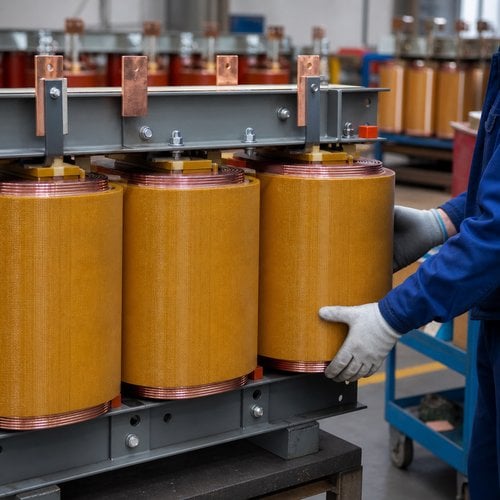
Conformance and certification are two different things. For IEC markets, transformer certification usually means a type-test report executed per the IEC 60076 series — lightning impulse, temperature rise, and short-circuit tests witnessed or reviewed by an independent body — plus routine test reports for every unit. Our factory test lab is CNAS-accredited, and we run witnessed type tests for export orders, so the report a client submits to a utility is the same document our own QC uses on the floor.
North American certification is mark-based: UL listing or CSA certification means a third party evaluated the design against the applicable standard and keeps auditing the factory on a schedule. The rule we give every buyer: if your end user is a U.S. utility, plan for a UL-listed or IEEE-conformant unit and expect the file number to be checked at arrival; if your end user is a utility in the Middle East or Southeast Asia, plan for IEC type tests and make sure the report covers the exact rating you ordered — a test report for a different kVA helps nobody.
What to Put in Your RFQ (and What to Leave Out)
The most common RFQ mistake we see is a single line reading "IEEE C57.12.00 or equivalent" — the words "or equivalent" tell a factory nothing. Instead of one vague clause, our engineers ask buyers for a short block like this:
- Standard and edition on one line: "IEC 60076-1:2011 with 60076-11" or "IEEE C57.12.00-2015".
- Frequency and system voltages: 50 Hz or 60 Hz, primary and secondary kV, and the connection type.
- Vector group or phase relation — for example Dyn11, or delta with a grounded wye.
- Service conditions: altitude above 1,000 m and the ambient temperature range.
- Test program: routine tests only, or witnessed type tests covering impulse, temperature rise, sound level, and short-circuit withstand.
- Certification deliverables: UL/CSA file number, IEC type-test certificates, and per-unit routine test reports.
If you are not sure which family your project falls into, send us the utility drawing, the system voltage, and the frequency. Our engineers will tell you which standard applies — usually within one working day, before you commit a spec to paper. That single conversation has saved several of our customers from re-testing costs that ran into five figures.
Ryan Electric Builds to Both Systems
Our factory in Jiangsu runs both test regimes on the same floor: IEC routine and type-test sequences for export orders, and IEEE/ANSI test procedures for North American units. The same production lines have shipped CSA-certified pad-mounted transformers to Canada and UL-listed dry-type units into U.S. projects, while building 50 Hz IEC units for Southeast Asia and the Middle East. As an Eaton joint venture partner with 37 patents and a 120,000 m2 manufacturing base behind us, we treat the standards question as an engineering input — not a contract clause to argue about after the order is placed.
When the standard is wrong, everything downstream is wrong: tests, certificates, commissioning, and the commercial operation date. If you are specifying transformers for a cross-border project, send your draft spec through the contact page on ryantransformers.com — we will flag IEC/IEEE conflicts before they become change orders, and quote you against the standard your utility actually accepts.
About the Author — This guide was written by the engineering team at Ryan Electric, an Eaton joint venture partner and UL/CSA-certified transformer manufacturer in Jiangsu, China, serving utility, renewable, and industrial clients across North America, Southeast Asia, the Middle East, and Africa.
Table of Contents
- Why This Choice Decides Your Delivery, Not Just Your Paperwork
- IEC 60076: The Global Baseline
- IEEE C57.12: The North American Way
- IEC 60076 vs IEEE C57.12: Where the Specs Actually Diverge
- Transformer Certification: The Second Half of the Story
- What to Put in Your RFQ (and What to Leave Out)
- Ryan Electric Builds to Both Systems