
 EN
EN
Two weeks ago an EPC buyer in Texas sent us an RFQ for wind farm transformer units with “33 kV” typed into the collector voltage column. The project is in the United States, where 34.5 kV is the default collector class. One number separates two different worlds of bushings, surge arresters, and switchgear — and a mismatch like that only surfaces at commissioning. We see the pattern constantly: turbine selection gets six months of engineering, while the wind farm transformer package gets two emails. That is the wrong way around.
The stakes are higher than ever. According to the Global Wind Report 2026 from the Global Wind Energy Council, developers connected a record 165 GW of new wind capacity in 2025 — 40 percent above the previous record — pushing global installed wind power to 1,299 GW. Every turbine in that fleet ties to the grid through a step-up unit, and every collector network terminates at a substation transformer. When transformer supply or specification slips, the whole project slips with it.
Why Transformer Specs Delay More Wind Projects Than Turbines
Turbine OEMs have standardized their machines, but the electrical collection system has not. Every project rewrites the collector voltage, the earthing philosophy, the utility protection requirements, and the certification target. That is where a wind project goes wrong — rarely in the kVA arithmetic, which is simple, and almost always in the details the spec sheet leaves blank.
Here is the part most buyers miss: impedance and tap range are contractual numbers, not design suggestions. When our engineers review an RFQ, those two columns get checked before price. A collector substation transformer specified at 10 percent impedance but delivered at 12 percent changes the fault current the protection engineer used in the coordination study, and relay settings are not something you redo during energization week.
The Two Transformer Jobs on a Wind Farm
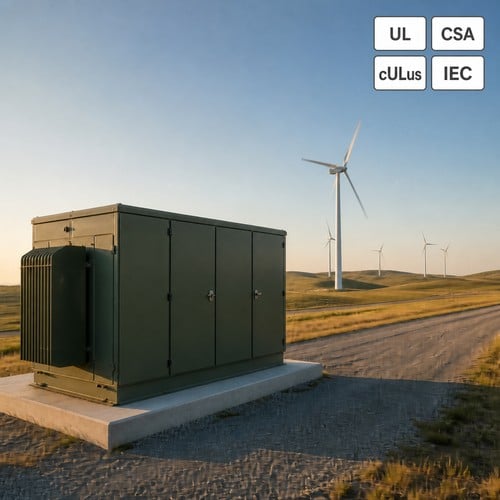
A wind farm uses two distinct classes of transformer, and treating them as one product family usually means one of the two is under-specified. The wind turbine step-up unit sits at each turbine and lifts the generator voltage to the medium-voltage collector. The collector substation transformer steps the whole farm up to the transmission voltage at the point of interconnection — typically 110 kV to 230 kV.
Sizing the step-up unit starts with the turbine, not with a rule of thumb. A 3 MW turbine exporting at 0.95 power factor draws roughly 3.2 MVA, so the unit is commonly rated around 3.5 MVA with margin for auxiliaries and reactive capability. In North America these pad-mounted units follow IEEE C57.12.34-2022, which now covers three-phase liquid-immersed units up to 10 MVA at 34.5 kV and below; internationally, IEC/IEEE 60076-16:2018 is the reference for turbine step-up transformers.
| Parameter | WTG step-up unit | Collector substation transformer |
|---|---|---|
| Typical rating | 1.5–6 MVA | 20–100+ MVA |
| Voltage levels | Generator side to 34.5 kV collector (NA) or 33 kV (EU/Asia) | 34.5/33 kV to 110–230 kV |
| Governing standard | IEC/IEEE 60076-16:2018; IEEE C57.12.34 (NA) | IEC 60076 / IEEE C57.12.00 + utility spec |
| Mounting | Pad-mounted or tower-base enclosure | Substation plinth, fenced bay |
| Key design driver | Compact footprint, cyclic gust loading, corrosion | Impedance, OLTC voltage control, efficiency |
| Tap equipment | Off-circuit taps typical | Motor-driven on-load tap changer typical |
Collector Voltage and the Standards That Follow It
Collector voltage is the first decision because everything downstream inherits it: cables, switchgear, arresters, and the transformer insulation class. In the United States the dominant choice is a 34.5 kV collector; in Europe and much of Southeast Asia it is 33 kV; offshore fleets are migrating to 66 kV. Confirm the nominal system voltage with the utility before anyone quotes — cable, switchgear, and transformer insulation class all follow the 34.5 kV collector decision — and put the number in the RFQ title.
The 2018 edition of IEC/IEEE 60076-16 made three changes that matter to buyers: rated power is now tied to the generator's output current, a thermal correction for the effective cooling medium was introduced, and the test regime was strengthened for the harsh electrical environment of a turbine. In practice this means a wind-duty unit is not an industrial transformer with a wind logo. The thermal model and the test certificate are different, and the difference shows up in winding temperature behavior under gust-driven loading.
One more North America check: if the step-up unit is a liquid-immersed distribution transformer within 10–2,500 kVA at 34.5 kV or below, it sits inside the U.S. Department of Energy's scope, and the amended efficiency standards with a 2029 compliance date apply to units for U.S. installation unless the design meets a defined exclusion — special-impedance and wide-tap-range designs being the common ones on wind duty. Ask the supplier to state the DOE efficiency tier or the exclusion in writing. Definitions are on the DOE distribution transformer standards page.
Cyclic Loading and Tap Changer Duty: The Wind Farm Transformer Specs Buyers Underrate
Wind output is cyclic by nature: full load during a gust front, near zero at 3 a.m. A transformer can ride those peaks if the thermal mass and cooling allow it — the real limit is winding hot-spot temperature, and loading guides such as IEEE C57.91 (oil-immersed) and IEC 60076-7 exist precisely to evaluate such duty cycles. What buyers should request is the load-capability curve for the actual wind profile, not a nameplate figure. No-load loss also deserves attention on wind duty: the unit runs energized through low-wind nights when copper loss is minimal and core loss dominates.
Do the arithmetic transparently: a 100 MW farm exporting at 0.95 power factor delivers about 105 MVA, so the collector station is usually built with two units — for example 2×60 MVA — or a single unit rated comfortably above 105 MVA. Then handle voltage control. Collector voltage swings with farm output and grid stiffness, and the utility expects the point-of-interconnection voltage held in band. That is why the collector substation transformer normally carries a motor-driven on-load tap changer, often specified as a ±10 percent range in seventeen positions, while WTG step-up units use off-circuit taps because the turbine converter manages its own voltage. Specify OLTC duty explicitly: operations per day, control from SCADA, and remote position indication. An on-load tap changer is a wearing part with a maintenance schedule — count it in the life-cycle cost, not just the first price.
Both decisions belong in the factory test scope. The routine test report should show measured impedance, no-load loss, load loss, and — for the units where it is specified — the temperature-rise test at full load. That report is your evidence at commissioning, and it is the same document the utility's engineer will ask for first.
The Checklist We Use to Review Wind Farm RFQs
Below is the checklist our engineers apply to every wind farm transformer RFQ that enters the factory. If your supplier cannot answer rows three and four from documented test data, the price is not the issue.
| Spec item | Why it matters | What to ask |
|---|---|---|
| Generator & collector voltages | Locks insulation class, bushings, arresters, and the governing standard | Confirm nominal system voltage on both windings; 34.5 kV vs 33 kV for the site |
| kVA and duty basis | Rating must cover apparent power, not just MW | Provide turbine MW, power factor, and the load profile used for sizing |
| Impedance (%) and tolerance | Drives fault current and relay coordination | State %Z and the tolerance basis (IEEE or IEC); request the measured value from the test report |
| Tap range and type | Voltage control vs wearing-part cost | OLTC ±10% / 17 positions for substation units; off-circuit taps for WTG units |
| Cooling and ambient | Nameplate assumes stated ambient and altitude | State maximum ambient, altitude, cooling class (ONAN/ONAF) |
| Standards & certification | UL/CSA required for US/Canada; IEC elsewhere | List certification target, edition, and marking requirements |
| Test scope | Test report is the delivery evidence | Request routine tests per IEEE C57.12.90 / IEC 60076-1, including measured losses and impedance |
| Accessories & monitoring | Determines O&M cost after commissioning | Winding temperature sensors, DGA sampling valve, SCADA-ready tap position |
How Ryan Electric Builds Wind Transformers With Test Data Behind Every Nameplate
Ryan Electric has built transformers in Jiangsu since 2007 on a 120,000-square-meter site with more than 180 production and test machines and 37 patents. We manufacture liquid-immersed distribution and power transformers up to 200 MVA, pad-mounted units with UL/CSA certification for North America, and dry-type lines for indoor duty. Since 2023 we have operated as an Eaton joint venture partner, which matters for wind buyers in one specific way: component selection and test discipline follow Eaton's quality system, not a lowest-cost parts list.
North American utilities routinely ask for measured no-load and load loss values before they release a shipment. Those numbers come from the routine test report, and we treat them as part of the commercial agreement — guaranteed values in the quotation, measured values in the report, and no gap between the two. When a wind EPC sends us an RFQ for collector or step-up units, they get back a specification review that flags the blank cells: impedance basis, tap range, ambient assumptions, and the certification target.
The practical advice from our engineers is short. Lock the collector voltage and the impedance early, send the turbine schedule and the site conditions with the RFQ, and ask for a production slot at the same time — transformer capacity is tight across the industry, and the wind farm that specifies early is the one that energizes on schedule.
If you are specifying wind farm transformers for a 2027 connection date, these are the questions we will ask you back. Send your turbine schedule, collector voltage, and site conditions through ryantransformers.com, and we will come back with a specification review and a realistic production slot — not a generic quotation.
About the Author: This article was written by the engineering team at Ryan Electric (Jiangsu, China), a UL/CSA-certified transformer manufacturer and Eaton joint venture partner serving wind, solar, storage, and utility projects across North America, Southeast Asia, the Middle East, and Africa.
Table of Contents
- Why Transformer Specs Delay More Wind Projects Than Turbines
- The Two Transformer Jobs on a Wind Farm
- Collector Voltage and the Standards That Follow It
- Cyclic Loading and Tap Changer Duty: The Wind Farm Transformer Specs Buyers Underrate
- The Checklist We Use to Review Wind Farm RFQs
- How Ryan Electric Builds Wind Transformers With Test Data Behind Every Nameplate