
 EN
EN
Last month, a buyer in Ohio sent us two quotes for what looked like the same transformer: 1,000 kVA, three-phase, 13.8 kV to 480Y/277 V, both UL-listed, both from established Asian factories. One quote was 9% cheaper. He asked us to match the price. We asked for the full specifications first — and found the difference on the fourth line of each data sheet. The cheaper unit was designed at 4.5% impedance. His engineer's spec, and the breaker coordination study behind it, assumed 5.75%.
That single number can change your fault current by thousands of amps, your voltage regulation, whether two transformers share load evenly, and your invoice. This article explains what transformer percent impedance actually is, why it matters before you buy, and the questions that keep a bad spec from reaching your site.
What Transformer Percent Impedance Actually Means
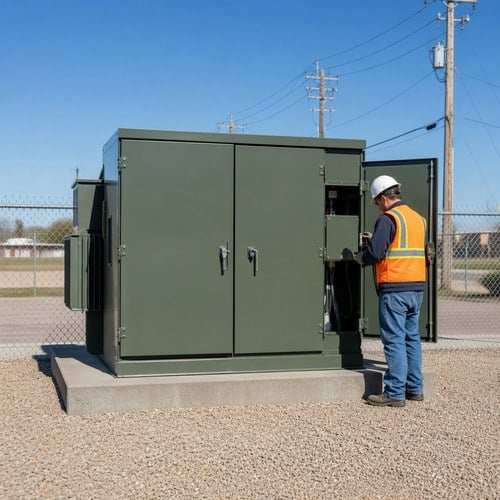
Percent impedance — usually written %Z or impedance voltage — is the voltage, expressed as a percentage of rated voltage, required to push rated current through a transformer with its secondary terminals short-circuited. In the factory routine test, the short-circuit test measures exactly this value. The number on the nameplate is the vector sum of winding resistance and leakage reactance, and in distribution designs reactance dominates.
That number is also the transformer's internal series impedance, and it decides how the unit behaves the moment something goes wrong downstream. Most three-phase pad mounted transformers in North America ship with impedance between 4% and 7%, and a 1,000 kVA unit is commonly specified at 5.75%.
Why %Z Decides Fault Current, Voltage Drop, and Parallel Operation
Fault current comes first because it is the biggest safety number on the sheet. On the standard infinite-bus approximation, a transformer contributes maximum symmetrical short-circuit current equal to rated current multiplied by (100 ÷ %Z). At 5.75%Z that is roughly 17.4 times rated current; at 4.5%Z it jumps to about 22 times. That difference decides whether your existing switchgear, CT ratios, and arc-flash study stay valid — or whether the utility and your insurer reject the installation.
Voltage regulation follows the same physics. Higher impedance means a larger internal voltage drop from no-load to full load. On a feeder already near its limit, a unit at 5.75%Z regulates visibly softer than one at 4.0%Z, which is one reason utilities publish minimum impedance values in pad mounted transformer specifications.
Parallel operation is where %Z mismatch becomes visible in the field. Two transformers in parallel share load in inverse proportion to their impedances; industry practice keeps impedance voltages within roughly 10% of each other. Beyond that, the lower-impedance unit carries more than its share and overheats while its partner runs half-loaded. We have re-engineered more than one retrofit order because the "identical" replacement unit turned out to be more than one percentage point lower in %Z than the transformer it was replacing.
Typical Impedance Values by Rating and Application
| Transformer type / rating | Typical %Z (indicative) |
|---|---|
| Single-phase distribution, 25–100 kVA | 1.5 – 2.5% |
| Three-phase distribution / pad mount, 300–500 kVA | 3.5 – 5.0% |
| Three-phase pad mounted, 750–2,500 kVA | 5.75% typical (5.5 – 7.0% range) |
| Substation power transformers, 5–50 MVA | 7 – 12% (per system study) |
| Generator step-up transformers | Often 10 – 14% |
Treat the table as a starting point, not a substitute for your utility's specification. IEEE C57.12 product standards publish standard impedance tables, and many North American utilities set their own minimums. If your utility publishes a minimum %Z, the transformer percent impedance you specify starts there — and every delivered unit should prove it on the routine test report.
How Impedance Moves Price, Losses, and Delivery
Higher impedance is not free. Reaching 7.0%Z instead of 5.75%Z usually means more winding turns, adjusted core geometry, or both — more copper, more core steel, and a heavier unit. That is why two otherwise identical quotes can differ by 8–10%: they are not the same transformer design wearing different labels.
Lower impedance makes the tank lighter and the invoice smaller, and it raises the fault current your protection must handle. There is no "good" or "bad" %Z in isolation — there is only the %Z your system study assumed. Here is the part most buyers miss: when a cheaper quote arrives with a lower %Z, the savings on the transformer can be wiped out by switchgear upgrades, restudies, and project delays on the other side of the purchase.
Losses shift as well. Because %Z is mostly leakage reactance, it is not the same story as winding resistance — but the design changes made to reach a target impedance can move both no-load loss and load loss. If your project falls under DOE efficiency rules, the loss values on the test report matter as much as the impedance number itself.
What to Ask Before You Approve a Spec
Buying on kVA alone ignores what transformer percent impedance does to the rest of your system. Add these four questions to your review:
- Guaranteed value, not aspirational. Ask for the guaranteed %Z at the principal tap, and state the kVA base it is referenced to. Impedance changes with tap position, and a number quoted "at rated tap" is not the same as one quoted at an off-tap position.
- Tolerance and proof. For liquid-immersed units, IEEE C57.12.00 holds production transformers to ±7.5% of the specified impedance voltage; IEC 60076-1 allows ±10% when the declared impedance is below 10%. Ask for the measured value from the routine short-circuit test report and compare it against the guaranteed figure.
- System study assumption. Confirm what %Z your breaker coordination and arc-flash studies assumed, and make sure the transformer meets that value with margin — not the other way around.
- Parallel units. If you are adding a second unit beside an existing transformer, request %Z matching within roughly 10% and verify the vector group and phase-angle relationship before ordering.
The current requirements for liquid-immersed transformers are defined in IEEE C57.12.00-2021, and the scope is summarized on the IEEE SA page if your engineer needs the exact reference for the project file.
How Ryan Electric Handles Impedance in the Factory
Every transformer we build — pad mounted transformer units for North America, dry type transformers for data centers, and oil-immersed distribution and power transformers for grid and industrial projects — receives a short-circuit impedance measurement as part of routine testing before it leaves our 120,000-square-meter facility in Jiangsu. The measured value is compared with the guaranteed figure and recorded on the test report that ships with the unit, not buried in a folder we email on request.
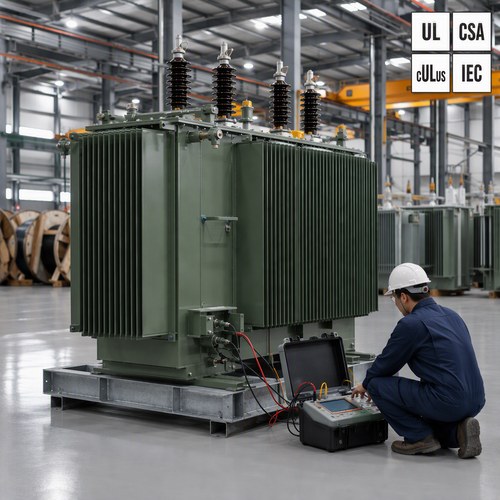
We also flag mismatches before shipment. When a customer's system study assumes 5.75%Z and the production unit measures 6.1%, that is a conversation we start in the factory, because it changes fault studies downstream. As an Eaton joint-venture partner since 2023, with UL, CSA, IEEE, and DEKRA certifications across our portfolio, we treat spec conformity as part of product quality — not as paperwork attached to it.
Spec It Right the First Time
Transformer percent impedance is one line on a data sheet — and one of the most expensive lines to get wrong. Before you send an RFQ, check the %Z your system study assumed. Before you accept a quote, ask for the guaranteed value and the routine test report. If you are not sure which impedance your project needs, send your rating, voltage, and fault-study assumptions to our engineers at ryan-transformers.com, and we will tell you what to specify — with the numbers to back it up.
About the Author: This article was written by the engineering team at Ryan Electric, an Eaton joint-venture partner and UL/CSA-certified transformer manufacturer in Jiangsu, China, serving utility, data center, solar, storage, and industrial clients across North America, Latin America, Southeast Asia, and the Middle East.
Table of Contents
- What Transformer Percent Impedance Actually Means
- Why %Z Decides Fault Current, Voltage Drop, and Parallel Operation
- Typical Impedance Values by Rating and Application
- How Impedance Moves Price, Losses, and Delivery
- What to Ask Before You Approve a Spec
- How Ryan Electric Handles Impedance in the Factory
- Spec It Right the First Time