
 EN
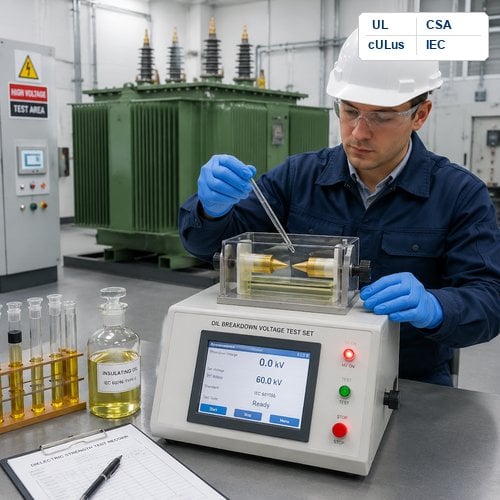
When commissioning a new medium-voltage substation or energizing a three-phase pad-mounted transformer, few quality parameters carry as much operational weight as the transformer oil dielectric breakdown voltage. Insulating liquid serves dual roles in liquid-filled transformers: it acts as a primary dielectric barrier across high-stress winding insulation clearances and functions as the primary cooling medium transferring core and coil heat to the external radiator walls. If the dielectric breakdown strength of the dielectric fluid degrades due to particulate contamination, dissolved water, or aging byproducts, internal flashover between winding turns, phase-to-phase leads, or HV-to-ground clearances becomes an immediate catastrophic risk.
In North American electrical utility, industrial, and renewable generation projects, transformer asset managers and commissioning engineers frequently encounter two distinct ASTM test methods on oil test reports: ASTM D877 and ASTM D1816. While both evaluate dielectric strength, their electrode configurations, sensitivity to contamination, and underlying physics differ substantially. Misunderstanding these differences can lead specifiers to approve oil that contains critical moisture levels or reject completely serviceable fluid during site commissioning.
Understanding the Physics: How Dielectric Breakdown Occurs in Insulating Liquids
Dielectric breakdown in transformer mineral oil is not a simple bulk-fluid conductivity threshold; it is a localized avalanche phenomenon initiated by electric field concentrations. Under power-frequency AC electric stress, free electrons accelerate across the liquid gap. When the applied voltage gradient exceeds the local dielectric withstand strength of the oil molecules, electron collisions produce molecular ionization, forming a conductive vapor bubble or ionized plasma filament between the energized electrodes.
In pristine, degassed, and moisture-free mineral oil, the intrinsic dielectric breakdown strength easily exceeds 70 kV across a standard 2 mm gap. However, in real-world transformer applications, microscopic contaminants—polar water molecules, conductive carbon particles, cellulose insulation lint, and oxidation sludges—alter the electric field distribution and trigger early electrical discharge.
ASTM D877 vs ASTM D1816: Electrode Geometry and Testing Methodology
ASTM D877 (Standard Test Method for Dielectric Breakdown Voltage of Insulating Liquids Using Disk Electrodes) utilizes two flat-faced brass disk electrodes measuring 1.0 inch (25.4 mm) in diameter with sharp square edges, spaced at a fixed gap of 0.100 inches (2.54 mm). The test cell relies on quiescent (non-stirred) oil and is primarily sensitive to gross free water droplets and large physical foreign particles.
In contrast, ASTM D1816 (Standard Test Method for Dielectric Breakdown Voltage of Insulating Oils of Petroleum Origin Using VDE Electrodes) employs spherically capped brass electrodes with a continuous smooth contour. The electrode gap is set precisely to either 0.040 inches (1.0 mm) or 0.080 inches (2.0 mm), and the test cup incorporates a motor-driven PTFE impeller that continuously circulates the oil between successive breakdown discharges. This provides a more realistic simulation of dynamic dielectric stresses inside energized transformer winding ducts.
| Technical Parameter | ASTM D877 Standard | ASTM D1816 Standard (1 mm / 2 mm) | IEC 60156 Equivalent |
|---|---|---|---|
| Electrode Shape | Flat brass disks, sharp square edges | Spherical VDE contour | Spherical / mushroom VDE electrodes |
| Standard Gap Spacing | 0.100 inch (2.54 mm) | 0.040 in (1.0 mm) or 0.080 in (2.0 mm) | 2.50 mm (0.098 in) |
| Sensitivity Profile | Gross free water, large foreign debris | Dissolved moisture, fine cellulose fibers, dust | Dissolved moisture and micro-particles |
| Primary Application | Legacy maintenance and bulk drum checks | Factory acceptance, commissioning, MV/HV grid | Global IEC substation transformers |
Because of ASTM D1816's superior sensitivity, IEEE C57.106 identifies it as the authoritative acceptance test for modern liquid-filled transformers with primary voltage ratings exceeding 69 kV and strongly recommends it for 15 kV to 35 kV class distribution and substation transformers.
IEEE C57.106 Standard Limits and Oil Breakdown Voltage Acceptance Criteria
Engineers must evaluate results against established oil breakdown voltage limits categorized by equipment voltage class and transformer lifecycle stage.
1. New Unprocessed Oil: Virgin mineral oil delivered from the refiner prior to vacuum processing and degassing. ASTM D877 minimum is 30 kV; ASTM D1816 (1 mm gap) minimum is 20 kV; ASTM D1816 (2 mm gap) minimum is 35 kV.
2. New Processed Oil: Oil after factory or field vacuum dehydration, degasification, and filtration. For distribution and substation transformers rated ≤ 69 kV, ASTM D1816 (1 mm gap) must achieve ≥ 25 kV, while the 2 mm gap must exceed 45 kV to 50 kV. For EHV units above 230 kV, the 2 mm gap must reach ≥ 60 kV.
3. Service-Aged Oil: For transformers rated ≤ 69 kV, oil should be reconditioned if ASTM D1816 (1 mm gap) drops below 23 kV or the 2 mm gap drops below 40 kV (or ASTM D877 falls below 26 kV).
Practical Field Experience: Sampling Protocols and False Failure Traps
Dielectric breakdown testing is extraordinarily sensitive to atmospheric moisture ingress and sample container cleanliness. Samples should be collected strictly according to ASTM D923: flush 1 to 2 liters through the sampling valve, use pre-cleaned oven-dried amber glass bottles with PTFE-lined caps, and allow the sample to equilibrate to ambient temperature before opening in the test cell.
A pad mounted transformer dielectric test can fail because of improper sampling rather than oil degradation. In one commissioning case, a humid-weather sample measured only 18 kV by ASTM D1816; a correctly collected sample measured 32 kV at 1 mm and 58 kV at 2 mm.
Root Causes of Dielectric Breakdown Degradation and Mitigation Strategies
Water Contamination: Water has a dielectric constant of approximately 80, compared with 2.2 for mineral oil. Vacuum dehydration and molecular sieve filtration restore dielectric strength.
Particulate Contamination: Multi-stage sub-micron cartridge filtration removes suspended cellulose and carbon bridges.
Thermal Oxidation and Sludge: When oil exhibits severe chemical aging, clay reclamation or complete oil replacement is necessary.
Ryan Electric Engineering Standards: Precision Dielectric Assurance
At Ryan Electric, ensuring absolute dielectric integrity is engineered into every stage of transformer design and manufacturing. Every oil-immersed and pad-mounted transformer undergoes comprehensive factory dielectric verification in a certified high-voltage testing bay. Ryan Electric applies quality systems complying with UL, CSA C22.2, IEEE C57.12.00, and IEC 60076 standards, with FAT test certificates and certified oil analysis documentation.
Summary Checklist for Specifying Transformer Oil Breakdown Testing
1. Always mandate the ASTM D1816 test method with a 1 mm or 2 mm gap as the primary dielectric acceptance standard for factory acceptance and site commissioning.
2. Ensure oil samples are collected according to ASTM D923 using dedicated glass containers, drain-line purging, and relative-humidity controls.
3. Correlate dielectric breakdown voltage with Karl Fischer moisture content (ASTM D1533), Dissolved Gas Analysis (IEEE C57.104), and Interfacial Tension (ASTM D971).
Need expert guidance on transformer testing, dielectric specifications, or custom medium-voltage transformer engineering? Contact Ryan Electric's technical team to review your project requirements and request a certified submittal package.
About the Author
Ryan Electric Engineering Team is a specialized group of senior power electrical engineers with decades of combined experience in medium- and high-voltage transformer design, dielectric insulation testing, and North American utility compliance.
Table of Contents
- Understanding the Physics: How Dielectric Breakdown Occurs in Insulating Liquids
- ASTM D877 vs ASTM D1816: Electrode Geometry and Testing Methodology
- IEEE C57.106 Standard Limits and Oil Breakdown Voltage Acceptance Criteria
- Practical Field Experience: Sampling Protocols and False Failure Traps
- Root Causes of Dielectric Breakdown Degradation and Mitigation Strategies
- Ryan Electric Engineering Standards: Precision Dielectric Assurance
- Summary Checklist for Specifying Transformer Oil Breakdown Testing
- About the Author