
 EN
EN
Why Oil Condition, Not Age, Decides How Long an Oil-Immersed Transformer Lasts
Oil does two jobs inside an oil-immersed transformer, and they are not the same job. It is the cooling medium that carries heat away from the windings to the radiators, and it is the dielectric that stands between live conductors and the tank. Neither function belongs to the oil alone. Oil immersed transformer maintenance exists because the oil is the messenger for the solid insulation: water dissolved in the oil migrates into the cellulose, and the cellulose is what actually fails.
The ageing curve is thermal. Industry loading guides such as IEEE C57.91 describe an Arrhenius relationship in which the insulation ageing rate roughly doubles for every 6 to 8 degrees Celsius of additional winding hot-spot temperature. Water accelerates that curve further, and acidic oxidation products attack the paper directly. Here is the part most buyers miss: oil tests pick up those changes long before the paper is gone, because acidity and interfacial tension shift while the cellulose is still serviceable.
So the first question is never how old the transformer is. It is whether the cellulose still has life left worth protecting. If dissolved gas analysis shows no active fault and the paper has not embrittled, the oil is worth treating. If the unit is already gassing or the windings have been running hot for years, new oil will not rebuild anything.
Reconditioning vs Reclamation: Two Different Jobs, Two Different Prices
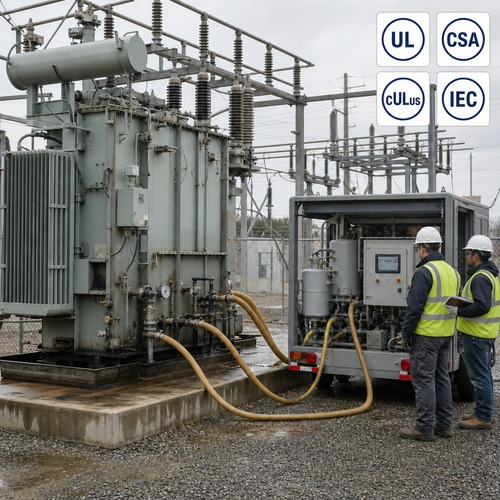
Suppliers use these two words interchangeably, and that is where budgets go wrong. Transformer oil reconditioning is a physical process: filtration, vacuum degassing, dehydration and particulate removal, usually performed on site with a mobile plant. It takes out water, dissolved gases, free particles and loose sludge, and it restores dielectric strength and heat transfer. What it does not do is remove dissolved acidic oxidation products, which is why interfacial tension and neutralisation number barely move after a straight reconditioning pass.
Reclamation is chemical as well as physical. The oil is passed through an adsorbent bed, typically activated clay or Fuller earth, which strips the acidic ageing products and sludge precursors out of solution. That is the treatment that actually moves acidity and interfacial tension back toward new-oil values. The distinction matters because reclamation costs more per litre and needs a longer outage, but on badly aged oil it is the only option that works.
The table below is the version we walk buyers through before any decision is made.
| Method | What it removes | Effect on acidity and IFT | Typical trigger |
| Reconditioning (on site) | Water, dissolved gases, free particles, suspended sludge | Minimal change; oil looks clean but stays aged | Moisture above the specification limit, low breakdown voltage, gas content high |
| Reclamation (adsorbent / clay) | Acidic oxidation products, sludge precursors, colour bodies | Acidity and IFT move back toward new-oil values | Acidity approaching 0.4 mg KOH/g, IFT at or below 22 mN/m |
| New oil charge | Nothing upstream; replaces the oil volume | Resets oil parameters to new-oil values | Oil exhausted, tank contaminated, or the retrofit is bundled with gasket and breather work |
| New transformer | Not applicable; addresses the whole asset | Not applicable | Active fault, overheated windings, or load growth beyond the unit design |
The Test Numbers That Tell You Which Method You Need
The decision should never rest on one number. Transformer oil testing gives you a set of parameters, and the pattern across them is what points to reconditioning, reclamation or replacement. These are the figures we check first.
Neutralisation number, or acidity, is the ageing indicator. Most utilities treat a value under 0.2 mg KOH/g as acceptable for continued service on non-inhibited mineral oil, watch anything above that closely, and expect sludge formation as the number approaches 0.4 mg KOH/g. Interfacial tension runs the other way: new mineral oil typically sits between 40 and 45 mN/m, values below roughly 25 mN/m indicate ageing, and an oil sitting at or below 22 mN/m is in reclamation territory.
Moisture, measured by Karl Fischer titration, is the parameter that most directly threatens dielectric strength, and its acceptance limit is set by voltage class rather than by a single global number. Add breakdown voltage, dissipation factor measured at 90 degrees Celsius, and dissolved gas analysis interpreted against IEEE C57.104, and you have a profile rather than a snapshot.
The reference to work from changed three weeks ago. IEEE C57.166-2026 was published on 15 September 2026 as the consolidated guide for acceptance and maintenance of insulating liquids in transformers and related equipment, and it explicitly references the methods of reconditioning and reclaiming insulating liquids together with the levels at which those methods become necessary. If your oil programme is still running on a scattered set of internal limits, that guide is the current baseline.
One screening step is non-negotiable before any decision to reuse or reclaim. Oil must be checked for polychlorinated biphenyls first, because PCB content changes both the permitted handling route and the disposal cost. The EPA used oil management requirements and their supporting recordkeeping rules apply to whatever volume leaves your site.
What On-Site Processing Actually Looks Like
The sequence we describe to clients has not changed much in a decade, and the discipline is in the order. De-energise the unit and let it cool to a safe handling temperature, take a pre-processing sample, then connect the mobile plant across the top and bottom valves so oil is drawn from the bottom and returned as a hot spray to the top of the tank.
From there the oil is circulated at elevated temperature through vacuum degassing, and if reclamation is required it is routed through adsorbent columns in the same loop. Two instruments tell you when to stop: the differential pressure across the filter elements, which climbs as the clay bed saturates, and the acid and interfacial tension numbers, which are re-run before and after each pass. When the parameters hold, the unit is flushed, refilled and left to settle before a post-treatment sample is taken, so the transformer oil testing results before and after treatment sit in the same maintenance record.
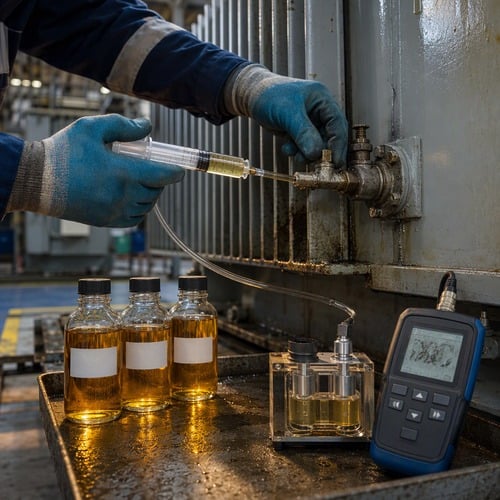
Two field traps are worth flagging. A unit that passes its oil test but has sludge packed into the radiator fins will not be fixed by processing the oil alone, because the flow path is already blocked and the sludge has to be removed mechanically or by a solvent flush. And processing a unit with leaking gaskets or a perished breather is money spent on a hole: seal the tank and fix the oil preservation system first, or the moisture returns within months.
Transformer Life Extension vs a Waiting Order: The Procurement Math
Compare the two paths honestly and the numbers usually sort themselves. Processing the oil is a planned outage measured in days, using equipment that can be mobilised to site. A new unit is a capital purchase plus a foundation, cable terminations, protection settings, commissioning tests and a re-energisation plan, and it arrives when the factory slot allows rather than when your load needs it.
Framed properly, transformer life extension is a capacity decision rather than a maintenance expense, because it holds load that the grid cannot yet replace.
The regulatory calendar adds a second reason to think in stages. The DOE distribution transformer efficiency standards were amended with compliance required for units manufactured on and after 23 April 2029. That date applies to new equipment entering commerce, so extending the life of an installed unit is not affected by it. What it does mean is that any replacement you defer is a replacement you will eventually buy to a tighter efficiency specification, and that timing deserves to be planned rather than forced by a failure.
We give buyers three questions, in this order:
1. Is the solid insulation still healthy? Dissolved gas analysis, load and temperature history, and an oil profile answer this. If the paper is degraded, spending on oil is spending on a dying asset.
2. Does the chemistry point to reconditioning or reclamation? Moisture and gas content alone can often be handled on site. Once acidity and interfacial tension have moved, expect an adsorbent treatment and plan the longer outage accordingly.
3. What does the outage actually cost? For a utility feeding a hospital or a data hall, the cost of a two-day outage may exceed the cost of the oil treatment several times over. For a plant with a spare unit on the pad, the same outage window is close to free.
If you are holding an oil report and a delivery date you do not like, send both to our engineering team. We will tell you which of the two paths the data supports, and what the unit needs to stay in service safely.
How Ryan Prepares Oil-Immersed Units Before They Ship
Ryan Electric has built transformers since 2007 and runs oil processing and routine testing on every oil-immersed unit before dispatch. Production takes place in a 120,000 square metre manufacturing base with more than 180 sets of production and test equipment and 37 registered patents, and the routine test report travels with the unit: ratio and polarity, winding resistance, impedance, no-load and load loss, applied and induced overvoltage, and the oil breakdown voltage measured after processing.
Certification coverage includes UL, CSA, IEEE, DEKRA, CNAS and CE, and our oil preservation designs are selected for the environment the unit will live in, whether that is a coastal site, a 50 degree desert ambient or a cold climate substation. Since 2023, Ryan Electric has also operated as an official joint-venture partner of Eaton, which sits alongside our own manufacturing and test capability rather than replacing it.
That specification experience is worth using before you commit to an oil programme. The choices that decide how well an oil charge survives are made at the design stage: whether the unit is hermetically sealed or conservator type, what breather or diaphragm system is fitted, which moisture limit is written into the acceptance criteria, and how the tank gaskets are specified. Get those right on a new order and the first reconditioning interval moves years into the future. They are also the difference between an oil immersed transformer maintenance plan that runs on a five-year cycle and one that is chasing moisture samples every year.
Deciding on Transformer Oil Reconditioning
Oil treatment is not a way to avoid buying transformers. It is a way to stop a healthy unit from being replaced for the wrong reason, and to hold capacity while the equipment market catches up. Treat the oil programme as part of asset strategy, pair it with dissolved gas analysis on a fixed cycle and a documented spare plan, and it will keep a substation running through the longest delivery window the industry has seen in decades.
Send us your latest oil test report, the nameplate data and your load profile. We will give you a straight answer on whether transformer oil reconditioning is enough, whether reclamation is needed, or whether the asset has reached the end of its economic life.
About the Author
This article was prepared by the transformer engineering team at Ryan Electric (Ryan Transformers). We have manufactured oil-immersed, dry-type and pad mounted transformers since 2007 for utilities, EPC contractors, data centre operators and industrial plants, and we review oil and insulation questions from buyers in North America, the Middle East, Southeast Asia and Africa every week. Our manufacturing base covers 120,000 square metres, supported by more than 180 sets of production and test equipment and 37 registered patents, with every unit routine tested and oil processed before dispatch.
Table of Contents
- Why Oil Condition, Not Age, Decides How Long an Oil-Immersed Transformer Lasts
- Reconditioning vs Reclamation: Two Different Jobs, Two Different Prices
- The Test Numbers That Tell You Which Method You Need
- What On-Site Processing Actually Looks Like
- Transformer Life Extension vs a Waiting Order: The Procurement Math
- How Ryan Prepares Oil-Immersed Units Before They Ship
- Deciding on Transformer Oil Reconditioning