
 EN
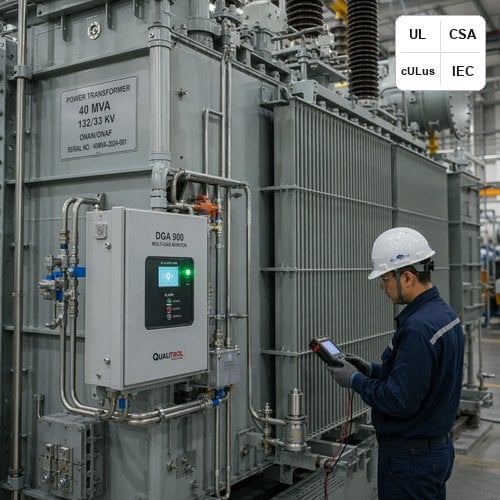
When an oil-immersed substation transformer experiences an incipient thermal or dielectric anomaly, mineral insulating oil and cellulose pressboard decompose into distinct hydrocarbon gases long before sudden pressure relays trip or differential protection operates. Critical power asset managers cannot afford to rely solely on annual laboratory oil sampling when dynamic electrical loading, steep solar ramps, and harmonic stresses can accelerate thermal breakdown within days. Making the right online DGA sensor selection ensures asset managers capture rapid gas generation rates, distinguish minor atmospheric breathing from active arcing, and prevent catastrophic tank ruptures.
Physics of Gas Evolution in Transformer Oil Dissolved Gas Analysis
Electrical and thermal stresses within mineral oil break chemical covalent carbon-hydrogen bonds (C-H) and carbon-carbon bonds (C-C), producing free radical hydrogen atoms and hydrocarbon fragments that recombine into seven diagnostic gases: hydrogen (H2), methane (CH4), ethane (C2H6), ethylene (C2H4), acetylene (C2H2), carbon monoxide (CO), and carbon dioxide (CO2). The specific molecular distribution of these gases depends directly on the localized energy density and hotspot temperature of the fault mechanism during transformer oil dissolved gas analysis.
Low-energy partial discharge (PD) ionization across dielectric voids primarily breaks C-H bonds at ambient temperatures to generate hydrogen (H2) with minor methane (CH4). Thermal breakdown of mineral oil begins above 150°C with methane and ethane production, transitions to ethylene (C2H4) predominance between 300°C and 700°C, and yields acetylene (C2H2) exclusively under intense electrical arcing where local temperatures exceed 700°C up to 3000°C. Concurrently, thermal degradation of solid cellulose insulation generates carbon monoxide (CO) and carbon dioxide (CO2), where a CO2/CO concentration ratio falling below 3.0 indicates severe paper aging or localized tracking.
Here is the breakdown of gas evolution mechanisms, characteristic generation temperatures, and associated internal transformer failure modes:
| Fault Type | Predominant Fault Gases | Activation Temp Range | Common Internal Root Causes |
|---|---|---|---|
| Partial Discharge (PD) | H2, minor CH4 | Ambient to 150°C | Dielectric voids in pressboard, gas bubbles, moisture in solid insulation |
| Low-Temp Thermal Fault (T1) | CH4, C2H6 | T < 300°C | Overloaded core laminations, poor contact in tap changers, stray flux heating |
| Medium-Temp Thermal Fault (T2) | C2H4, CH4, C2H6 | 300°C ≤ T < 700°C | Circulating currents between core bolts, localized winding hot spots, blocked duct |
| High-Temp Thermal Fault (T3) | C2H4, minor C2H2 | T ≥ 700°C | Severe winding short circuits, circulating currents in tank walls, heavy joint failure |
| Low-Energy Discharge (D1) | H2, C2H2, CH4 | T > 700°C (sparking) | Tracking in solid insulation, broken shielding wires, capacitive discharge |
| High-Energy Discharge (D2) | C2H2, H2, C2H4 | T > 1000°C (power arc) | Flashover between winding turns, phase-to-ground flashover, tap selector flash |
| Cellulose Degradation | CO, CO2 | 105°C - 250°C | Overheated conductor paper wrapping, localized thermal tracking on pressboard |
Sensor Technology Matrix for Online DGA Sensor Selection
Selecting an online gas monitoring architecture requires matching sensor extraction physics, analytical selectivity, and cross-sensitivity mitigation to the criticality index of the transformer asset. Modern industrial instruments utilize three primary gas extraction and detection methodologies: fuel-cell/semiconductor sensors, Non-Dispersive Infrared (NDIR) / Photoacoustic Spectroscopy (PAS), and carrier-gas-free Gas Chromatography (GC). Precise online DGA sensor selection balances Capex with diagnostic depth.
Single-gas hydrogen monitors utilize semi-permeable polytetrafluoroethylene (PTFE) or polyimide membranes immersed directly in the oil flow, where hydrogen molecules diffuse across the membrane to contact a palladium-nickel (Pd-Ni) or fuel cell detector. While single-gas sensors offer rapid 10-minute response times and zero consumable maintenance for distribution-class units, they cannot distinguish between benign core overheating and destructive high-energy arcing because they measure only hydrogen.
For high-criticality transmission and industrial furnace transformers, multi-gas analyzers (typically 3-gas, 5-gas, or full 9-gas plus moisture) extract dissolved gases via cyclic vacuum headspace degasification or permeation membranes before optical or chromatographic analysis. Photoacoustic Spectroscopy (PAS) pulses infrared light into an acoustic measurement chamber at specific absorption wavelengths, measuring acoustic pressure pulses generated by gas molecules with detection limits below 0.5 ppm for acetylene (C2H2). Solid-state Gas Chromatography uses micro-machined capillary columns and thermal conductivity detectors (TCD) to achieve laboratory-grade measurement repeatability (±5%) without carrier gas cylinders.
Evaluating IEEE C57.104 Transformer Gas Limits and Gas Generation Rates
Interpreting online sensor outputs requires moving beyond static ppm thresholds to evaluate continuous rates of gas generation (95th percentile rates) as defined in the IEEE Std C57.104-2019 standard and international guidelines published in IEC 60599:2022. The IEEE standard establishes three operational health conditions (Condition 1: Normal, Condition 2: Suspicious/Elevated, Condition 3: Critical/Active Gassing) based on 90th and 95th percentile historical population statistics.
Under IEEE C57.104 transformer gas limits, an asset operates in Condition 1 when all gas concentrations and daily rates remain below the 90th percentile baseline: H2 < 80 ppm, CH4 < 90 ppm, C2H6 < 50 ppm, C2H4 < 50 ppm, C2H2 < 1 ppm, CO < 900 ppm, and CO2 < 9000 ppm. If acetylene (C2H2) rises above 1.0 ppm or exhibits a generation rate exceeding 0.1 ppm/day, the system immediately escalates to Condition 3, triggering automated alarm contacts and mandatory oil sampling verification.
Continuous monitoring enables asset managers to calculate 7-day and 30-day Rate of Change (R_Delta in ppm/day). A transformer with high total dissolved combustible gas (TDCG) but flat daily slope represents historical dormant damage that does not require an immediate outage. Conversely, a unit with moderate 40 ppm ethylene (C2H4) that increases at 5 ppm/day indicates an active, accelerating hotspot governed by IEEE C57.104 transformer gas limits that demands prompt load curtailment or cooling intervention.
Diagnostic Fault Identification: Duval Triangle Fault Diagnosis
When multi-gas online sensors detect elevated combustible gases, asset engineers apply graphical ratio methods to pinpoint the fault location. While classical Rogers Ratios and Dornenburg Ratios frequently return inconclusive diagnoses due to non-matching ratio codes, Duval triangle fault diagnosis (specifically Duval Triangle 1, Triangle 4, and Triangle 5) provides unambiguous classification across 100% of gas combinations.
Duval Triangle 1 plots the relative triangular percentage of three key hydrocarbon gases on a normalized 100% scale: %CH4 = (CH4 / (CH4 + C2H4 + C2H2)) * 100, %C2H4 = (C2H4 / (CH4 + C2H4 + C2H2)) * 100, and %C2H2 = (C2H2 / (CH4 + C2H4 + C2H2)) * 100.
The resulting coordinate maps directly into six discrete fault zones:
- PD (Partial Discharge): High relative CH4 (>98%) with negligible C2H4 and C2H2.
- T1 (Thermal Fault <300°C): High CH4 (>76%) and low C2H4 (<20%) without acetylene.
- T2 (Thermal Fault 300°C-700°C): Moderate CH4 and rising C2H4 (20%-50%).
- T3 (Thermal Fault >700°C): Dominant C2H4 (>50%) with minimal C2H2 (<15%).
- D1 (Discharges of Low Energy): Measurable C2H2 (13%-29%) and C2H4 (23%-40%).
- D2 (Discharges of High Energy): Dominant C2H2 (>29%) indicating heavy power frequency arcing.
For low-temperature transformer faults, engineers switch to Duval Triangle 4 (H2, CH4, C2H6) and Triangle 5 (CH4, C2H4, C2H6) under Duval triangle fault diagnosis to distinguish carbonization of paper from localized oil overheating around stray-flux core structures.
Real-World Engineering Insights from Factory Acceptance and Field Operations
During factory acceptance testing (FAT) for a 40 MVA 115 kV substation transformer batch destined for an industrial chemical complex, our engineering team witnessed a sudden spike in ethylene (C2H4) during the temperature-rise heat run test. By isolating the sensor and cross-referencing with laboratory Gas Chromatography, we immediately identified a localized hotspot of approximately 420°C on a magnetic shield bolt before the unit was vacuum-sealed and shipped.
Field installation requires meticulous attention to sensor mounting location, oil circulation velocity, and ambient thermal gradients. Mounting a DGA sensor on a dead-end bottom drain valve without forced circulation can cause up to a 48-hour delay in detecting top-oil gas evolution. Best engineering practice mandates installing the sensor on an active loop between the main tank top-oil sampling port and the radiator return manifold, or specifying an integrated submersible circulation pump that maintains a constant 0.5 to 1.5 L/min sample stream across the analytical chamber during transformer oil dissolved gas analysis.
Ryan Electric Manufacturing and Advanced Transformer Monitoring Integration
At Ryan Electric, reliable transformer monitoring begins at the manufacturing stage. Operating from our state-of-the-art 120,000 m² manufacturing facility equipped with over 180 advanced production stations and holding 37 design patents, we engineer substation, pad-mounted, and power transformers with integrated optical fiber temperature sensors and dedicated DGA monitoring manifolds. Since 2023, as an official joint venture partner with Eaton, we implement rigorous vacuum degasification and oil filling protocols under 0.05 mbar absolute pressure, ensuring baseline total dissolved combustible gas levels remain below 15 ppm before factory dispatch.
Whether your project requires high-performance sub-station transformers certified to UL, CSA, IEEE, and CE standards or custom-engineered units for AI data centers and renewable energy plants, our engineering team provides fully factory-wired, calibrated, and SCADA-integrated online DGA monitoring packages tailored to your asset protection strategy.
Strategic Procurement Guide for Online DGA Systems
When preparing technical specifications for utility or industrial transformer procurement, follow these concrete engineering recommendations:
- Classify Asset Criticality: Specify single-gas (H2) sensors for distribution transformers under 5 MVA; deploy 3-gas or 5-gas monitors (H2, CH4, C2H4, C2H2, CO) for 5 to 25 MVA industrial units; and mandate full 9-gas plus moisture-in-oil analyzers for generating step-up (GSU) and critical transmission assets >25 MVA.
- Demand Low Acetylene Detection Limits: Ensure the instrument specifies a Lower Detection Limit (LDL) of ≤ 0.5 ppm for acetylene (C2H2) with ±5% repeatability to detect micro-arcing before catastrophic insulation failure.
- Verify Communication Protocol Compatibility: Require native DNP3, Modbus TCP/IP, and IEC 61850 MMS output capabilities to integrate gas alarms and generation rate slopes directly into substation SCADA and asset performance management (APM) software.
- Evaluate Calibration Maintenance Lifecycle: Prioritize carrier-gas-free Photoacoustic Spectroscopy or optical NDIR systems that offer 10-year calibration stability without consumable gas cylinder replacement.
Making an informed online DGA sensor selection safeguards critical electrical infrastructure, maximizes operational uptime, and extends asset lifespan across decades of severe grid duty.
About the Author
Ryan Electric Engineering Team
Ryan Electric is a global manufacturer of power, distribution, pad-mounted, and dry-type transformers, operating a 120,000 m² facility with 37 patents and UL/CSA/IEEE/CE certifications. As an official joint venture partner with Eaton since 2023, Ryan Electric delivers precision-engineered transformer solutions to world-class utilities, renewable energy developers, and hyperscale data centers worldwide.
Table of Contents
- Physics of Gas Evolution in Transformer Oil Dissolved Gas Analysis
- Sensor Technology Matrix for Online DGA Sensor Selection
- Evaluating IEEE C57.104 Transformer Gas Limits and Gas Generation Rates
- Diagnostic Fault Identification: Duval Triangle Fault Diagnosis
- Real-World Engineering Insights from Factory Acceptance and Field Operations
- Ryan Electric Manufacturing and Advanced Transformer Monitoring Integration
- Strategic Procurement Guide for Online DGA Systems