
 EN
EN
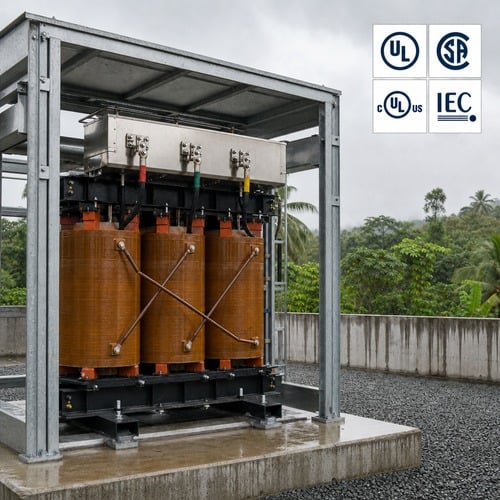
Two weeks ago an EPC buyer in Johor sent us a specification for a 2,000 kVA cast resin unit for a new data center campus. On paper it looked like every other request in our inbox. The design ambient was written as 40 °C, copied almost word for word from a Texas template. What the template left out was the half of the climate that actually causes failures here: a 32 °C daily average, relative humidity above 90 %, and a dew point that crosses the temperature of bare metal most nights of the year. Specifying a transformer for tropical climates is not a temperature exercise. It is a moisture exercise with a thermal clause attached.
Why a Transformer for Tropical Climates Is Not a Desert Unit With Less Heat
Desert duty is easy to describe. High maximum ambient, dust, UV, and a wide swing between a scorching afternoon and a cool night. Tropical duty looks milder on the datasheet and is harder on the insulation.
A site in Southeast Asia might top out at 34 °C, well below a Gulf site at 50 °C. But the daily average sits at 30 to 32 °C for months at a time and the night only drops 3 to 5 K. The unit never gets the long cool recovery period that lets a winding shed heat and lets insulation ageing slow down. Thermal life is governed by the average and by the winding hot spot, not by the record high on the site report.
The demand side explains why this matters right now. Johor’s data center supply nearly doubled in twelve months to 5.8 GW by the second quarter of 2025, with vacancy down to 1.1 %, while Asia Pacific logged close to 13 GW of new project announcements in the first half of that year, a 160 % jump year on year. See the Knight Frank findings reported by Xinhua. Every one of those campuses needs transformers that behave in that climate, not in a template.
That is where the standards framework earns its keep. IEC 60076-2:2011 defines the temperature rise limits for liquid-immersed transformers and the heat-run test methods used to prove them, and its 2011 edition added the winding hot-spot temperature rise limit to the requirements, the number that actually decides how fast paper insulation loses its mechanical strength. The full scope is listed on the IEC Webstore page for IEC 60076-2. The second half of tropical duty, moisture, has no temperature-rise clause at all.
The Design Ambient: What 35 °C Actually Costs You
Every tropical specification should carry two numbers: the maximum ambient and the monthly average. Most enquiries we receive quote only the first. A unit rated against a 35 °C maximum with no stated average is an incomplete order, because the average is what the heat-run calculation has to be checked against.
This is also where the dry-type standard became more useful than most buyers realise. IEC 60076-11:2018 applies to dry-type power transformers with a highest voltage for equipment up to and including 72.5 kV and at least one winding above 1.1 kV, and its second edition introduced new climatic classes and, for the first time, an explicit relationship between the installation location and the environmental class the transformer must be designed for. The scope and the changes are summarised on the IEC Webstore page for IEC 60076-11. In plain terms: the standard now asks where the unit is going, instead of letting a specification copy a number from another continent.
Here is the comparison we use internally when a buyer has no site survey yet. These are indicative design ranges, not measured site data, but they show why a tropical order cannot be priced from a temperate template.
| Design input | Temperate (Central Europe) | Desert (Gulf) | Tropical (Southeast Asia) |
| Maximum ambient | 35 °C | 48 to 50 °C | 34 to 36 °C |
| Monthly average ambient | 20 to 25 °C | 30 to 35 °C | 30 to 32 °C |
| Night-time temperature drop | 10 to 15 K | 12 to 18 K | 3 to 5 K |
| Relative humidity | 60 to 75 % | 20 to 40 % | 80 to 95 % |
| Dominant stress | Load cycling | Thermal and dust | Condensation and thermal |
| Typical failure mode | Winding ageing | Insulation and cooling | Moisture, corrosion, partial discharge |
When we quote a unit for Johor, Ho Chi Minh City or Jakarta, the heat-run calculation is run against the site’s monthly average and the enclosure plus heater package is priced with it. Buyers who skip that step usually discover the gap during the first monsoon season, not in the factory.
Condensation: The Failure Mode That Never Appears in a Specification
Read a tropical failure report and the sequence is almost always the same. Warm, saturated air fills the enclosure during the day. After dark, steel and winding surfaces cool faster than the air around them, and the moisture in that air condenses on the coldest surface available. Water sits on terminal boxes, creeps along creepage paths, and on oil-immersed units with a spent breather it eventually finds the oil.
The electrical symptom arrives weeks later. Insulation resistance drops, partial discharge activity appears, and the winding temperature climbs for no obvious load reason.
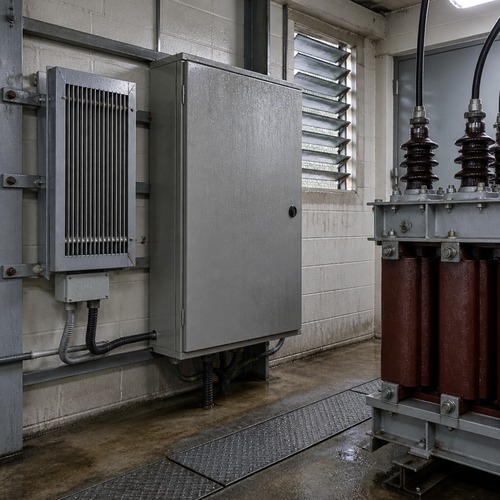
Every tropical unit that leaves our works gets the condensation package as standard. Each one ships with space heaters and a thermostat wired to a separate auxiliary supply, so the enclosure is held a few degrees above ambient whenever the transformer is de-energised, which on a data center standby feed or a seasonally loaded distribution unit is exactly when the damage would otherwise happen. Terminal boxes are gasketed and carry their own anti-condensation heater. Insulation resistance is recorded at one minute and at ten minutes during routine test, so the polarization index is on the record before the unit is packed.
On oil-immersed units the decision that matters most is the oil preservation system. A hermetically sealed tank keeps the oil out of contact with humid air entirely; a conservator design with a silica gel breather depends on that breather being maintained. On tropical sites with thin maintenance crews we steer buyers toward the sealed design unless the oil volume genuinely requires a conservator.
Enclosure, IP Rating and Materials in Humid Air
Humidity creates a design conflict that a temperate specification never surfaces. You want an enclosure sealed against moist air, but a sealed dry-type enclosure restricts the airflow that carries heat away from the windings and forces transformer derating. That is why the anti-condensation heater and the filtered vent usually have to be designed together rather than specified one at a time.
We resolve the conflict in one of two ways. Smaller units get a higher IP-rated enclosure, filtered ventilation and a heater package, accepting a modest transformer derating in continuous rating. Larger units get weatherproof ventilation with insect mesh, positive drainage paths, internal screens over the windings, and heaters sized for the enclosure volume, so airflow is preserved while standing water and insects are kept out.
Corrosion is the other slow failure. Hot-dip galvanised frames, stainless fasteners and a finish system chosen against a defined corrosion category do more for service life in a monsoon climate than a thicker paint film. Worth knowing: IEC 60076-11:2018 lists ISO 12944-6 among its normative references, so the corrosion protection category is already part of the dry-type conversation rather than an optional extra.
The dry-type versus oil-immersed choice itself shifts in the tropics. Cast resin windings are immune to moisture in a way exposed paper insulation is not, which is why indoor switchrooms across Southeast Asia are dominated by cast resin and VPI units. Outdoors, an oil-immersed unit with a sealed tank and a properly specified finish is still the more economical answer above roughly 5 MVA.
Test Evidence and Certification to Ask For
A transformer for tropical climates should not be accepted on a certificate alone. Ask for the documents behind it:
- The heat-run record, with the ambient assumption printed on it
- Insulation resistance and polarization index readings taken at routine test
- Partial discharge measurement on dry-type units
- Oil moisture content in ppm on oil-immersed units, before filling and after processing
- The corrosion category the finish system was specified to
On certification, North American listings for dry-type units are reviewed against UL 1561 or UL 1562 and, for Canada, the applicable CSA requirements. Our own laboratory is CNAS-accredited and runs dual 35 kV and 110 kV test bays, so routine tests and heat runs are performed and recorded in-house, and third-party witnesses are welcome to attend.
How We Build Tropical-Ready Units at Ryan Electric
Ryan Electric has built transformers since 2007 from a 120,000 m² production area and now exports to more than 80 countries across Southeast Asia, the Middle East, Africa and the Americas. Work on data center and utility projects in high-humidity markets is why the tropical package exists as a standard configuration rather than a special: cast resin or VPI windings, gasketed and heated terminal boxes, space heaters and an anti-condensation heater circuit on a separate auxiliary supply, insect-screened ventilation with positive drainage, and a finish system specified against the corrosion category of the site.
Since 2023 we have operated as a joint venture partner of Eaton, which brought a digitised production line and a second set of process controls into the plant. For a buyer in a humid climate the practical benefit is a shorter loop between specification and design review, because the enclosure, heater and finish decisions are signed off by the same team that builds the winding.
If your project sits anywhere the relative humidity stays above 80 % for most of the year, send us the site’s ambient profile and we will run the thermal and moisture calculations before quoting the kVA. Tell us the monthly average, the maximum, and whether the unit will be energised year-round or only in season. Those three answers change the design more than the kVA figure does.
Whether you are buying a transformer for tropical climates for a data center campus, a utility substation or an industrial plant, our application engineers will return a heat-run check, an enclosure and heater proposal, and the test evidence list your project needs. Reach the team through the Ryan Electric contact page with your site data.
About the Author. This article was prepared by the application engineering team at Ryan Electric (Jiangsu Ryan Electric Co., Ltd.), which supports EPC contractors, utilities and data center developers on transformer specification for high-humidity and high-ambient projects across Southeast Asia, the Middle East and Africa. The team covers insulation systems, enclosure design and factory testing for tropical and desert duty.
Table of Contents
- Why a Transformer for Tropical Climates Is Not a Desert Unit With Less Heat
- The Design Ambient: What 35 °C Actually Costs You
- Condensation: The Failure Mode That Never Appears in a Specification
- Enclosure, IP Rating and Materials in Humid Air
- Test Evidence and Certification to Ask For
- How We Build Tropical-Ready Units at Ryan Electric