
 EN
EN
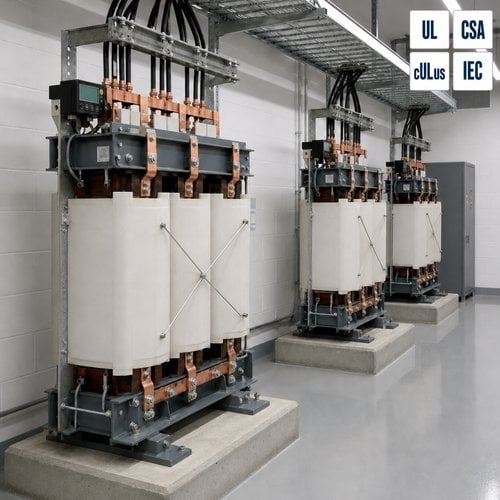
Why a Pharmaceutical Plant Is Harder on a Transformer Than It Looks
On a single-line diagram a pharma facility looks like an ordinary commercial building. It is not. Three things change the duty cycle. The load never stops — a sterile suite runs 24/7 at stable temperature and pressure, so the transformer sits at 60–75% load for years rather than cycling. Almost every motor is on a variable frequency drive, including the supply and exhaust fans that hold the cleanroom pressure cascade. And the loads that are not on drives — HPLC systems, mass spectrometers, laser particle counters — are exactly the loads that care most about voltage distortion.
A fill-finish plant we quoted last year runs a 1,500 kVA dry type unit at 68% average loading with no seasonal relief. After 26 months the winding temperature indicator was reading 12 °C above the design calculation. Nothing had failed. The unit was simply living at the top of its thermal class because of harmonic current circulating in the winding that the original load schedule never counted.
The Load Profile You Are Actually Feeding
Break a pharma plant into four power blocks and the transformer duty becomes easier to size. The cleanroom HVAC block is the largest: supply and exhaust fans, HEPA filtration, humidification, and the chilled water plant behind it. An ISO 8 suite typically runs 20 to 60 air changes per hour, which is why HVAC often carries 40–50% of connected load. The process block covers autoclaves, clean steam generators, WFI stills and CIP/SIP skids. The utilities block covers compressed air, nitrogen, chillers and the pure water plant. The lab block is small in kW but heavy in power electronics.
The most common sizing mistake we see is a flat diversity factor applied to connected load. A pharma load schedule is not a motor list. Autoclaves are cyclic and can add 30–40% of their rating for the duration of a heat-up cycle. WFI stills run continuously once commissioned. Cleanroom fans run at part speed for years and then step up as filter pressure drop rises. Sizing at 80% of connected load with a 25% spare margin is a defensible starting point — but only after you account for the harmonic distortion in the drive-fed portion of that load.
Cleanroom Power Quality: Where the Harmonics Come From
A six-pulse VFD front end draws a characteristic current spectrum: the 5th harmonic at roughly 20–25% of fundamental, the 7th at around 12–15%, then progressively smaller 11th and 13th components, with total current distortion commonly landing between 25% and 35% at the drive input. When those drives share a common bus, the transformer carries that distortion in its windings and delivers it to every other load on the secondary.
On the voltage side, IEEE 519 caps total harmonic voltage distortion at 5% and any individual harmonic at 3% on a bus rated 1 kV to 69 kV. For the transformer itself, three specification responses matter. A K-factor rating (K-13 or K-20) tells the manufacturer to design the core and winding for a defined harmonic current profile without exceeding rated hot-spot temperature. A 200% neutral keeps the neutral from becoming the hottest conductor in the system, because triplen harmonics add arithmetically instead of cancelling. And a lower design flux density keeps no-load loss and audible noise inside the limits a cleanroom next door will tolerate.
Here is the part most buyers miss. Harmonic current does not appear on the kVA nameplate, but it does appear as heat. A 1,500 kVA unit carrying 65% linear load plus 30% harmonic current can run hotter than a fully loaded linear unit of the same rating. If the load schedule carries no harmonic spectrum, the transformer for pharmaceutical plants is sized blind — and the first symptom is a winding temperature alarm two years later.
If you are working through a submittal right now, our engineering team will review the load schedule with you before you commit to a rating. Send it to us and we will size the unit with you rather than for you.
Redundancy: What N+1 Actually Changes in the Transformer Scheme
In an ordinary commercial building, redundancy usually means a spare breaker. In a pharma plant it is a qualification requirement. An N+1 redundancy transformer scheme normally means two units, each capable of carrying the full critical load, with a tie breaker between two switchboards so either transformer can be taken out for maintenance without interrupting the cleanroom pressure cascade.
The sizing arithmetic runs the other way from what most people expect. Two 1,000 kVA units in an N+1 pair are not interchangeable with one 2,000 kVA unit: each must carry the whole load at a loading that keeps its hot-spot temperature inside its thermal class, which usually means designing each unit at roughly 60–70% of total load, not 50%. If the critical load also carries 30% harmonic content, the effective design margin shrinks again.
Three practical details decide whether the scheme works in service: percent impedance matched within ±7.5% so the tie breaker does not produce a circulating current, identical vector groups and tap positions, and a deliberate decision about whether the tie is normally open or normally closed. That last decision changes the short-circuit rating of every switchboard downstream, so it belongs in the electrical consultant's scope before the units are released to production.
Choosing a Transformer for Pharmaceutical Plants: Cast Resin or VPI
Almost every cleanroom electrical room ends up with a dry type transformer, and for good reason: no liquid to contain, no bunded vault, and a fire load a risk assessment can live with. Within dry type, the choice is between cast resin transformer construction and VPI. Cast resin wins where humidity and washdown are real — epoxy encapsulation is not affected by condensation the way an impregnated winding can be — and where a Grade A area is directly adjacent, because it tolerates higher temperature rise with a lower fire load.
VPI units are typically lighter and lower cost at the same kVA, and their open-winding construction is easier to repair. For a lab block or a warehouse-side substation well away from sterile areas, VPI is often the sensible commercial choice. The table below is the version we work through with clients.
| Parameter | Cast Resin (cleanroom / sterile block) | VPI (lab, utilities, warehouse) |
| Insulation system | Epoxy-encapsulated, Class H (180 °C) | Impregnated, Class H, typically 100 K rise |
| Partial discharge limit | ≤ 10 pC to IEC 60076-11 | ≤ 10 pC to IEC 60076-11 |
| Moisture and washdown | Unaffected by condensation | Requires a dry, ventilated room |
| Siting inside the building | Can sit within the building envelope | Normally a dedicated ventilated room |
| Typical repair path | Winding or unit replacement | Re-impregnation or unit replacement |
| Relative cost at same kVA | Baseline | Lower |
Documentation and Certification That Pharma Audits Ask For
A transformer for pharmaceutical plants is procured as qualified equipment, not as a commodity, and the documentation package is part of the acceptance criteria. On the certification side, a North American installation needs a UL 1561 or UL 1562 listed unit and, for Canadian sites, CSA certification — the same marks our dry type and pad mounted units already carry. UL Solutions publishes the listing records, and the nameplate has to show the matching file number.
On the efficiency side, a US installation has to meet the DOE energy conservation standards for distribution transformers (10 CFR Part 431 Subpart K), which set minimum efficiency by kVA and voltage class for dry type units. The practical implication for a pharma project is that the efficiency class must be fixed at the RFQ stage, because it drives core material and therefore weight, footprint and lead time.
Then there is process documentation. Facility qualification teams work to the FDA cGMP regulations for finished pharmaceuticals (21 CFR Part 211) for equipment that touches the product environment, and they will ask for the factory test report with routine test values, the partial discharge record, material certificates and a traceable serial number. ISPE guidance and each company's own validation master plan set the exact package, but the factory has to be able to produce it on paper, not on request.
What Ryan Electric Builds for Cleanroom Projects
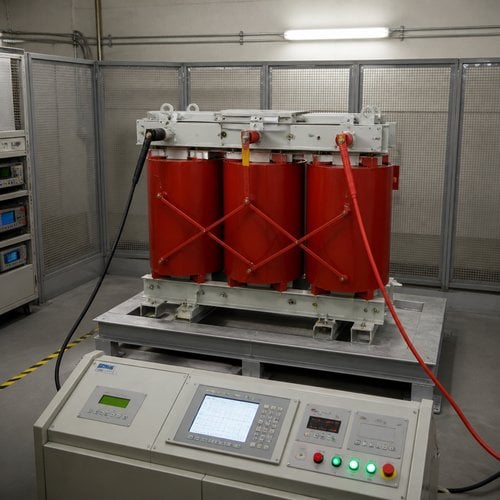
Our manufacturing base covers 120,000 m² with more than 180 pieces of production and test equipment and 37 patents. Every cleanroom-destined dry type unit goes through a routine test sequence that includes winding resistance, ratio and vector group verification, induced voltage withstand, and a partial discharge measurement recorded in pC — the number a pharma qualification team actually reads. Cast resin coils are vacuum-cast in house, so the insulation system in the finished unit is the one that was tested, not an outsourced unknown.
Since 2023 Ryan Electric has manufactured as a joint-venture partner of Eaton, which is why our documentation package follows the format North American project teams already expect to receive.
For cleanroom work we most often build cast resin units between 1,000 and 2,500 kVA, with a K-13 rating and a 200% neutral wherever the submittal shows more than 20% drive-fed load. We ask for the harmonic spectrum before we commit to a temperature rise, and we will say so if the spectrum does not support the loading the client had assumed.
If you are specifying a transformer for pharmaceutical plants — a sterile block, a laboratory or a fill-finish line — send us the load schedule and the harmonic data behind it, not just the kVA. Our engineering team will come back with a transformer rating, a K-factor recommendation and the test documentation your qualification team will ask for. Request a quote today.
Table of Contents
- Why a Pharmaceutical Plant Is Harder on a Transformer Than It Looks
- The Load Profile You Are Actually Feeding
- Cleanroom Power Quality: Where the Harmonics Come From
- Redundancy: What N+1 Actually Changes in the Transformer Scheme
- Choosing a Transformer for Pharmaceutical Plants: Cast Resin or VPI
- Documentation and Certification That Pharma Audits Ask For
- What Ryan Electric Builds for Cleanroom Projects