
 EN
EN
Mobile Substation Transformers Explained: Ratings, Transport Limits and Storm Response
Storm surge through a 138 kV yard. A transmission transformer quoted at fourteen months. A town running on diesel generators. When those three things land in the same week, utility planners stop shopping for a bigger transformer and start asking a harder question: what can we roll in and energize? That job belongs to the mobile substation transformer, and the limits that decide whether it works have very little to do with the number on the nameplate.
Most of those limits live somewhere electrical engineers do not usually look: the highway.
What a Mobile Substation Transformer Actually Is
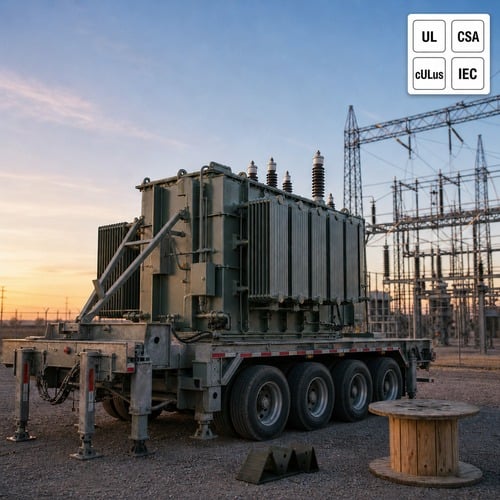
An IEEE Power & Energy Society technical presentation on the subject describes the equipment the way field crews do - a substation on wheels. A single trailer carries the transformer plus its cooling equipment, high- and low-voltage circuit protection, metering, relaying, AC and DC auxiliary supplies, and surge protection, all of it wired, tested and ready to connect.
Two configurations exist, and buyers mix them up constantly. A complete mobile substation transformer package keeps the high-voltage switching on the same trailer. A mobile transformer alone carries only the transformer, with the HV equipment on a second trailer - the route most projects take when the MVA rating has to stay high but the road envelope cannot absorb the extra gear. The second option buys capacity, and pays for it with a second pull and a longer setup.
Whatever the configuration, the same five assemblies show up: the high-voltage section, the transformer and its cooling, the low-voltage section, the control and protection cabinet with auxiliary supply, and a trailer designed around the first four.
The Spec That Limits a Mobile Unit Is Weight, Not MVA
Here is the part most buyers miss. Mobile substations are generally rated 60 MVA or less - not because of insulation limits, but because of road limits. The IEEE PES material is direct about the cause: MVA and voltage combinations are limited by transport weight and dimensions.
In the United States, federal law caps a single axle at 20,000 lb, a tandem axle at 34,000 lb and gross vehicle weight at 80,000 lb on the Interstate System, and the Bridge Formula can reduce those figures further depending on axle spacing. The rules are published on the FHWA Bridge Formula Weights page. Now put a 138 kV power transformer on a trailer and try to stay inside that envelope. The transformer is the largest, heaviest and most costly item on the unit, which is why a trailer-mounted transformer of this class starts from a weight budget rather than a winding drawing.
Height and width bite as well. A standard mobile unit is built to roughly 8 ft 6 in wide and 13 ft 6 in tall. Exceed those numbers and the unit moves into oversize and overweight permit territory - route surveys, escorts and restricted travel windows. That is precisely the paperwork a utility is trying to avoid during emergency power restoration.
| Parameter | Conventional substation transformer | Mobile substation transformer |
| Rating range | 833 kVA single-phase and above | Generally 60 MVA or less, transport-limited |
| Binding constraint | Insulation, thermal and short-circuit duty | Axle loading, gross vehicle weight, road envelope |
| Percent impedance | ANSI/IEEE standard values | Typically about 2x standard values |
| Cooling | ONAN or ONAF, static | ODAF, pumps and fans energized with the unit |
| Winding temperature rise | 55 C or 65 C typical | 95 C with hybrid Nomex insulation to cut weight |
| Bushings | Standard height, air or oil | Bottom-mounted; polymer where weight matters |
| Losses and sound | Evaluated and optimized | Losses not usually evaluated; NEMA-standard sound |
| HV switching | Fixed yard structure | Same trailer, or a second trailer at high MVA |
Five Technical Choices That Decide Whether the Unit Works
The standard most buyers quote for liquid-immersed power transformers, IEEE C57.12.10, explicitly excludes mobile transformers from its scope, as the IEEE standards page states. A mobile specification therefore cannot inherit the design assumptions of a fixed substation unit. Five decisions carry most of the risk.
- Impedance. Mobile units typically run about twice the ANSI standard percent impedance for the same rating, which changes voltage regulation and load sharing if the unit is paralleled with an existing transformer.
- Cooling. ODAF, with pumps and fans energized whenever the transformer is. Without the coolers running, the unit cannot carry load at all. Redundancy is designed in: with one pump out of service, a properly built cooler bank still carries roughly 70% of rated load indefinitely.
- Temperature rise. A 95 C winding rise with an upgraded hybrid Nomex insulation system keeps weight and size down without surrendering expected life.
- Insulation level. Trimming high-voltage BIL is one of the largest weight savers available. Low-voltage BIL is normally kept at full level - up to 25 kV and 150 kV BIL.
- Voltage regulation. LV-side load tap changing, typically plus or minus 10% in plus or minus 16 steps. Multiple LV voltages look flexible on paper until the LTC needs a series transformer to cover both - and that series transformer puts weight and size straight back on the trailer.
The pattern repeats. Every choice that adds electrical flexibility costs kilograms, and kilograms are the one budget with a legal ceiling. Designs that ignore this end up as two-trailer projects whether the buyer planned for it or not. The same physics is documented in the IEEE PES mobile substation presentation, which walks through real 40 MVA and 45 MVA units and the weight trade-offs behind them.
Where a Mobile Unit Earns Its Keep
Storm and flood response - emergency power restoration in the language of most utility procurement documents - is the use case that sells the concept internally. Planned work is the quieter payback: a unit that bypasses a transformer during a maintenance program keeps customers energized while the work happens, which removes the political cost of a scheduled outage.
- Bypass transformer during planned maintenance, inspection or testing programs
- Emergency replacement after a transformer or switchgear failure
- Temporary capacity while a permanent substation is designed and built
- Over-capacity service during seasonal peaks or plant commissioning
- Primary supply for isolated areas and remote construction sites
- Backup where earthquake, flood or conflict risk threatens fixed infrastructure
- De-icing of HV transmission lines in very cold regions
The commercial logic is not complicated. A mobile substation transformer that sits parked for eleven months and restores service in one has already paid for itself, because the alternative is a rebuilt substation measured in years.
The Field Detail Most Buyers Learn Too Late
A utility in the Gulf Coast region asked us to quote a 138 kV unit on a single trailer. The specification ran to thirty pages and mentioned the highway once. The first thing our design team did was not choose a core - it was calculate the transport load. Weight distribution decides where the transformer sits on the deck, and that decision constrains every drawing that follows.
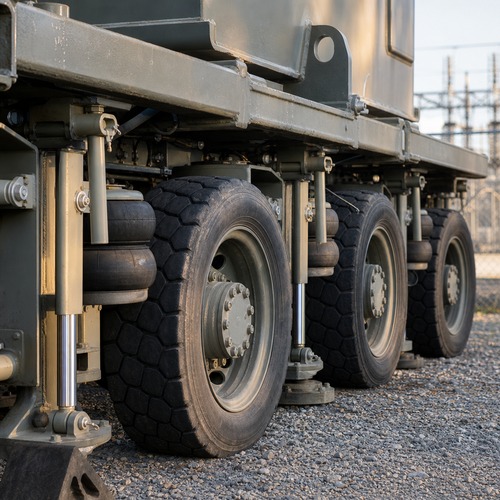
The conversation reordered the project. Axle count and axle spacing went onto the drawing before the winding. The trailer design ended up with steerable axles, air-ride suspension and hydraulic leveling, plus chock blocks so the unit stays put once the tractor is unhooked. The customer's tractor became part of our scope too, because the trailer and the towing tractor together have to meet the highway regulations of the states and counties where the unit will operate.
Three questions now open every mobile quotation we write. What primary voltage and MVA must the unit carry? Which states and routes will it travel, and who owns the tractor? And how many low-side voltages does the site actually need - since each additional one can pull a series transformer onto the deck?
How Ryan Electric Approaches Mobile Projects
Ryan Electric has built transformers since 2007 and has worked as an official joint-venture partner of Eaton since 2023. The factory runs 120,000 square meters with more than 180 sets of production and test equipment and 37 patents, and we build both liquid-immersed and dry-type units. The same weight logic shows up in our North American pad mounted transformer line, where a few hundred kilograms decide whether a design ships standard or needs a crane on site. Certification coverage includes UL, CSA, IEEE, DEKRA, CNAS and CE, and every unit ships with routine test data - ratio, winding resistance, impedance, no-load loss, load loss and dielectric tests.
On mobile work our engineers start from the transport envelope and work inward: vehicle weight, axle spacing, road restrictions, then electrical ratings. If your route rules out a single trailer, we would rather tell you before quoting a rating you cannot legally move. A trailer-mounted transformer is not a standard unit dropped onto a flatbed; the trailer and the transformer are designed together, from the first sketch. That is the same discipline we apply to a pad mounted transformer built to a specific enclosure, clearance and vault standard.
Planning Before the Next Storm Season
Mobile units are ordered by utilities that have already had the bad week, and lead time works against anyone who waits for the storm to arrive. If you are evaluating one, send us the primary and secondary voltages, the MVA you must carry, the low-side configuration and the states the unit will travel. We will come back with a weight budget, a trailer arrangement and test documentation you can hand to your own transmission planners. Our power transformer team can be reached through our contact page.
About the Author: This article was written by the engineering team at Ryan Electric, an Eaton joint-venture partner and UL/CSA-certified transformer manufacturer in Jiangsu, China, serving utility, data center and industrial clients across North America, the Middle East, Southeast Asia and Africa.
Table of Contents
- Mobile Substation Transformers Explained: Ratings, Transport Limits and Storm Response
- What a Mobile Substation Transformer Actually Is
- The Spec That Limits a Mobile Unit Is Weight, Not MVA
- Five Technical Choices That Decide Whether the Unit Works
- Where a Mobile Unit Earns Its Keep
- The Field Detail Most Buyers Learn Too Late
- How Ryan Electric Approaches Mobile Projects
- Planning Before the Next Storm Season