
 EN
EN
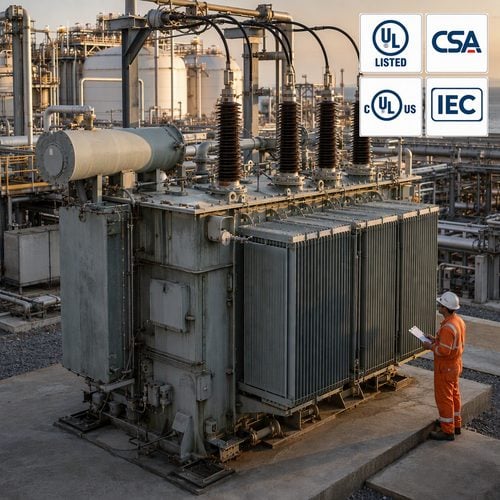
Last December an EPC contractor in the Gulf sent us a specification for six 13.8 kV units feeding refrigerant compressor drives on a liquefaction train. The kVA was there, the impedance was there, and the paint system was described in three words: marine grade. That phrase tells a transformer factory almost nothing. Before we quoted we asked two questions — where does each unit sit relative to the process area, and what is the harmonic spectrum at the drive input? The answers changed the design of four of the six units.
A transformer for LNG plants is not an ordinary kVA figure with a different nameplate. It sits where three sets of requirements overlap: continuous heavy duty from large variable-frequency drives, a marine atmosphere that eats paint for a living, and a safety regime written around fire and gas rather than electrical convenience. That overlap is getting crowded. U.S. LNG exports averaged 17.4 Bcf/d in the first half of 2026, 23% above the same period in 2025, with Plaquemines running at full capacity, Corpus Christi Stage 3 exporting from six of seven trains and Golden Pass shipping from April 2026, according to the EIA LNG export analysis. North American export capacity is projected to nearly double by 2029, and almost every one of those trains sits on a coastline.
Why a Transformer for LNG Plants Works Harder Than Its Nameplate Suggests
Start with duty. A liquefaction train is a continuous process, not a shift-based factory. The refrigerant compressors run at high load for months at a time, and the load factor through a normal week sits in the 80–95% band. There is no quiet Sunday night to let a winding cool back down, so designs inherited from commercial building practice arrive undersized for the duty.
Then add the environment. A Gulf Coast, North African or Southeast Asian LNG site combines 45 °C design ambient, salt-laden air and, in some locations, cyclone exposure. The outdoor unit sees all three; the indoor unit sees humidity and condensation instead. The mechanical specification — paint system, gaskets, breathers, heater elements — carries as much weight as the electrical one.
The third factor catches buyers arriving from ordinary industrial plants: these loads are harmonic-rich, and that is a sizing problem rather than a power quality footnote.
The Load That Sizes the Unit: Compressor Drives and Harmonics
Propane and mixed-refrigerant compressors on a modern train are typically 4 MW to 30 MW machines on 6.6 kV or 13.8 kV motors, and they are almost always fed from variable-frequency drives. A six-pulse drive draws a current rich in fifth and seventh harmonics. Moving to an 18-pulse or 24-pulse arrangement, or to an active front end, cuts the distortion considerably without removing it.
Harmonic currents do not simply ride on top of the fundamental. They add eddy and stray losses in the windings and in structural parts, and those losses concentrate heat at the winding hot spot — the exact place that decides insulation life. Harmonic derating is the correction, and IEEE C57.110 is the reference most North American specifiers use: it sets out methods for establishing what a liquid-immersed or dry-type unit can actually carry when part of its load is non-sinusoidal. Distortion limits at the coupling point are handled separately under IEEE 519. For a transformer for LNG plants, that spectrum has to come from the drive vendor, not from a template.
Here is the part that changes the design. On a direct-on-line motor the starting kVA usually sizes the transformer. On a VFD-fed compressor drive, starting current is controlled by the drive and is no longer the governing event. What sizes the unit is often continuous load plus harmonic heating — and occasionally the drive’s tolerance to voltage dip, which depends on impedance rather than kVA. We have watched a drive trip on commissioning because the impedance had been chosen purely for short-circuit coordination.
Temperature rise then sets the margin. IEEE C57.12.00 gives two common columns for liquid-immersed units: 55 °C average winding rise with a 65 °C hot spot, or 65 °C average rise with an 80 °C hot spot. LNG specifications usually land in the second column, because it buys load headroom in a hot ambient without extra radiator area. It also spends insulation margin, so it needs a loading study behind it rather than an assumption.
One habit from our quoting desk: when a compressor drive datasheet arrives without a harmonic spectrum, we ask for one. On a recent project the difference between the generic six-pulse spectrum in the buyer’s template and the actual drive arrangement moved the recommended rating two standard steps down. Guess it the other way and the same gap becomes a failure instead of a saving.
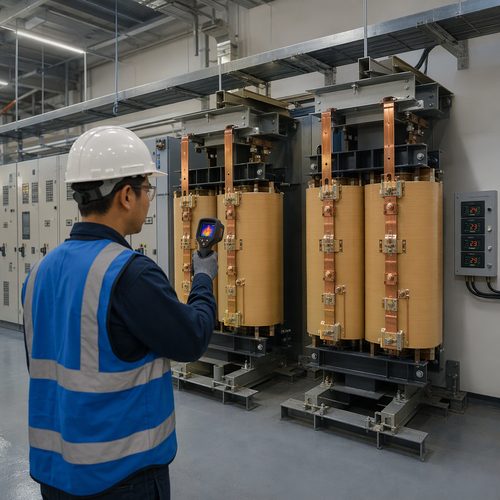
Oil Immersed Transformer or Cast Resin Transformer? Let the Location Decide
This is the first decision on any LNG job, and it is not really an electrical decision. The area classification drawing and the fire protection strategy decide what you may install where; only then does the technology comparison matter.
| Decision point | Oil immersed transformer | Cast resin transformer |
| Normal installation | Outdoor yard beside the process train, on a pad with oil containment | Indoor electrical house or control-adjacent room |
| Fire behaviour | Mineral oil is combustible; needs separation distances, fire walls and containment | Epoxy-cast windings, self-extinguishing, low fire load |
| Typical rating band | 5 MVA to 60 MVA and above | 0.5 MVA to 15 MVA |
| Weight and footprint | Heavier; foundation and crane access planned early | Lighter; easier inside modular electrical houses |
| Cooling | ONAN or ONAF with radiator banks | AN or AF with fans and room ventilation |
| External corrosion | High exposure; needs an ISO 12944 C5-M paint system | Low exposure, protected by the building envelope |
| Maintenance regime | Oil testing, breather and gasket inspection, radiator cleaning | Cleaning, torque checks and infrared scans |
| Best fit on site | Main MV distribution and large compressor feeds outdoors | LV/MV distribution, UPS and harmonic-rich auxiliary loads indoors |
Notice that the table does not declare a winner. Most coastal LNG projects we quote run both technologies on the same train: an oil immersed transformer in the yard carrying the bulk refrigerant or utility load, and cast resin transformer units inside the electrical house feeding switchboards, UPS systems and harmonic-rich auxiliary loads, where an oil spill would be unacceptable.
Quoting an oil immersed transformer for a coastal site comes down to four items: oil preservation (sealed tank with nitrogen blanket versus conservator with breather), the paint system, on-load tap changing where utility voltage swings, and protection accessories such as pressure relief, Buchholz relay and winding temperature indication.
For a cast resin transformer, the equivalent list is insulation class against the design ambient, AN versus AF rating, enclosure IP rating, and harmonic derating through a K-factor design or a documented calculation. Indoors, room ventilation becomes part of the transformer specification, because a fan-cooled unit dumps its losses into a space that was never sized for them.
Hazardous Areas, Fire Separation and the Rules That Decide Layout
LNG plants are not refineries with a different product label. NFPA 59A sets the siting, design, construction and fire protection requirements for facilities that produce, store and handle LNG, and in the United States it is incorporated by reference into the federal LNG facility rules under 49 CFR Part 193. Both push the same way: keep ignition sources away from releases, and prove it on the plot plan. In practice that means transformers rarely sit inside a classified area; they sit in electrical buildings in non-classified zones, or in an outdoor yard with defined separation, drainage, containment and fire protection.
The first consequence is distance. When the electrical building is pushed away for safety, cable runs get longer, which adds voltage drop, cable charging current and a longer fault path, so impedance selection has to be coordinated with the drives and the protection settings rather than copied from a template — the trade-off we described in our guide to transformer impedance.
The second is wording. We regularly see a line asking for a transformer ’suitable for hazardous area installation’. A dry-type unit can be installed in some classified locations with the right enclosure and pressurization scheme, but the cheaper answer is usually to move the electrical room rather than buy an exotic transformer.
Coastal Corrosion, Hot Ambient and Storm Loading
Corrosion is the slow failure mode on coastal LNG work, and it rarely attacks where people expect. The tank body usually survives a decent paint job; radiator fins, cooling accessories, bolted connections and nameplates fail first. For a site inside salt spray range we specify an ISO 12944 C5-M coating system for tank, radiators and baseplate, stainless or hot-dip galvanized fasteners, and sealed cable boxes. Where acid gas is also present, the conversation changes again — we covered that in our article on transformers for geothermal plants.
Ambient design temperature is the second cost driver. Standard ratings assume a 40 °C average ambient, and Gulf, Red Sea and West African sites routinely specify 45 °C or 50 °C. That difference is paid somewhere: upsize the unit, add cooling stages, or accept a reduced continuous rating and document the loading study that proves it is adequate. Buyers who copy the design ambient from an earlier project usually discover the cost at drawing approval, when the schedule has no room left.
Storm and humidity requirements round out the mechanical specification: baseplate anchorage against the site wind or seismic basis, anti-condensation heaters for humid nights, and breather and gasket selection suited to marine air. Our tropical climate selection guide covers the condensation side of that in more detail.
Where Ryan Electric Fits
Ryan Electric manufactures in a 120,000 m² plant in Jiangsu with more than 180 sets of production and test equipment and 37 patents, and has built transformers since 2007. Since 2023 the company has operated as an official joint-venture partner of Eaton, and its certification portfolio includes UL, CSA, IEEE, DEKRA, CNAS and CE approvals.
For LNG and gas processing work, the parts of the factory that matter most are the test bay and the documentation package. Every unit goes through ratio, winding resistance, no-load loss, load loss and impedance measurement, dielectric tests and — where specified — temperature-rise testing, with partial discharge measurement on dry-type units. When a buyer needs harmonic capability documented, we calculate harmonic derating from the drive spectrum using the IEEE C57.110 method and show the arithmetic, because a derating figure without its working is of little use in a submittal review.
The six-unit Gulf inquiry that opens this article ended as a mixed package: three oil filled units for the outdoor yard and three cast resin units for the electrical house, with the compressor duty derated against the drive vendor’s actual harmonic spectrum — the normal shape of a well-run LNG transformer package.
What to Put in Your RFQ Before You Order
If you are preparing an inquiry for an LNG or gas plant transformer package, these seven items separate a quote you can compare from one you have to rebuild:
Harmonic spectrum, not a headline figure. Ask the drive vendor for the current harmonic spectrum, pulse number and filter arrangement. A single THD value cannot derate a winding.
Area classification and intended location of every unit, taken from the current plot plan.
Design ambient, altitude and corrosion category, with the ISO 12944 class stated rather than described.
Continuous load factor and redundancy scheme, plus the duration of any expected overload.
Certification target, frozen before design freeze. UL or CSA listing, IEEE C57.12.00 and C57.12.90 test reports, or IEC 60076 documentation for IEC-based projects.
Witness test and documentation deliverables, agreed in writing before the purchase order.
Spares and long-lead items. With large transformer lead times still measured in years, the spare and accessory plan belongs in the first order.
If you are specifying a transformer for LNG plants, send the single-line diagram, site conditions and the drive spectrum to our engineering team through www.ryantransformers.com, or write to [email protected]. You will get a rating recommendation, the derating arithmetic behind it, and a production schedule that reflects the real backlog rather than the optimistic one.
About the Author
This article was prepared by the Ryan Electric transformer engineering team. Ryan Electric (Jiangsu Ryan Electric Co., Ltd.) designs and manufactures cast resin and VPI dry type transformers, oil-immersed transformers and pad mounted units at its 120,000 m² manufacturing base, and has operated as an official joint-venture partner of Eaton since 2023. The company supplies LNG, gas processing, data center, industrial and utility projects across North America, the Middle East, Southeast Asia and Africa.
Table of Contents
- Why a Transformer for LNG Plants Works Harder Than Its Nameplate Suggests
- The Load That Sizes the Unit: Compressor Drives and Harmonics
- Oil Immersed Transformer or Cast Resin Transformer? Let the Location Decide
- Hazardous Areas, Fire Separation and the Rules That Decide Layout
- Coastal Corrosion, Hot Ambient and Storm Loading
- Where Ryan Electric Fits
- What to Put in Your RFQ Before You Order