
 EN
EN
A frozen-food plant in the Midwest replaced two tired 750 kVA units with a single 1,500 kVA dry type transformer sized straight from a running-load list. Eleven months later the winding temperature relay started tripping during clean-in-place washdown, at night, with barely 60% of nameplate current on the meter. The unit was not overloaded. It was wet, dusty, and sitting in a room that touched 43°C in August.
That one callback explains why a food processing plant transformer cannot be specified the way an office building transformer is. In food manufacturing almost every load is wet, cyclic, harmonic-rich, or all three at once, and the specification has to survive all three.
Why Food Plants Break Ordinary Sizing Rules
Most industrial loads behave. A chiller runs near a predictable percentage of rating, an office block peaks at 5 p.m. and idles overnight, and the transformer thermal time constant quietly absorbs the difference. Food production refuses that pattern. Refrigeration compressors start loaded. Mixers and fillers reverse thousands of times a shift. And the room the transformer stands in is usually the same room the sanitation crew hoses down at the end of the shift.
Three assumptions fail most often on this type of project. First, design ambient is written as 30°C when the mechanical room or the washdown alcove actually runs 40°C to 45°C in summer, which quietly eats the unit loading margin. Second, a cyclic refrigeration duty is treated as continuous because the kVA total looked acceptable on paper. Third, distortion is ignored because the connected kVA seemed clean; nobody adds up what six-pulse drives actually draw.
Here is the practical consequence. When those three assumptions are wrong at the same time, a transformer that is thermally fine on a load-flow study becomes a maintenance problem in its second summer, and the plant blames the manufacturer for a specification nobody stress-tested.
The Three Loads That Decide a Food Processing Plant Transformer Spec
Refrigeration and freezing. Screw and reciprocating compressors, ammonia or cascade CO2 systems, and the low-temperature rooms they serve. Starting is the hard part: an across-the-line compressor pulls roughly six to eight times full-load current for the first fraction of a second, and a compressor that starts loaded is the classic cause of nuisance relay trips in plants that added freezing capacity after the original service was built.
VFD-driven process lines. Conveyors, mixers, fillers, cappers and packaging machines are almost all drive-fed now. The mechanical benefit is real, but a six-pulse drive front end draws a non-sinusoidal current, and that current raises VFD harmonics and the extra winding and stray losses that come with them. On a drive-heavy line, current distortion of 25% to 40% is common without mitigation, which is exactly the regime where a standard general-purpose unit starts running warmer than its nameplate suggests.
Washdown, CIP and humidity. Clean-in-place chemistry is caustic, acidic and wet, and it reaches the electrical room as vapour, not just as spray. Condensation on a winding is the failure mode nobody photographs: insulation resistance drops, tracking begins at the terminals, and a unit that passed its factory test two years earlier fails a routine field test.
Dry Type or Liquid-Immersed? The Decision Table We Use
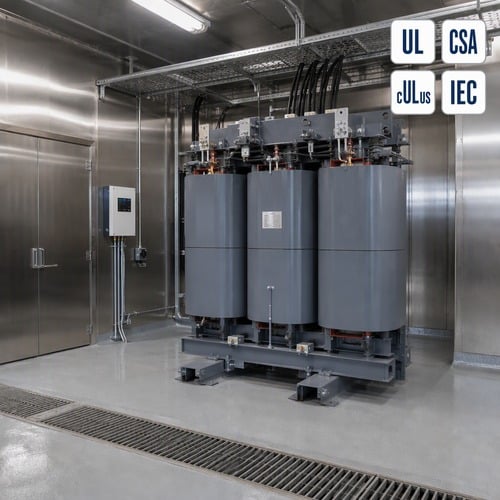
Inside a food building the default answer is a dry type transformer, because there is no flammable liquid, no vault requirement, and no oil containment to design around a production floor. Cast resin and VPI units also tolerate the dust and the temperature cycling of a plant much better than a vented dry unit.
Liquid-immersed still wins where the load is large and the location is outdoors: a main incoming unit, a freezing plant with megawatt-class refrigeration, or a substation shared with the site utility service. The table below is the short version of how we walk clients through the choice.
| Decision point | Dry type (cast resin / VPI) | Liquid-immersed |
| Placement | Indoor electrical rooms, mezzanines and CIP areas | Outdoor concrete pad or fenced yard |
| Fire and insurance | No flammable liquid; preferred inside food buildings | Requires vault or separation per NEC 450 |
| Enclosure | NEMA 12, or NEMA 4X stainless for hosed areas (IP54+) | Welded tank, C5-M coating, sealed or conservator |
| Moisture behaviour | Needs anti-condensation heaters in washdown rooms | Sealed tank plus breather or conservator handles cycling |
| Typical plant size | 300 kVA to 3,000 kVA | 1,000 kVA to 10,000 kVA |
| Maintenance routine | Vacuum dust, torque checks, IR scans | Dissolved gas and moisture tests per IEEE C57.104 |
One nuance that catches buyers: an outdoor oil unit is rarely the answer for a washdown-adjacent load just because it is cheap per kVA. By the time the vault, separation, fire protection and oil containment required by NEC Article 450 are counted, the installed cost usually stops being the bargain the quote suggested.
Sizing Numbers We Actually Apply
Sizing a food processing plant transformer starts with the load list but finishes with the duty cycle. On a food project we build the connected load per NEC Article 220, apply the largest motor at 125% per Article 430, then add explicit margin for the two things every plant does within five years: another freezing line, and another drive-fed packaging machine.
A typical mid-size dry type specification from our order book reads like this: 1,000 kVA, 480 V delta primary to 480Y/277 V secondary, 5.75% impedance, 220°C insulation system, and a temperature rise class chosen from the room, not from habit. A 150°C rise unit is the standard workhorse; an 80°C rise unit buys noticeably longer insulation life in a 40°C-plus room and is worth the extra copper when the transformer sits next to a fryer line.
When VFD harmonics dominate the plant, we derate rather than guess. IEEE C57.110 sets out how to establish capability when the load current is non-sinusoidal, and UL 1561 gives the K-factor ratings (K-4, K-9, K-13, K-20) that let a buyer specify the ability to carry harmonic current without exceeding rated temperature rise. For a plant with a handful of small drives, K-4 with a documented derating calculation is usually enough. For a hall full of packaging lines, K-13 is the honest starting point, and K-20 shows up whenever the drives are large and the mitigation budget was cut late in the project. The more VFD harmonics on a bus, the less a general-purpose unit is the right answer.
Motor starting gets its own check. We hold the bus voltage dip at the largest compressor under 10% wherever the utility or the plant process will allow it, and when the arithmetic will not close we say so early, because the alternatives — a larger unit, a soft starter, or a VSD — all cost less before the transformer is ordered than after the concrete pad is poured.
Enclosures, Moisture and Certification Paperwork
The enclosure is where washdown plants are won or lost. A dry room wants NEMA Type 12 for dust and dripping water; a room the sanitation crew hoses directly wants Type 4X in stainless. The NEMA enclosures publication list is the reference most North American electrical contractors already carry, and it is worth reading the definitions rather than accepting a supplier catalogue claim of “washdown rated”.
Inside the unit, the cheap insurance is thermostatically controlled anti-condensation heaters plus a drip shield, specified from the start. Retrofitting heaters into a sealed cast resin unit is somewhere between awkward and impossible, and the cost of the option at order stage is trivial compared with a failed insulation resistance test on commissioning day.
Certification is the other part buyers underestimate. In the United States, dry type units are listed to UL 1561; in Canada the governing construction standard is CSA C22.2 No. 47. Efficiency matters too: the U.S. Department of Energy standards for distribution transformers, summarised on the DOE distribution transformers programme page, carry a compliance date of 23 April 2029, which is closer than most five-year capital plans assume. And where equipment sits in a hygienic zone, the design language comes from food-industry practice rather than electrical codes, which is why 3-A Sanitary Standards guidance is worth a look before you accept a bolted panel with exposed fasteners next to a filler.
How Ryan Electric Approaches Food Plant Orders
We build cast resin and VPI dry type transformers and oil-immersed units at a 120,000 m² factory in Jiangsu with more than 180 sets of production equipment and 37 patents behind the designs, and the food and beverage work we see is rarely about a single exotic rating. It is about getting the unglamorous details right: the enclosure that survives a hose, the K-factor that survives the drives, the anti-condensation heaters nobody asked for, and the temperature rise class that matches the actual room.
As an Eaton joint venture partner since 2023, we also carry the documentation side — UL, CSA, IEEE and DEKRA files, nameplate marks, and factory test reports that a plant’s insurance engineer or a third-party inspector can actually verify.
One habit we recommend to every client: write the washdown environment and the refrigeration starting duty into the food processing plant transformer specification itself, not into an email thread. Suppliers quote what the specification says, and a specification that says only “1,000 kVA, 480 V” will be quoted as exactly that.
Send Us Your Load List and Room Conditions
If you are adding a freezing line, replacing a saturated unit, or specifying for a new plant, send us the load list, the room ambient, and a photograph of where the unit will sit. That is often enough for our engineers to tell you whether a 150°C rise or an 80°C rise unit belongs in the space, which enclosure the sanitation crew will force you into, and what K-factor the drives demand — before the quote is written. Reach us through ryantransformers.com and we will come back with a specification, not a catalogue page.
About the Author: This article was written by the engineering team at Ryan Electric, an Eaton joint venture partner and UL/CSA-certified transformer manufacturer in Jiangsu, China, supplying dry type and oil-immersed transformers to food and beverage processors, data centres, utilities and industrial plants across North America, Southeast Asia, the Middle East and Africa.
Table of Contents
- Why Food Plants Break Ordinary Sizing Rules
- The Three Loads That Decide a Food Processing Plant Transformer Spec
- Dry Type or Liquid-Immersed? The Decision Table We Use
- Sizing Numbers We Actually Apply
- Enclosures, Moisture and Certification Paperwork
- How Ryan Electric Approaches Food Plant Orders
- Send Us Your Load List and Room Conditions