
 EN
EN
A ground handler in Southeast Asia replaced 24 diesel baggage tractors with electric units and plugged them into a charging group fed from the apron substation. One season later the 1,000 kVA airport transformer in that substation ran hotter at night, with the terminal nearly idle, than it ever had at the morning peak. Nothing had failed. The charger current spectrum was never in the specification.
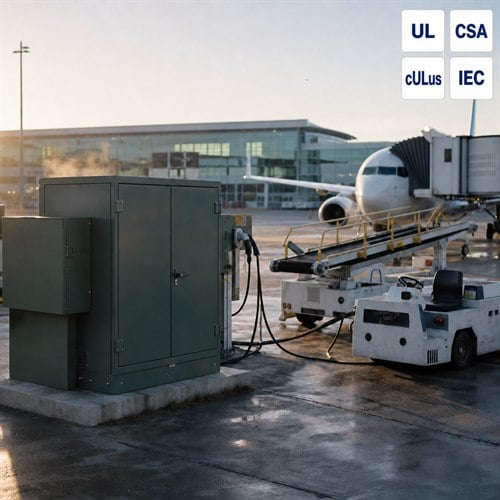
That pattern shows up in most electrification enquiries we quote. An airport transformer is not one load with one duty. It sits inside three electrical systems that behave nothing alike: an airfield lighting network built on series circuits, a terminal full of chillers, conveyors and security systems, and an apron crowded with battery-powered equipment that has to be charged inside the turnaround window.
Three Load Families, Three Different Answers for an Airport Transformer
Start with the airfield, where airport practice diverges from ordinary industrial work. The FAA keeps the public reference set on its airport design and engineering standards page, and much of it is lighting: runways, taxiways, signage, beacons and the control equipment behind them, all on series circuits fed by constant current regulators.
The second shift is commercial. IATA estimates that electric GSE produces 35 to 52 percent less CO2 and 5.5 to 8.3 dB less noise per turnaround than diesel equipment, and publishes a electric GSE programme page for operators planning the transition. Airport climate programmes have become the enforcement mechanism: Airport Carbon Accreditation lists more than 650 certified airports, and its higher levels require documented action by third parties, ground handlers included.
The third family is the terminal itself: chillers and air handling, baggage handling systems, security screening, lifts, jet bridges, and the IT and telecom rooms everything else depends on. Put all three in one table and it is easy to see why a single specification keeps failing on site.
| Load family | What sets the rating | What usually gets missed |
|---|---|---|
| Airfield lighting (regulator-fed series circuits) | Regulator duty at every dimming step, plus single-phase concentration | Harmonic allowance across the dimming range, vault ventilation, sound limit |
| Terminal and baggage systems | Coincident chiller, conveyor and IT demand with N+1 redundancy | Winding rise class in a confined room, generator-source fault coordination |
| Apron and GSE charging | Coincident charger demand after load management | Charger current spectrum, load-management scheme, distortion margin |
Airfield Lighting: Why the Feed Transformer Deserves Its Own Analysis
Runway and taxiway lighting is not a lumped load. Each segment is a series loop driven by a constant current regulator at a nominal 6.6 A, with 20 A circuits used for some high-intensity applications. Every fixture sits behind its own series-to-series isolation transformer, so one circuit may carry a hundred small transformers instead of a single large one. The FAA covers the isolation transformers in AC 150/5345-47 and the regulators in AC 150/5345-10.
None of that hardware is the transformer’s problem. The transformer’s problem is what the regulator looks like from the primary side, and three features of it belong in the specification.
- Dimming changes the waveform, not just the magnitude. Phase-controlled regulators produce a distorted primary current whose harmonic content is worst at low output, so a unit specified from full-brightness data alone is under-specified for the hours spent at 10 percent.
- One regulator is one phase. A regulator of tens of kilowatts sits on a single phase, so a transformer feeding several regulators can carry a badly unbalanced load, and the negative-sequence heating that follows is invisible on a top-oil thermometer.
- The regulator is chasing a reference. Primary-side voltage regulation translates directly into how well the regulator holds its setpoint, which is why a lighting vault usually deserves a dedicated feed rather than a tap off a mixed-load unit.
The dimming step most specifications forget
Ask for the regulator input current harmonic data at minimum, mid and full output, then specify a K-factor or a documented harmonic-loss allowance against the worst of the three. Vault transformers normally sit in small rooms with limited airflow, so a 55 °C average winding rise design plus a ventilation plan usually costs less than going up a frame size.
Sound is the other constraint that catches out airfield projects. Where a vault shares a wall with a terminal, an operations building or a control tower, the decibel limit belongs in the order, not in a complaint after commissioning. Low-noise design is settled at quotation stage and cannot be retrofitted.
Sizing the Apron for Electric Ground Support Equipment Charging
Ground support equipment is the fastest-moving part of the airport load. Baggage tractors and belt loaders are typically charged from AC units in the 20 to 43 kW class, while pushback tractors and heavier electric ground support equipment move to DC chargers from 60 kW upward. The number that decides the transformer is not the sum of the charger nameplates; it is the coincident demand after load management.
Take a depot with 12 DC chargers rated 60 kW each, so 720 kW connected. With a load-management scheme that caps the group at 400 kW, the arithmetic is 400 kW ÷ 0.92 power factor ≈ 435 kVA, plus a 25 percent allowance for charger input distortion and part-load inefficiency, which lands near 545 kVA. A 630 kVA unit covers it. Sized on connected nameplate instead, the same depot gets quoted a 1,000 kVA unit: nearly double the copper, core and no-load loss for a peak the charging controller already prevents. The terminal distribution transformer, the charging controller and the airport’s shift pattern therefore have to be specified together, because load management only works if the charging schedule matches the way the apron operates.
Charger front ends are nonlinear loads. A six-pulse front end without filtering draws a current spectrum dominated by fifth and seventh harmonics, which heat windings and tank steel in ways a 60 Hz model misses. The K-factor arithmetic is the same one used for any drive-heavy load: the K number is the sum, across harmonic orders, of the squared per-unit harmonic current multiplied by the square of its order, so a 25 percent fifth harmonic contributes 0.25² × 5² = 6.25 per unit of eddy loss on its own. An active front end largely avoids the problem, which is why we ask for the charger datasheet rather than the nameplate.
One apron detail decides the enclosure rather than the kVA. Charging points are usually outdoor kiosks or pad-mounted units, and in the Gulf or the Sahel that means a 50 °C design ambient, radiant heat off the concrete and wind-blown dust. Transformers specified for hot and dusty sites follow different rules from a unit in a conditioned electrical room.
Terminal Substations: Certification, Efficiency and a 2029 Deadline
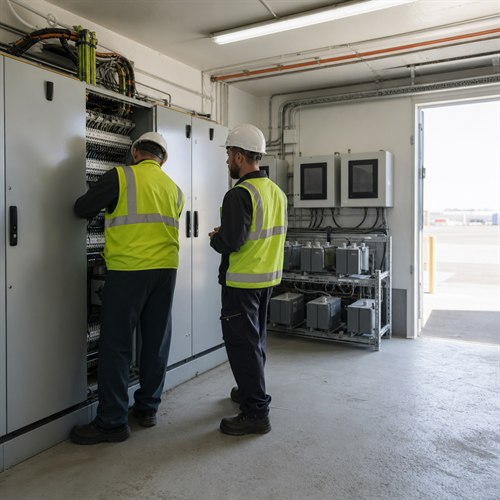
Terminal electrical rooms usually run as double-ended substations, dual-fed with a bus tie and either N+1 or 2N redundancy for the screening, IT and telecom boards. Indoor units there are normally cast resin dry type, which removes oil containment, bunding and fire separation from the design.
For North American projects the efficiency question now has a date attached. The U.S. Department of Energy’s distribution transformer standards programme defines the product class precisely: input voltage of 34.5 kV or less, output of 600 V or less, 60 Hz operation, and 10 to 2,500 kVA for liquid-immersed units or 15 to 2,500 kVA for dry type. Its amended standards apply to units manufactured on or after 23 April 2029, so a specification written in 2026 with the older loss values will need re-quoting before a 2029 delivery.
The general requirements basis for liquid-immersed units is IEEE C57.12.00-2021, which applies to transformers with a highest-winding voltage of 601 V and above and, just as usefully, states what it excludes: instrument, rectifier, arc furnace, specialty, grounding, mobile and mine transformers all sit outside it. A certification mark and a design standard are separate evidence a commissioning authority will ask for.
One terminal detail that keeps costing projects money is standby generation. A terminal distribution transformer coordinated against a utility source behaves differently when a generator carries the load, because available fault current is much lower. Protection settings and through-fault capability have to be reviewed against the weaker source.
What Belongs in the RFQ
These are the items our engineers check first on an airport package, sorted by load family. Most delays trace back to one of them arriving after the order.
| Item | Airfield lighting feed | Apron charging feed | Terminal unit |
|---|---|---|---|
| Rating basis | Regulator schedule with harmonic data | Managed charger group kW | Coincident demand plus N+1 |
| Harmonic allowance | Documented, at each dimming step | K-factor or derating, from charger datasheet | From chiller and conveyor drive spectrum |
| Winding rise class | 55 °C for vault installation | 65 °C, shaded outdoor pad | 55 °C in a confined room |
| Sound level | Low-noise if near terminal or tower | Standard | Low-noise order |
| Certification | UL/cULus or CSA plus local mark | Same | Same, plus 2029 efficiency statement |
| Test evidence | Ratio, losses, impedance, sound level | Plus harmonic loss calculation | Plus SFRA fingerprint before shipment |
How We Build and Test Units for Airport Duty
Ryan Electric has manufactured transformers since 2007 from a 120,000 m² plant in Jiangsu with more than 180 sets of production and test equipment and 37 patents, and the portfolio carries UL, CSA, IEEE, DEKRA, CNAS and CE certification. Airport work arrives from both ends of the site: cast resin and VPI dry-type units for terminal rooms and vaults, and liquid-immersed or pad-mounted units for apron substations.
The first document our application engineers ask for is not the transformer schedule. It is the regulator harmonic data and the charger controller’s load-management settings, because those two sheets settle the kVA and the distortion allowance before anyone argues about price. An airport unit ships with:
- Routine tests — ratio, polarity, winding resistance, no-load loss, load loss, impedance, applied and induced potential, on every unit.
- Type-test evidence — temperature rise, lightning impulse and short-circuit withstand traceable to the design being supplied.
- A harmonic loss calculation — where the specification includes a distortion allowance, the design check is recorded rather than assumed.
- A sound level measurement — where a decibel limit is on the order, tested in our own bay rather than quoted from a catalogue.
- An SFRA fingerprint before shipment — so transport damage is identified by comparison at site instead of argued about.
- Nameplate photography and the certification file reference — the commissioning electrician photographs the nameplate before energization, and the inspector reads the same data.
Packaging gets the same attention as testing. An apron substation is usually a road or rail journey from the port, so larger ratings travel sealed, bushings are crated separately where the route demands it, and an impact recorder travels with the unit.
Send Three Schedules Before You Send the Order
Three documents turn an airport enquiry into a quotable specification: the airfield lighting regulator schedule with input current data at each dimming step; the apron charger list with the load-management scheme and the charger datasheets; and the terminal single-line with the redundancy requirement, the site ambient and the certification target for the destination market. Add the date you are working back from, because substation energization is fixed by terminal handover.
Send those schedules through our application engineering team and we will return ratings, rise classes, harmonic allowances and a delivery date on your own numbers. You can also reach the team at [email protected] or +86-15371760308.
The cost of leaving the harmonic data out of an airport transformer enquiry does not disappear. It shows up two years later, as a unit running hot at three in the morning on a nearly empty apron.
About the Author: This guide was prepared by the application engineering team at Jiangsu Ryan Electric Co., Ltd. (Ryan Transformers), which has designed and manufactured oil-immersed and dry-type transformers for utility, data centre, industrial and transport infrastructure projects since 2007. Project-specific questions on runway lighting feeds, charging substations and certification for North American and IEC markets are answered directly by the engineering team at [email protected].
Table of Contents
- Three Load Families, Three Different Answers for an Airport Transformer
- Airfield Lighting: Why the Feed Transformer Deserves Its Own Analysis
- Sizing the Apron for Electric Ground Support Equipment Charging
- Terminal Substations: Certification, Efficiency and a 2029 Deadline
- What Belongs in the RFQ
- How We Build and Test Units for Airport Duty
- Send Three Schedules Before You Send the Order